Allegoria della Pace
Allegoria della Pace | Stampe | TESTA detto "Il Lucchesino" Pietro
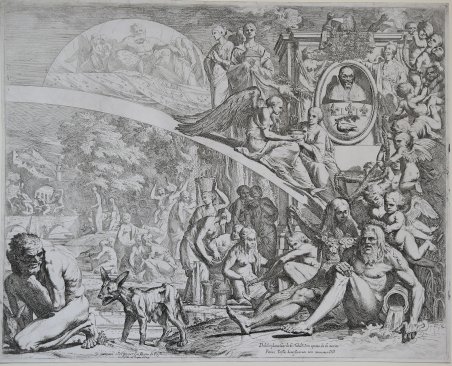
Allegoria della Pace
Allegoria della Pace | Stampe | TESTA detto "Il Lucchesino" Pietro
Metodi di Pagamento
- PayPal
- Carta di Credito
- Bonifico Bancario
- Pubblica amministrazione
- Carta del Docente
Dettagli
- Anno di pubblicazione
- 1644
- Formato
- 425 X 390
- Incisori
- TESTA detto "Il Lucchesino" Pietro
Descrizione
Acquaforte, 1644, firmata in lastra in basso al centro. Esemplare nel terzo stato di quattro, edito da Giovanni Giacomo de Rossi. Bellissima prova, impressa su carta vergata coeva con filigrana “doppio cerchio e giglio”, con piccoli margini, piccoli strappi di carta restaurati nella parte superiore, nel complesso in ottimo stato di conservazione. L’opera viene realizzata dal Testa quale omaggio al neo-eletto papa Innocenzo X Pamphili, che nel 1644 veniva a succedere a Urbano VIII. La composizione del Testa è incentrata sul mezzo busto del nuovo pontefice, circondato da putti inneggianti alla Pace, uno dei quali porge una corona d’alloro al dio Tevere, seduto in maniera classica in primo piano sulla destra. La presenza della colombo e dell’olivo, simboli di pace, nello stemma dei Pamphili si prestano a celebrare il ritorno alla quiete dopo i lunghi anni della disastrosa guerra di Castro, negli ultimo periodo del papato di Urbano VIII. La vicenda artistica di Pietro Testa, detto il Lucchesino dalla sua città d’origine, è assai tormentata. Poco o nulla si sa del suo primo apprendistato nella città natale. Arrivato a Roma nel 1629, fu probabilmente dapprima a scuola presso il Domenichino, poi presso la bottega di Pietro da Cortona, suo vero maestro. Il carattere introverso dell’artista gli procurò comunque sempre difficoltà con ' i suoi colleghi: il Cortona infatti fu costretto a cacciarlo dalla sua scuola per l’atteggiamento di sprezzante superiorità assunta dall’allievo . Il Testa frequentò allora la casa del suo primo mecenate, il celebre collezionista Cassiano del Pozzo, per il quale eseguì disegni dall’antico. Fu probabilmente nella sua casa che conobbe il pittore Nicolas Poussin, che influenzerà profondamente la sua arte sia nella sua prima fase di adesione tizianesca ' al movimento neo-veneto, sia nel periodo più maturo, a partire dagli anni 1635 in poi, caratterizzati da un intellettualismo classicheggiante. Resta comunque il fatto che le sue incisioni (che ammontano a 40 tavole circa) furono considerate fin dall’antichità, a partire dal Sandrart e dal Baldinucci, le opere grafiche più importanti del '600 italiano. Etching, 1644, inscribed in the image below the figure of the Tiber: Dno Stephano Garbesi Nobili Viro optime de se merito/ Petrus Testa beneficiorum non immemor DD; in lower left Si Stampano alla Pace per Gio Jacomo de Rossi/ in Roma all insegna di ParigiExample in the third state of four, published by Giovanni Giacomo de Rossi. Excellent work, printed on contemporary laid paper with “double circle and fleur-de-lis” watermark, small margins, small tears perfectly repaired on upper part, in very good condition. "Innocent X Pamphili was elected pope on September 15, 1644. For those who had prospered under the patronage of the Barberini, his election brought hard times. Testa’s own patron Girolamo Buonvisi left Rome for Lucca, and his opportunities to win favor for the young artist, now thirty-four years old, were curtailed. No prints bearing his emblem can be dated after 1644. Cassiano dal Pozzo also lost his favored position at the papal couR With the production of this print Testa hoped to find fresh patronage had done on the occasion of Cardinal Franciotti's appointment as bishop of Lucca (cat. no. 36). The Pamphili coat of arms includes the fleur-de- lys and a dove bearing an olive branch (seen here in the oval niche at the right). Like many other artists and writers Testa seized upon the implication of the dove and the olive branch to develop the conceit that, after suffering the economic catastro- phe of Urban VIII's War of Castro,' Rome would enjoy a golden age of peace under the new pope. Building on the inventions of "The Seasons" (see cat. nos. 74-83), Testa shows at the left the orb of a new sun above the cloth of the starry skies in whose folds the ladder of the Zodiac appears. The most prominent sign, below the lion of Leo, is Virgo, whose return to the earth heralds the return of Justice and the beginning of the golden age. But it is now God the Father himself, flanked by angels, who leans upon the globe of the earth and points commandingly down to the scene below. Beside the orb in which he sits, and again appropriate tor an invention dedicated to the celebration of a pope, stands a woman with her hands folded in prayer, representing Religion. Next to her stands another woman who represents Piety, her hands covered in reverence as she holds a model of the Pantheon, the temple of all the gods. with the new pope, just as he As in The Triumph of Painting on Parnassus (cat. no. 73), Testa shows the triumphal arch of the rain- bow lending colors to painting, only here the rain- bow is the sign of God's promise of peace first granted to Noah, and the artist is symbolized as Peace herself. The figure of Iris, the messenger o the gods and the personification of the rainbow, holds out her pot of colors to Peace as a dove bearing an olive branch swoops down from above. The image painted by ' Peace is realized in the form of a monument to Innocent X, a bust of whom appears in an oval niche above the Pamphili lilies and dove. Resting on the top of the monument are the papal tiara, keys, and stole and two pots of smoking incense. The oval image is flanked by two allegorical figures, the one with the fasces in her hand standing for Justice, the other in the form of Minerva circled by a snake representing the prudent wisdom that accompanies justice. Each holds an olive branch of peace. To the familiar conjoining of Justice and Peace in Psalm 85, to which Testa had referred in his drawing for the fresco in Lucca (cat. no. 31), is thus here added the equally familiar Virgilian theme that Justice (the figure of Virgo in the zodiac) returns in the golden age. Beneath the benign aspect of the heavens at the election of Innocent X Testa shows the city of Rome enjoying the perpetual springtime of the golden age. Nymphs collect flowers in baskets and weave them into garlands with which winged putti bedeck the monument to Innocent X. In the right foreground reclines the figure of the Tiber, so identified by Testa in his note. Cfr. Bartsch 31; Bellini 25 III/IV.