Cerere e Fitalo
Cerere e Fitalo | Stampe | ROSA Salvator
Cerere e Fitalo
Cerere e Fitalo | Stampe | ROSA Salvator
Metodi di Pagamento
- PayPal
- Carta di Credito
- Bonifico Bancario
- Pubblica amministrazione
- Carta del Docente
Dettagli
- Anno di pubblicazione
- 1662
- Formato
- 235 X 355
- Incisori
- ROSA Salvator
Descrizione
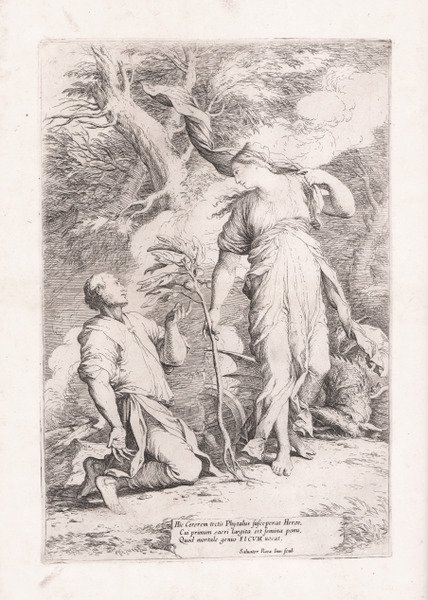
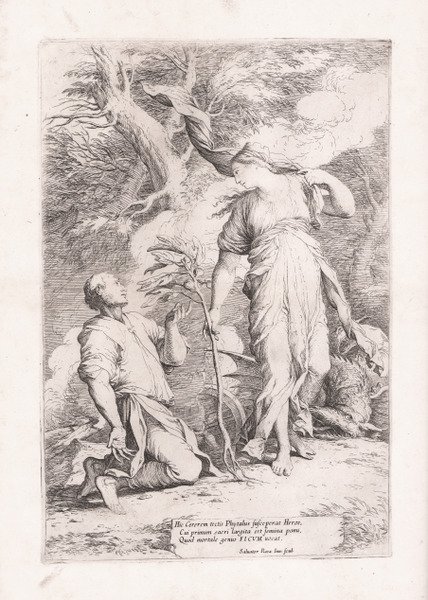
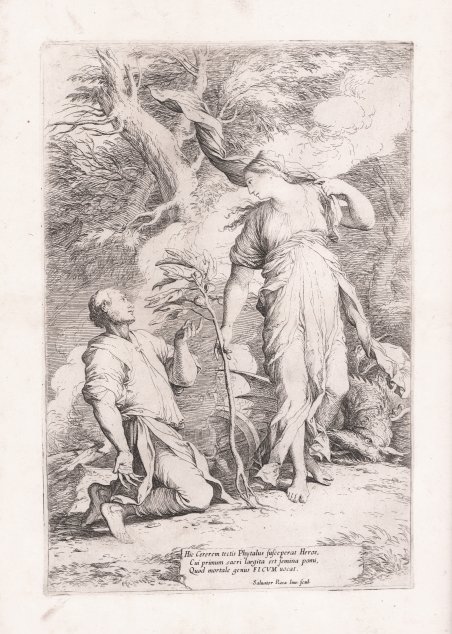
Acquaforte e puntasecca, circa 1662, firmata in lastra in basso al centro. Esemplare nel secondo stato di due, con la lastra ritoccata nel piede destro di Fitalo e nel profilo di Cerere, alla quale viene, inoltre, aggiunta una terza ciocca di capelli. Magnifica prova, impressa su carta vergata coeva con filigrana “giglio nel cerchio e grappolo d’uva” (databile alla seconda metà del XVII secolo), con un bel tono di lastra, ampli margini, in perfetto stato di conservazione. L’opera descrive il mito di Cerere che, ospitata da Fitalo nella sua casa, in segno di gratitudine gli dona l’albero di fico che era sino ad allora sconosciuto agli uomini. Alcuni studiosi sostengono che il soggetto sia ispirato dalla Vita di Teseo di Plutarco ed altri che invece l’opera sia più banalmente dovuta alla predilezione dell’artista per il frutto del fico. “L’incisione è citata in una lettera scritta da Salvator Rosa all’amico Ricciardi nel 1662 dal suo eremo nella villa di Strozzavolpe presso Poggibonsi, insieme ad altre celebri realizzazioni: Policrate, Democrito, Alessandro e Diogene, l’Accademia di Platone, Diogene getta la scodella, e la Morte di Attilio Regolo. Si può concludere perciò che il 1662 fu un anno particolarmente felice e fecondo per il Rosa incisore, che ha legato la sua fama di grande artista grafico proprio ai rami eseguiti in questo periodo. Il soggetto raffigurato nella nostra stampa illustra il mito di Cerere che, ospitata da Fitalo nella sua casa, gli dona l’albero di fico sino ad allora sconosciuto agli uomini, in segno di gratitudine. La fonte da cui Rosa trae ispirazione nelle sue letture colte, è da ricercare nel Periegesis tes Ellados (I, 37, 24) di Pausania o nella Vita di Teseo (cap. XXIII) di Plutarco, ma alcuni critici hanno collegato questo soggetto con la nota predilezione dell’artista per il frutto del fico, riportata dal suo biografo Baldinucci.La scena raffigurata nell’incisione appare improntata ad una compostezza classica, per quanto sia stato notato che gli atteggiamenti delle due figure derivino dalla mimica del teatro contemporaneo, ampiamente noto e praticato dall’artista” (cfr. Massari, Tra Mito ed Allegoria, p. 446). Bibliografia Bartsch / Le Peintre graveur (XX.275.19); Wallace 1979 / The Etchings of Salvator Rosa (112.II); Salamon 98; S. Massari, Tra Mito ed Allegoria, p. 446, 170, II/II. Ceres and Phytalus; to left, Phytalus, kneeling, receives the fig tree from the goddess Ceres, standing to right, as a reward for his hospitality. Etching and drypoint, circa 1662, signed at lower center. Example of the second state of two with the plate retouched in Phytalus's right foot and in the profile of Ceres, to which a third lock of hair is also added. A fine impression, printed on contemporary laid paper with "fluer-de-lys in a circle with grapes" watermark, wide margins, very good condition. The work describes the myth of Ceres that, hosted by Phytalus in his home, gives him the fig tree, which was hitherto unknown to men, as a sign of gratitude. Some scholars argue that the subject is inspired by the Life of Theseus of Plutarch and others that the work is more banally due to the predilection of the artist for the fruit of the fig tree. The work is mentioned in a letter written by Salvator Rosa to his friend Ricciardi in 1662 from his hermitage in the villa of Strozzavolpe near Poggibonsi, along with other famous works: Polycrates, Democritus, Alexander and Diogenes, Plato's Academy, Diogenes Throwing the Bowl, and the Death of Atilius Regulus. We can therefore conclude that 1662 was a particularly happy and fruitful year for the engraver Rosa, who linked his fame as a great graphic artist to the copperplates executed during this period. The subject depicted in our print illustrates the myth of Ceres who, hosted by Phytalius in his home, gives him the fig tree hitherto unknown to man, as a sign of gratitude. The source from which Rosa draws inspiration in her learned readings is to be found in Pausanias' Periegesis tes Ellados (I, 37, 24) or in Plutarch's Life of Theseus (chap. XXIII), but some critics have linked this subject with the artist's known predilection for the fig fruit, reported by his biographer Baldinucci. The scene depicted in the engraving appears marked by a classical composure, although it has been noted that the attitudes of the two figures derive from the mimicry of contemporary theatre, widely known and practised by the artist” (cfr. Massari, Tra Mito ed Allegoria, p. 446). Bibliografia Bartsch / Le Peintre graveur (XX.275.19); Wallace 1979 / The Etchings of Salvator Rosa (112.II); Salamon 98; S. Massari, Tra Mito ed Allegoria, p. 446, 170, II/II. Cfr.