Civitella der Statt Ab contrafactur.
Civitella der Statt Ab contrafactur. | Stampe | Münster Sebastian
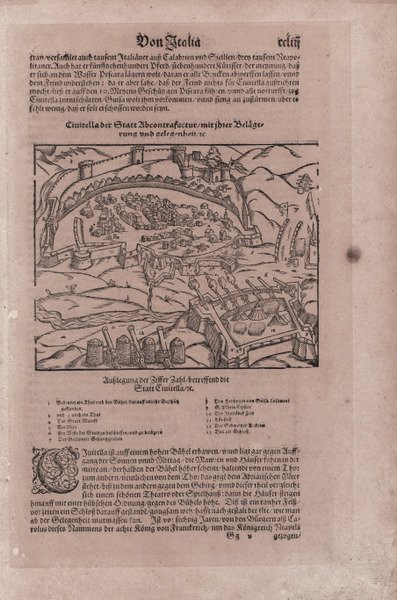
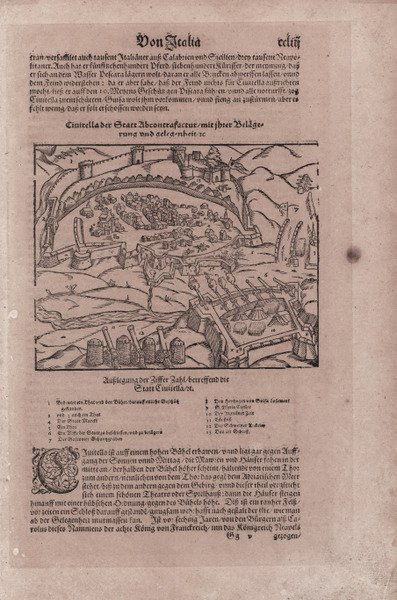
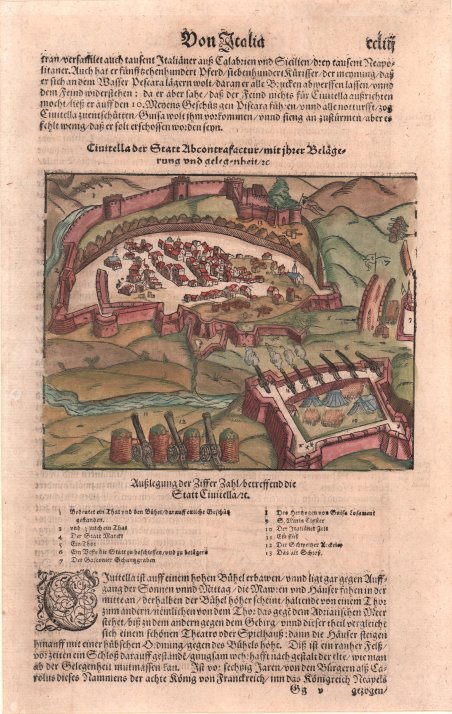
Civitella der Statt Ab contrafactur.
Civitella der Statt Ab contrafactur. | Stampe | Münster Sebastian
Metodi di Pagamento
- PayPal
- Carta di Credito
- Bonifico Bancario
- Pubblica amministrazione
- Carta del Docente
Dettagli
- Anno di pubblicazione
- 1560
- Luogo di stampa
- Basilea
- Formato
- 185 X 295
- Incisori
- Münster Sebastian
- Lingue
- Italiano
Descrizione
Veduta prospettica della fortezza di Civitella del Tronto, raffigurante l’assedio posto nel 1557 dalle truppe francesi del duca di Guisa, generale di Enrico II e alleato di papa Paolo IV; la cittadina riuscì a respingere il feroce e violento assalto. Proprio in quanto protagonista della Guerra del Tronto, tra Francesi e Spagnoli, la città fu poi denominata Civitella del Tronto, in luogo del semplice Civitella. In segno di riconoscenza dell’eroica resistenza, Filippo II accordò alla fortezza la qualifica di città e il titolo di fedelissima; i suoi cittadini furono esentati, per i successivi quarant’anni, dal pagamento degli oneri fiscali al Regno; inoltre, a spese del demanio regio, furono restaurati gli edifici e la fortezza. Tavola tratta dalla ' Cosmographiae Universalis, edizione in tedesco, Basilea, metà del XVI secolo. Si basa sulla stampa di Antonio Salamanca pubblicata a Roma nel 1557 circa.La ' Cosmographiae Universalis ' di Sebastian Münster (1488-1552), stampata per la prima volta Basilea nel 1544 dall’editore Heinrich Petri, venne più volte aggiornata e aumentata di nuove carte geografiche e rappresentazioni urbane nelle sue numerose edizioni che arrivano all’inizio del secolo successivo. Münster aveva lavorato a raccogliere informazioni al fine di ottenere un'opera che non deludesse le aspettative e, dopo un'ulteriore pubblicazione in tedesco abbellita da 910 stampe su legno, giunse nel 1550 all'edizione definitiva in latino, illustrata da 970 silografie. Vi furono poi numerose edizioni in diverse lingue, fra cui latino, francese, italiano, inglese e ceco. Dopo la sua morte di Münster (1552), Heinrich Petri prima, e il figlio Sebastian poi, continuarono la pubblicazione dell’opera. La ' Cosmographia universalis ' fu uno dei libri più popolari e di successo del XVI secolo, e vide ben 24 edizioni in 100 anni: l'ultima edizione tedesca venne pubblicata nel 1628, molto tempo dopo la morte dell'autore. La ' Cosmographia ' conteneva non solo le ultime mappe e vedute di tutte le città più famose, ma anche una serie di notizie enciclopediche di dettagli relative al mondo conosciuto, e sconosciuto. Il particolare successo anche commerciale di quest'opera fu dovuto in parte alle belle incisioni (tra i cui autori si possono citate Hans Holbein il Giovane, Urs Graf, Hans Rudolph Manuel Deutsch, David Kandel). Silografia, finemente colorata a mano, in buone condizioni. Perspective view of the fortress of Civitella del Tronto, depicting the siege laid in 1557 by the French troops of the Duke of Guise, general of Henry II and ally of Pope Paul IV; the town managed to repel the fierce and violent assault. Precisely because of its prominence in the War of Tronto, between the French and the Spanish, the town was later named Civitella del Tronto, instead of simply Civitella. In gratitude for the heroic resistance, Philip II granted the fortress the status of a city and the title of fedelissima; its citizens were exempted, for the next forty years, from paying tax burdens to the Kingdom; moreover, at the expense of the royal domain, the buildings and fortress were restored. Plate taken from the ' Cosmographiae Universalis, German edition, Basel, second half of the 16th Century. The ' Cosmographiae Universalis ' of Sebastian Münster (1488-1552), printed for the first time in Basel in 1544 by the publisher Heinrich Petri, was updated several times and increased with new maps and urban representations in its many editions until the beginning of the next century. Münster had worked to collect information in order to obtain a work that did not disappoint expectations and, after a further publication in German embellished with 910 woodblock prints, arrived in 1550 to the final edition in Latin, illustrated by 970 woodcuts. There were then numerous editions in different languages, including Latin, French, Italian, English and Czech. After his death in Münster (1552), Heinrich Petri first, and then his son Sebastian, continued the publication of the work. The ' Cosmographia universalis ' was one of the most popular and successful books of the 16th century, and saw as many as 24 editions in 100 years: the last German edition was published in 1628, long after the author's death. The ' Cosmographia ' contained not only the latest maps and views of all the most famous cities, but also a series of encyclopedic details related to the known, and unknown, world. The particular commercial success of this work was due in part to the beautiful engravings (among whose authors can be mentioned Hans Holbein the Younger, Urs Graf, Hans Rudolph Manuel Deutsch, David Kandel). Woodcut, fine later hand colour, in good condition. Cfr.