Copricapo a forma di ventaglio
Copricapo a forma di ventaglio | Stampe | CARRACI Agostino

Copricapo a forma di ventaglio
Copricapo a forma di ventaglio | Stampe | CARRACI Agostino
Metodi di Pagamento
- PayPal
- Carta di Credito
- Bonifico Bancario
- Pubblica amministrazione
- Carta del Docente
Dettagli
- Anno di pubblicazione
- 1589
- Formato
- 251 X 368
- Incisori
- CARRACI Agostino
Descrizione
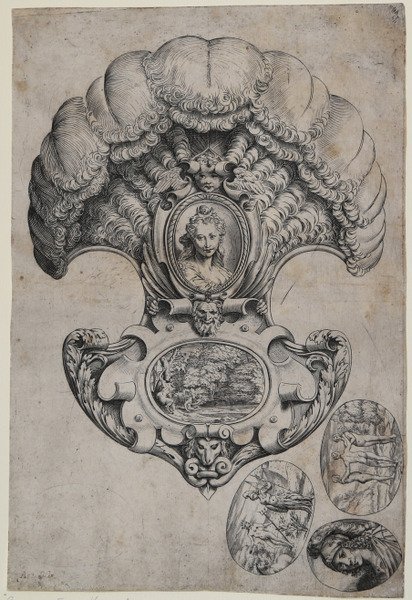
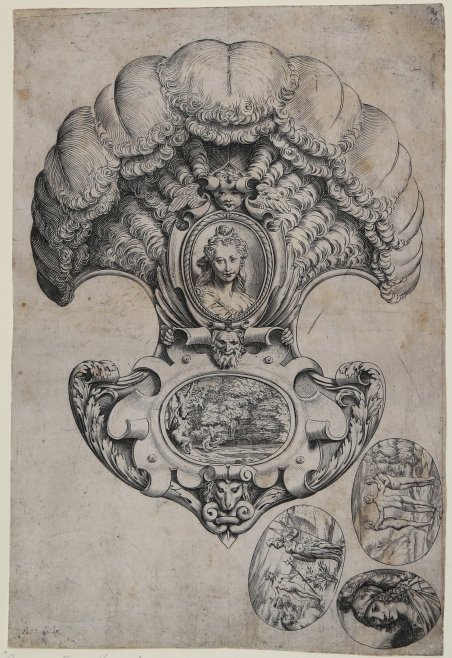
Bulino, circa 1589-95, firmato in lastra in basso a sinistra nelle prove di secondo stato. Esemplare nel raro primo stato di due, avanti lettera. Magnifica prova, ricca di toni, impressa su carta vergata coeva priva di filigrana, rifilata al rame, intervento di restauro perfettamente eseguito nella parte bianca superiore, tracce di colla al verso, per il resto in ottimo stato di conservazione. Scrive De Grazia ”L’incisione è sempre stata interpretata quale rappresentazione di un ventaglio, ma deve trattarsi di qualche cosa d’altro, perché del ventaglio non ha l’impugnatura e quella al centro è troppo scomoda per consentirne un uso siffatto. Non esiste una spiegazione dei tre ovali nell’angolo basso a destra e di un quarto appena accennato un basso a sinistra. Diane Russel ha suggerito che forse l’oggetto era inteso quale copricapo da ritagliare e portare in una festa. In questo modo ciascuna scena negli ovali poteva venire alternata a piacere al busto e al paesaggio del copricapo”. Se questa fu la sua destinazione probabile che sia realizzata nel 1589 in occasione delle nozze tra Ferdinando de’ Medici e Cristina di Lorena. Gli esemplari di primo stato sono assolutamente rarissimi. Bibliografia De Grazia, Le Stampe dei Carracci, pp. 178/9, 193 I/II; Bartsch 260. A headpiece in the form of a fan; sheet containing a design in the shape of a feathered fan, with two oval frames in centre, one containing a portrait of Diana and the other a landscape with a satyr and two nymphs, with grotesque masks above and below; at lower right of the sheet three further ovals, one containing a portrait of Minerva, one of the Three Graces and a third of Minerva and Neptune. Engraving, about 1589-95, signed on plate at bottom left (second state only). Example in the rare first state of two, before letters. Magnificent proof, rich tone, printed on contemporary laid paper without watermark, trimmed to the copperplate, restoration carried out perfectly in the white top, traces of glue on verso, otherwise in excellent condition.De Grazia writes "The engraving has always been interpreted as a representation of a fan, but it must be something else, because the fan does not have the handle and one in the center is too cumbersome to allow such use. There is no explanation of the three ovals in the lower right corner, and a fourth just mentioned a lower left. Diane Russell suggested that perhaps the object was intended as a cap to cut out and bring in a party. In this way each scene in the ovals could be alternated with pleasure at the bust and the landscape of the hat". If this was his destination likely to be realized in 1589 on the occasion of the wedding of Ferdinando de 'Medici and Christine of Lorraine. Example of the first state are absolutely rare. Bibliografia De Grazia, Le Stampe dei Carracci, pp. 178/9, 193 I/II; Bartsch 260. Cfr.