(Costumi delle Paludi Pontine)
(Costumi delle Paludi Pontine) | Stampe | Hochdanz Emil
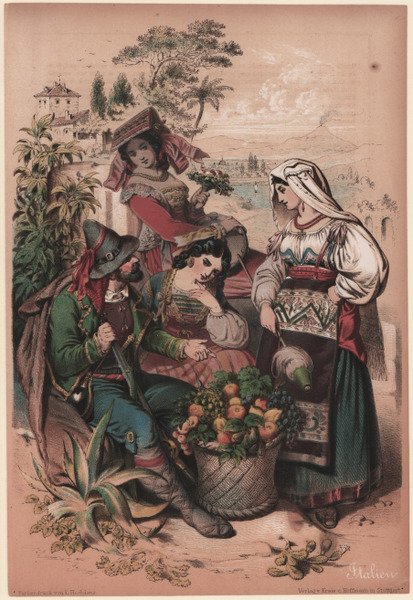
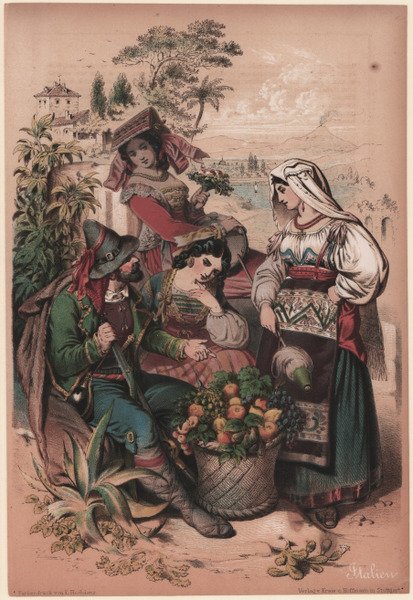
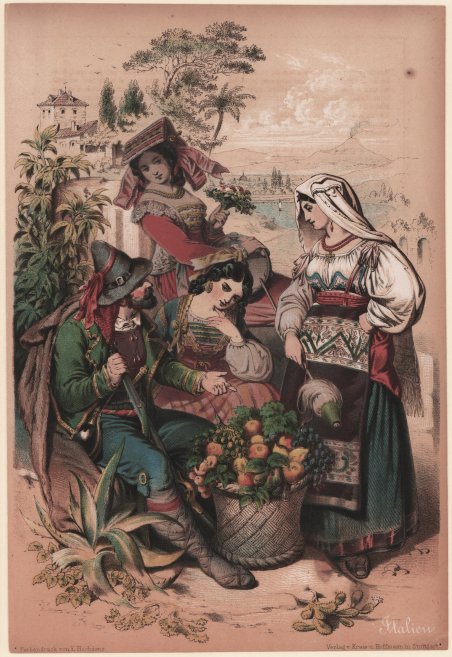
(Costumi delle Paludi Pontine)
(Costumi delle Paludi Pontine) | Stampe | Hochdanz Emil
Metodi di Pagamento
- PayPal
- Carta di Credito
- Bonifico Bancario
- Pubblica amministrazione
- Carta del Docente
Dettagli
- Anno di pubblicazione
- 1870
- Formato
- 190 X 280
- Incisori
- Hochdanz Emil
Descrizione
Scena raffigurante 4 costumi popolari riconducibili alla Campagna di Roma, basso Lazio e Paludi Pontine. Litografia a colori di Emila Hochdanz stampata dalla tipografia Krais e Hoffmann a Stoccarda nel 1850 circa. Emil Hochdanz è stato un litografo ed editore tedesco. A Weimar Emil Hochdanz completò un apprendistato come litografo e poi lavorò nello stabilimento litografico di Bernhard Friedrich Voigt. Alla fine degli anni 1830 Hochdanz si trasferì all'istituto d'arte litografica di Johannes Velten (1784-1864) a Karlsruhe e all'inizio degli anni 1840 all'istituto litografico Pobuda & Rees a Stoccarda. Il suo lavoro e il suo talento per le caricature attirarono l'attenzione del libraio editore Carl Hoffmann (1802-1883), che impiegò Hochdanz per diversi anni. Nel 1844 Hoffmann, insieme a Mathilde Courtin, avviò la fondazione della "Allgemeine Muster-Zeitung", con i suoi fogli di modelli il modello per molti altri giornali di moda illustrati che entrarono sul mercato nella seconda metà del XIX secolo. Per pubblicare questo giornale, Hochdanz e il suo amico Johann Christoph Engelhorn (1818-1890) fondarono uno stabilimento litografico e una casa editrice sotto il nome di Engelhorn & Hochdanz, che esisteva fino al 1860. Dopo lo scioglimento della società, Hochdanz prese in mano lo stabilimento litografico per conto proprio e continuò a dirigere il giornale campione ancora per qualche anno, finché non lo cedette alla Metzlersche Buchhandlung. Per molti anni, la sua azienda ha fornito servizi eccezionali nel campo dell'incisione di mappe e della stampa litografica a colori per una grande varietà di clienti, il che ha dato alla sua azienda un'eccellente reputazione. Quando Emil Hochdanz morì nel 1885 all'età di 69 anni, l'attività fu rilevata dal figlio maggiore Carl, che già lavorava nell'azienda del padre dal 1876. Il responsabile tecnico fu prima Paul Wagner, poi Hermann Friese, sotto la cui guida l'azienda Emil Hochdanz riuscì a mantenere la sua reputazione anche dopo la morte del fondatore. Nel 1899, Hermann Friese e Walther Hopf acquisirono l'azienda, che durò fino ai primi anni 1920. Rara. Scene depicting 4 popular costumes from the Campagna di Roma, basso Lazio and Paludi Pontine. Color lithograph by Emila Hochdanz printed by the typography Krais and Hoffmann in Stuttgart in about 1850. Emil Hochdanz (born February 2, 1816 in Nohra near Weimar; died February 20, 1885 in Stuttgart) was a German lithographer and publisher. In Weimar, Emil Hochdanz completed an apprenticeship as a lithographer and then worked at the lithographic institute of Bernhard Friedrich Voigt. At the end of the 1830s, Hochdanz moved to the Lithographisch Artistische Kunstinstitut of Johannes Velten (1784-1864) in Karlsruhe and in the early 1940s to the lithographic institute Pobuda & Rees in Stuttgart. His work and talent for caricature attracted the attention of the publishing bookseller Carl Hoffmann (1802-1883), who employed Hochdanz for several years. In 1844, Hoffmann, together with Mathilde Courtin, initiated the founding of the "Allgemeine Muster-Zeitung", with its pattern sheets the model for many other illustrated fashion newspapers that entered the market in the second half of the 19th century. To publish this paper, Hochdanz and his friend Johann Christoph Engelhorn (1818-1890) founded a lithographic establishment and a publishing company under the name Engelhorn & Hochdanz, which existed until 1860. After the dissolution of the company, Hochdanz took over the lithographic establishment on his own and continued to run the sample newspaper for a few more years until he handed it over to the Metzlersche Buchhandlung. For many years, his company provided outstanding services in the field of map engraving and lithographic color printing for a wide variety of clients, which gave his company an excellent reputation. When Emil Hochdanz died in 1885 at the age of 69, the business was taken over by his eldest son Carl, who had already been working in his father's company since 1876. The technical manager was first Paul Wagner, later Hermann Friese, under whose leadership the Emil Hochdanz company was able to maintain its reputation even after the death of the founder. In 1899, Hermann Friese and Walther Hopf acquired the company, which lasted until the early 1920s. Cfr.