(Emisfero Orientale)
(Emisfero Orientale) | Stampe | DE ROSSI Giuseppe
(Emisfero Orientale)
(Emisfero Orientale) | Stampe | DE ROSSI Giuseppe
Metodi di Pagamento
- PayPal
- Carta di Credito
- Bonifico Bancario
- Pubblica amministrazione
- Carta del Docente
Dettagli
- Anno di pubblicazione
- 1615
- Luogo di stampa
- Roma
- Formato
- 325 X 327
- Incisori
- DE ROSSI Giuseppe
Descrizione
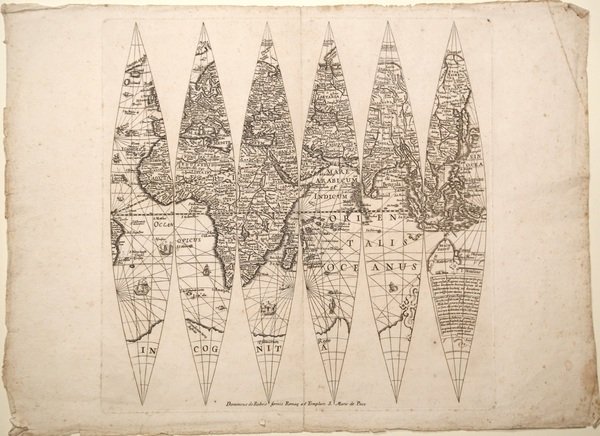
Foglio contenente sei fusi del Globo Terrestre, edito da Giuseppe de Rossi a Roma nel 1615.Il foglio costituisce la metà, raffigurante l'emisfero orientale, del celebre ed importante Globo Terrestre della tipografia De Rossi, replica italiana del più famoso globo di Jodocus Hondius, stampato ad Amsterdam nel 1601. La carta si estende dalle isole dell'Atlantico alle Indie Orientali, comprendendo le isole di Giappone (parzialmente tagliato) e Corea (qui appunto rappresentata come isola).Il solo set completo di gore di globo del de Rossi è oggi conservato alla Libray of Congress di Washington (https://www.loc.gov/item/2008627640/), mentre il solo foglio che contiene le gore qui mancanti, che coprono l'emisfero occidentale, è conservato al Marietim Museum di Rotterdam (WAE840).Sono invece noti alcuni esemplari del globo montati, tra cui quello della collezione Schmidt di Vienna, e quello del Maritime Museum di Greenwich.La peculiarità assoluta del nostro esemplare sta nel fatto che riporta in calce un imprint sconosciuto alla letteratura, Dominicus de Rubeis formis Romae ad Templum S. Marie de Pace. Domenico de Rossi, figlio o nipote di Giuseppe, è attivo a Roma nella seconda metà del XVII secolo. ' Fiorini (1899) descrive di Domenico de Rossi la sola ristampa del globo di Mattheus Greuter (1638) datata al 1695. Il globo terrestre di Giuseppe de Rossi – uno dei primi stampati in Italia – è una replica molto accurata dell’esemplare realizzato ad Amsterdam nel 1601 da Jodocus Hondius. Giuseppe de Rossi utilizzò le mappe di Hondius, apprezzate per la loro qualità, ma il globo è interamente realizzato in Italia e dedicato a un nobiluomo romano, come possiamo vedere dal cartiglio sul globo stesso: Ill.mo viro optimarumque artium amatori et Fautori D Paulo Mellino Romano Iosephus de Rubeis Mediolanensis devoti animi monumentum dat dicatque.Il cartiglio con dedica rivela anche la firma dell’artista e chiarifica le sue origini: Giuseppe infatti era conosciuto nella Roma dell’inizio del Seicento quale membro della nota famiglia de Rossi, già famosa a Milano per le sue stampe e mappe.Il globo presenta un secondo ampio cartiglio – nell’Oceano Pacifico – con le spiegazioni di Hondius e la data in cui è stato stampato in Italia: I[odocus] Hondius Lectori S[alutem]. In locorum longitudine hactenus mirifice peccatum esse omnibus hydrographiae peritis satis superque constat [.] Longitudinem incepimus non ab insulis fortunatis, ut Ptolemeus, sed ab ijs quae Açores vocantur, quod acus nautica ibi recte in Septentrionem vergat. Vale. Anno 1615.Un terzo cartiglio a sud dello Stretto di Magellano ci fa comprendere le conoscenze geografiche degli inizi del XVII secolo: TERRA AUSTRALIS NONDUM COGNITA ' (terra non ancora conosciuta).Foglio di estrema rarità.Bibliografia: Fiorini, Sfere Celesti e Terrestri di Autore Italiano, Roma 1899, pp. 271-272, 293, 369; E. L. Stevenson, Terrestrial and Celestial Globes, New Haven 1921, vol II, p. 13; P. van der Krogt, Globi Neerlandici, Utrecht 1993; ' The World In Your Hands. An Exhibition of Globes and Planetaria, exhibition’s catalogue of Christies Great Room in London and Museum Boerhaave in Leiden, 1995, p.42, n° 4.11; Sfere del cielo sfere della terra, exhibition’s catalogue edited by M. Milansei & R. Schmidt, Correr Museum, Venice 2007, pp. 50 and 59; Dekker, E. Globes at Greenwich (Oxford, 1999), pp. 357-9 & 482-4. Engraved plate showing 6 globe gores published by Giuseppe de Rossi in 1615, covering the Eastern Hemisphere, extended from Atlantic Ocena to the Far East. Including the Japan and Korea, here depicted as an insula (Corea ins.).This is the half set of the globe gores by Giuseppe de Rossi, known complete only for the example of the Library of Congress, while the sheet with the Western Hemisphere is preserved in the Maritiem Museum of Rotterdam. (WAE840).The peculiarity of our example is the imprint Dominicus de Rubeis formis Romae ad Templum S. Marie de Pace, not know in the literature. Domenico was the son or nephew of Giuseppe, active in Rome in the second half of 17th century.Fiorini (1899) listed by Domenico de Rossi only the late issue of the globe gores by Mattheus Greuter (1638).The terrestrial globe by Giuseppe de Rossi – one of the first printed in Italy – is a very accurate replica of the one made in Amsterdam in 1601 by Jodocus Hondius, who realized just few very detailed globes. Giuseppe de Rossi uses Hondius maps, appreciated for their quality, but the globe is entirely created in Italy and dedicated to a Roman nobleman, as we can see in the cartouche on the globe itself: Ill.mo viro optimarumque / artium amatori et Fau- / tori D Paulo Mellino Roma- / no Iosephus de Rubeis Mediolanensis devoti / animi monu- / mentum dat / dicatque. ' The cartouche with dedication includes also the artist’s signature and explains his origin: Giuseppe was renowned in Rome in early 17th century as a member of the well-known de Rossi family, already famous in Milan for its prints and maps.The globe bears a second large cartouche – in the Pacific Ocean – with the Hondius’ explanation and the date in which it has been printed in Italy: I[odocus] Hondius Lectori S[alutem]. / In locorum longitudine hactenus mirifice peccatum esse omnibus hydrographiae peritis satis / superque constat [.] Longitudinem / incepimus non ab insulis fortunatis, ut Ptolemeus, sed ab / ijs quae Açores vocantur, quod acus nautica ibi recte in Se- / ptentrionem vergat. Vale. / Anno 1615.A third cartouche under the Strait of Magellan let us understand the geographical knowledges of the early 17th century: TERRA AUSTRALIS NONDUM COGNITA.Very similar examples are housed at Correr Museum in Venice and in the Rudolf Schmidt’s Collection.Literature Fiorini, ' Sfere Celesti e Terrestri di Autore Italiano, ' Roma 1899, pp. 271-272, 293, 369; E. L. Stevenson, ' Terrestrial and Celestial Globes, ' New Haven 1921, vol II, p. 13; P. van der Krogt, ' Globi Neerlandici, ' Utrecht 1993; ' The World In Your Hands. An Exhibition of Globes and Planetaria, exhibition’s catalogue of Christies Great Room in London and Museum Boerhaave in Leiden, 1995, p.42, n° 4.11; ' Sfere del cielo sfere della terra, exhibition’s catalogue edited by M. Milansei & R. Schmidt, Correr Museum, Venice 2007, pp. 50 and 59; Dekker, ' E. Globes at Greenwich ' (Oxford, 1999), pp. 357-9 & 482-4. Cfr.