I Pellegrini
I Pellegrini | Stampe | RAIMONDI Marcantonio
I Pellegrini
I Pellegrini | Stampe | RAIMONDI Marcantonio
Metodi di Pagamento
- PayPal
- Carta di Credito
- Bonifico Bancario
- Pubblica amministrazione
- Carta del Docente
Dettagli
- Anno di pubblicazione
- 1508
- Formato
- 120 X 150
- Incisori
- RAIMONDI Marcantonio
Descrizione
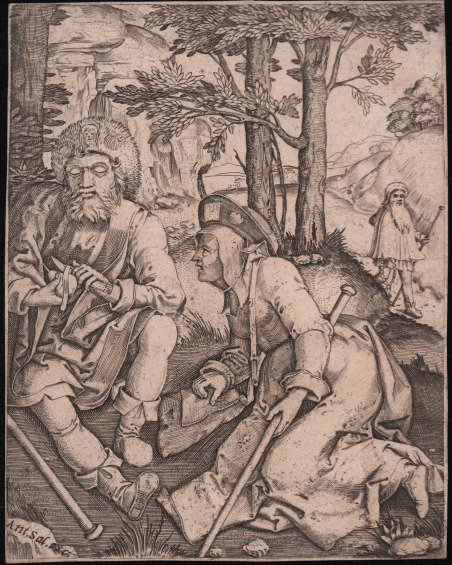
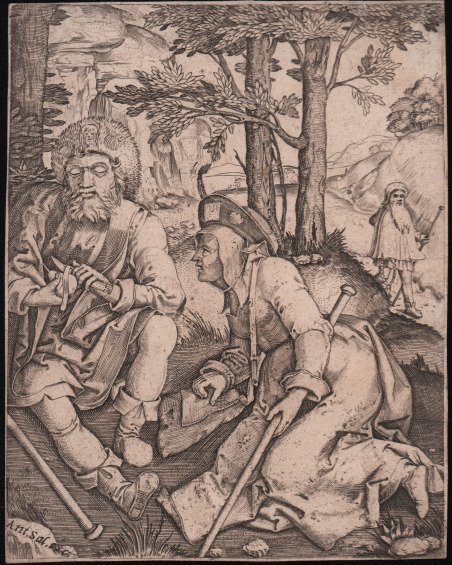
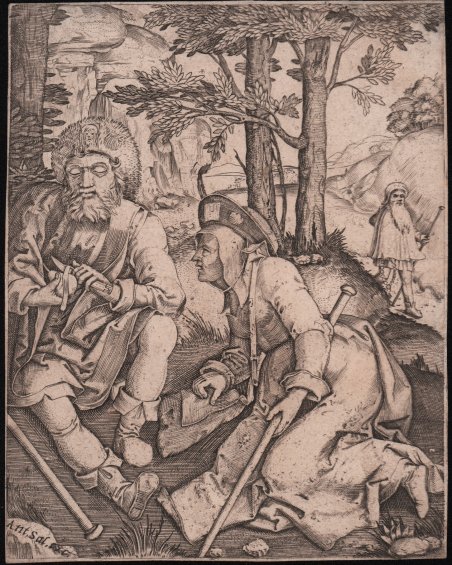
Bulino, circa 1508/1509, privo di firma. Esemplare nel secondo stato di due, con l’indirizzo di Antonio Salamanca in basso a sinistra. ' Da un soggetto di Lucas van Leyden. Buona prova, impressa su carta vergata, rifilata al rame, in ottimo stato di conservazione. Copia in controparte dell'incisione di Lucas van Leyden (Bartsch VII.418.149), l'unica composizione intera di Lucas copiata da Marcantonio Raimondi. Secondo Shoemaker, Marcantonio non aveva ancora compreso appieno la fine delicatezza del lavoro a bulino di Lucas e fece contrasti troppo forti. Bartsch ha descritto solo questo stato, tuttavia, esiste uno stato precedente senza l'indirizzo dell'editore Salamanca. ' "Tra il 1508 e il 1517 circa, Marcantonio prese in prestito numerosi motivi e porzioni di sfondo dalle incisioni dello stampatore olandese Lucas van Leyden. I Pellegrini è l'unica composizione intera di Lucas che Marcantonio abbia mai copiato. Fece la copia al contrario, e anche se seguì tutte le forme principali, facendo solo alcune piccole alterazioni, non seguì precisamente il lavoro a bulino di Lucas. Marcantonio lasciò fuori il monogramma di Lucas in basso a sinistra della sua stampa, e non aggiunse il suo alla copia. L'incisione di Lucas dei Pellegrini (B.VII, n. 149) è stata datata al 1505-08 circa. Probabilmente la copia di Marcantonio è datata intorno al 1508-09 (Passavant data l'incisione intorno al 1509, durante il soggiorno di Marcantonio a Venezia; Delaborde la data intorno al 1508); certamente è stata fatta prima del 1510, quando ha usato lo sfondo del Maometto e il monaco di Lucas negli Arrimpicatori, un lavoro che mostra una comprensione più sofisticata dello stile e della tecnica di Lucas. Ne I Pellegrini, Marcantonio non ha ancora compreso appieno la fine delicatezza del lavoro del bulino di Lucas e le sue tonalità argentee. Piuttosto che emulare le sottili modulazioni di tono e il convincente senso del volume di Lucas, Marcantonio crea forti contrasti di luce e buio e usa tratti più grossolani e variegati che spezzano la continuità dei volumi. Marcantonio enfatizza e addirittura delinea le zone di ombra profonda, come l'ombra sotto il piede della donna e le pieghe del suo panneggio. Nel 1510, quando Marcantonio copiò lo sfondo del Maometto e il Monaco di Lucas nella sua incisione degli Arrimpicatori, sembrò emulare meglio la finezza del lavoro a bulino di Lucas, anche se non riuscì mai a riprodurre pienamente le sottili qualità tonali delle incisioni di Lucas" (cfr. H. Shoemaker, The engravings of Marcantonio Raimondi, p. 80). Un'opera molto rara. ' Bibliografia Bartsch, Le Peintre graveur (Raimondi, n. 462); Passavant VI.40.253; Delaborde 1888, n. 309; Shoemaker 1981, n. 14; Gramaccini and Meier 2009, n. 52 Engraving, circa 1508/1509, without signature. Example of the second state of two with the Antonio Salamanca imprint added at lower left. A good impression, printed on laid paper, trimmed to the platemark, very good condition. ' Copy in reverse after Lucas van Leyden's engraving (Bartsch VII.418.149), the only entire composition by Lucas copied by Marcantonio Raimondi. According to Shoemaker, Marcantonio did not yet fully understand the fine delicacy of Lucas's burin work and made too strong contrasts. Bartsch only described this state, however, there is an earlier state without the publisher's address. “Between ca. 1508 and 1517, Marcantonio borrowed numerous motifs and portions of the background from the engravings of the Dutch printmaker, Lucas van Leyden. The Pilgrims is the only entire composition of Lucas's that Marcantonio ever copied. He made the copy in reverse, and although he followed all of the major forms, making only a few minor alterations, he did not precisely follow Lucas's burin work. Marcantonio left out Lucas's monogram from the bottom left of his print, and did not add his own to the copy. Lucas's engraving of The Pilgrims (B.VII, n. 149) has been dated ca. 1505-08. Probably Marcantonio's copy dates around 1508-09 (Passavant dates the engraving ca. 1509, during Marcantonio’s stay in Venice; Delaborde dated it about 1508); certainly it was done before 1510, when he used the background from Lucas's Mohammed and the Monk in The Climbers, a work that shows a more sophisticated understanding of Lucas's style and technique. In The Pilgrims, Marcantonio does not yet fully understand the fine delicacy of Lucas's burin work and his silvery tonalities. Rather than emulating Lucas's subtle modulations of tone and convincing sense of volume, Marcantonio makes strong contrasts of dark and light and uses coarser, more varied strokes that break up the continuity of the volumes. Marcantonio emphasizes and even outlines the areas of deep shadow, such as the shadow beneath the woman's foot and the folds of her drapery. In 1510, when Marcantonio copied the background of Lucas's Mohammed and the Monk in his engraving of The Climbers he seemed to emulate better the fineness of Lucas's burin work, although he was never to reproduce fully the subtle tonal qualities of Lucas's engravings” (cf. H. Shoemaker, The engravings of Marcantonio Raimondi, p. 80). A very rare work. ' Bibliografia Bartsch, Le Peintre graveur (Raimondi, n. 462); Passavant VI.40.253; Delaborde 1888, n. 309; Shoemaker 1981, n. 14; Gramaccini and Meier 2009, n. 52. Cfr.