Il Mercato degli Schiavi
Il Mercato degli Schiavi | Stampe | CALLOT Jacques
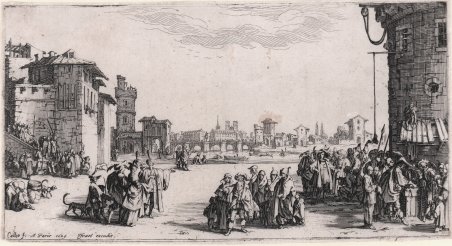
Il Mercato degli Schiavi
Il Mercato degli Schiavi | Stampe | CALLOT Jacques
Metodi di Pagamento
- PayPal
- Carta di Credito
- Bonifico Bancario
- Pubblica amministrazione
- Carta del Docente
Dettagli
- Anno di pubblicazione
- 1629
- Formato
- 218 X 116
- Incisori
- CALLOT Jacques
Descrizione
Acquaforte, 1629, datata e firmata in lastra nella parte inferiore sinistra.Esemplare secondo stato di sei con l’aggiunta dell’indirizzo di Israel che aggiunge anche la veduta di Parigi sullo sfondo. E’ questo l’unico caso in cui un’opera di Callot viene terminata da un altro incisore. Magnifica prova, impressa su carta vergata priva di filigrana, con piccolissimi margini, lieve restauro all’angolo superiore sinistro perfettamente eseguito, per il resto in perfetto stato di conservazione.L'opera è conosciuta anche come la "Piccola veduta di Parigi". Il punto di vista generale è quello della morte dell'artista, Isarel Henriet o un altro artista (forse Collignon), aggiunge la vista di Parigi sullo sfondo e, per motivi di plausibilità, la data "1629" (che corrisponde alla permanenza di Callot a Parigi). Il disegno preparatorio, che mostra un porto italiano piuttosto che una vista di Parigi sullo sfondo, tende a confermare questa teoria. Tuttavia, Mariette e Meaume non rifiutano la possibilità che Callot termini l'opera nel 1629; Meaume dubita che Henriet possa essere stato pubblicato da Callot, sotto il nome del maestro. In ogni caso, la composizione sembra essere stata progettata circa nel 1619/20.Anche il tema della soggetto è stato discusso; Balduccini lo identifica erroneamente come un gruppo di soldati che ricevono la paga; sembra essere un gruppo di prigionieri (o schiavi) cristiani liberati, un'interpretazione che sarebbe confermata da un'annotazione (forse scritta da Callot stesso) sul retro del disegno preparatorio: "redimere captivum". A public square, with people walking down the stairs of a building on the left and a crowd gathered at the bottom of a tower on the right; in the middle, two groups of figures; the one on the left is leaded by a man in Turkish costume; in the background, a view of Paris, with the Seine river crossed by the Pont-Neuf.The work has also kwnown as the "Little view of Paris". The general point of view is that Callot never finished the plate, which was completed after the artist's death by Henriet or another artist (maybe Collignon), who added the view of Paris in the background and, for plausibility reasons, the date '1629' (which corresponds to Callot's stay in Paris). The preparatory drawing, which shows an Italian harbour rather than a view of Paris in the background, tends to confirm this theory. However, Mariette and Meaume do not reject the possibility of Callot finishing the plate himself in 1629; Meaume doubts that Henriet could have published a plate which had not been finished by Callot, under the name of the master. In any case, the composition seems to have been designed c.1619/20.The subject of the plate has also been discussed; Balduccini wrongly identifies it as a group of soldiers receiving their pay; it appears that the scene actually represents a group of Christian prisoners (or slaves) being freed, an interpretation that would be confirmed by an annotation (perhaps written by Callot himself) at the back of the preparatory drawing: 'redimere captivum'.Etching, 1629, lettered with production and publication detail: 'Callot f. A Paris 1629 Israel excudit'.A fine impression, of the second state of six, showing the landscape in the background, with thin margins, a small repairs at the upper right corner, otherwise very good condition. Cfr. Lieure 369 II/VI; Mostra Nancy, p. 320, 441; Meaume 1860 712.II.