La Morte col fanciullo
La Morte col fanciullo | Stampe | Della BELLA Stefano
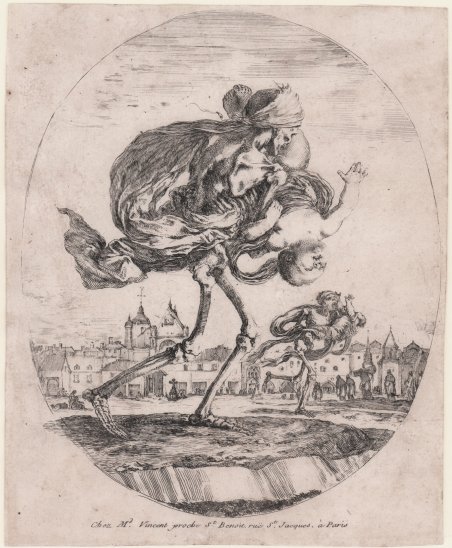
La Morte col fanciullo
La Morte col fanciullo | Stampe | Della BELLA Stefano
Metodi di Pagamento
- PayPal
- Carta di Credito
- Bonifico Bancario
- Pubblica amministrazione
- Carta del Docente
Dettagli
- Anno di pubblicazione
- 1647
- Formato
- 145 X 180
- Incisori
- Della BELLA Stefano
Descrizione
Morte che porta via un bambino; al centro di una composizione ovale, Morte di profilo a destra che porta via un bambino, con una seconda Morte che porta via un altro bambino a destra, con il Cimitero degli Innocenti, Parigi, sullo sfondo. Acquaforte e bulino, circa 1647. ' Esemplare nel terzo stato di tre, con l’indirizzo dell’editore Vincent in basso. Bellissima prova, impressa su carta vergata coeva priva di filigrana, rifilata al rame, leggere tracce di colla al verso, nel complesso in ottimo stato di conservazione. Sullo sfondo, aggiunto a partire dal secondo stato, si può riconoscere la facciata dell’ossario degli Innocenti a Parigi, sotto le cui arcate si svolgeva una rappresentazione di una Danza della Morte che può aver ispirato il Della Bella. Della serie “Le cinque Morti – Les Cinq Morts”, che l’autore completa in Francia. Fu probabilmente durante i suoi ultimi anni in Francia che Della Bella iniziò una versione aggiornata della ' Danza della Morte. Questo soggetto tipicamente nordico e medievale di solito mostrava la Morte in una varietà di situazioni, portando via vittime di ogni età e di ogni ceto sociale. Mentre Della Bella si trovava in Francia ha inciso quattro scene ovali della serie, tra cui questa stampa (Morte che porta un bambino), tre delle quali si svolgono nei cimiteri e la quarta sul campo di battaglia. A questi anni risale probabilmente anche una versione orizzontale della Morte che trionfa in guerra. Negli ultimi abbi della sua vita, la Bella riprende il tema, creando altri tre episodi in formato ovale - due di questi sono rimasti incompleti alla sua morte. Nelle prime stampe, in particolare, la Morte è tanto energica quanto spietata: qui si precipita nel cimitero con un bambino urlante e in difficoltà. L'ambientazione è il Cimitero degli Innocenti a Parigi, un luogo che della Bella conosceva senza dubbio, dato che molti editori e stampatori avevano i loro negozi al piano terra degli ossari. Il Metropolitan Museum of Art ha un disegno preparatorio (1983.137) per questa incisione. Stefano della Bella fu uno degli incisori più interessanti e originali nella Firenze del XVII secolo e può considerarsi l’unico geniale continuatore dell’opera di Jacques Callot. La sua educazione artistica ebbe inizio a Firenze nella bottega degli orafi Gasparo Mola e Orazio Vanni, e la precisione del segno, tipica dell’arte orafa resterà caratteristica del suo stile. Studiò poi presso Giovanni Battista Vanni e forse anche presso il Cantagallina e Cesare Dandini, ma ben presto si dedicò all'incisione. Il suo vero maestro può considerarsi Jacques Callot, l’incisore francese che soggiornò a lungo a Firenze lasciando una forte impronta nel panorama artistico della città. Gli anni più importanti della sua carriera sono quelli che trascorre a Parigi, dal 1639 al 1650, stipendiato da Lorenzo de' Medici: lavorò insieme ad Israel Silvestre, con gli editori Langlois, Ciartres e Pierre Mariette, per stampatori francesi e per commissioni di gran prestigio, come quelle del 1641 per il cardinale Richelieu che gli affidò le illustrazioni delle sue imprese guerresche. Intorno al 1647, durante un viaggio in Olanda, dove eseguì le acqueforti con le vedute del porto di Amsterdam, incontrò Rembrandt e da quella data notiamo una eco profonda dell’arte dell’olandese nella grafica del Della Bella. ' Bibliografia De Vesme - Massar Stefano della Bella (1971) n. 88, III/III; F.Carey (ed.), "The Apocalypse and the Shape of Things to Come", exh. cat., BM, London, 1999, nos 112-115. ' Death carrying off an infant; in centre of an oval composition, Death in profile to right carrying off an infant, with a second Death carrying off another child to right, with the Cemetery of the Innocents, Paris, in background. Example in the third state of three, with publisher Vincent’s address on lower part. On the background, added in the second state, we can see the ossuary of Les Innocents Cemetery in Paris, under whose arches the representation of the Dance of Death took place. ' From the series ' The Five Deaths- Les Cinq Morts, which Della Bella completed in France. It was probably during his last years in France that Della Bella began an updated version of the Dance of Death. This typically Northern and medieval subject usually showed Death in a variety of situations, carrying away victims of every age and walk of life. While in France Della Bella etched four oval scenes of Death's conquest, including this print (Death Carrying a Child), three of which take place in cemeteries and the fourth on the battlefield. A horizontal version of Death triumphing in war probably also dates to these years. At the end of his life, Della Bella took up the theme again, creating three more episodes in the oval format—two of these were left incomplete at his death. In the early prints particularly, Death is as energetic as he is ruthless—here he rushes into the cemetery bearing a screaming and struggling child. The setting is the Cemetery of the Innocents in Paris, a site with which della Bella was undoubtedly familiar, since many publishers and print dealers had their shops on the ground floor of the charnel houses. The Metropolitan Museum of Art has a preparatory drawing (1983.137) for this etching. Excellent work, printed on contemporary laid paper without watermark, trimmed to platemark, small signs of glue on verso, in general in good condition. Stefano della Bella was one of the most interesting and original engravers in 17th-century Florence and can be considered the only brilliant continuator of Jacques Callot's work. His artistic education began in Florence in the workshop of the goldsmiths Gasparo Mola and Orazio Vanni, and the precision of sign, typical of the goldsmith's art, will remain characteristic of his style. He then studied under Giovanni Battista Vanni and perhaps also under Cantagallina and Cesare Dandini, but soon turned to engraving. His real master can be considered Jacques Callot, the French engraver who stayed in Florence for a long time and left a strong imprint on the city's artistic scene. The most important years of his career were the ones he spent in Paris, from 1639 to 1650, salaried by Lorenzo de' Medici: he worked together with Israel Silvestre, with the publishers Langlois, Ciartres and Pierre Mariette, for French printers and for commissions of great prestige, such as those of 1641 for Cardinal Richelieu, who entrusted him with illustrations of his warlike exploits. Around 1647, during a trip to Holland, where he executed etchings with views of the port of Amsterdam, he met Rembrandt, and from that date we note a profound echo of the Dutchman's art in Della Bella's graphic work. Bibliografia De Vesme - Massar Stefano della Bella (1971) n. 88, III/III; F.Carey (ed.), "The Apocalypse and the Shape of Things to Come", exh. cat., BM, London, 1999, nos 112-115. ' Cfr.