La Sculpture
La Sculpture | Stampe | COCHIN Charles Nicolas
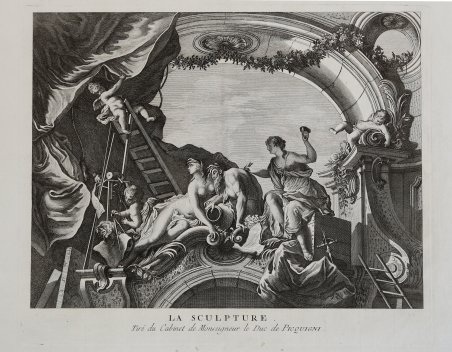
La Sculpture
La Sculpture | Stampe | COCHIN Charles Nicolas
Metodi di Pagamento
- PayPal
- Carta di Credito
- Bonifico Bancario
- Pubblica amministrazione
- Carta del Docente
Dettagli
- Anno di pubblicazione
- 1738
- Formato
- 370 X 305
- Incisori
- COCHIN Charles Nicolas
Descrizione
Acquaforte e bulino, priva di firma, da Jacques de Lajoüe. Tiratura avanti l'indizrizzo di Chéreau. L’incisione è una traduzione a stampa di dipinti decorativi collocati nel gabinetto di storia naturale di Michel Ferdinand d'Albert d'Ailly, Duc de Picquigny e Fifth Duc de Chaulnes. Jacques de Lajoüe ha prodotto un totale di tredici dipinti incisi da Cochin, John Ingram e Nicolas Tardieu. La serie di stampe con raffigurazioni delle arti e delle scienze liberali fu pubblicata nel 1738 dalla vedova di Chéreau, ed esposta al Salon di Parigi. In linea con la moda contemporanea, durante il regno di Luigi XV, l'illustrazione rivela una spiccata propensione per la decorazione esuberante. L'alchimista vestito con abiti orientali è seduto in un misterioso laboratorio pieno di ogni sorta di animali, coralli, vasi e manufatti esotici imbalsamati.L'incisione è nota in due diversi stati, entrambi recanti l'indirizzo della vedova di Chéreau. Le stampe della serie hanno goduto da subito di grande popolarità, il che spiega la decisione di pubblicare un'edizione rivista per soddisfare la domanda crescente del pubblico. Nella prima versione la scena è inquadrata come un trompe l'oeil per abbinarsi alla decorazione interna nel gabinetto del Duc de Picquigny, mentre nella seconda versione - qui proposta - ha un formato rettangolare ed è stata estesa su tutti e quattro i lati ad incorporare ulteriori elementi pittorici (vedi M. Roland Michel, Lajoüe et l'art rocaille, Neuilly-sur-Seine, 1984, pp. 329–330, 332). Bella impressione, con margini, in condizioni eccellenti. Etching and engraving after Jacques de Lajoüe. A proof state, before the Chéreau address.The present print is aa reproductive engraving after decorative paintings which served as supraportas in the natural history cabinet of Michel Ferdinand d’Albert d’Ailly, Duc de Picquigny and Fifth Duc de Chaulnes. Jacques de Lajoüe produced a total of thirteen paintings which were etched by Cochin, John Ingram and Nicolas Tardieu. The series of prints with depictions of the free arts and the sciences was published in 1738 by Chéreau’s widow and exhibited at the Paris Salon. In keeping with contemporary fashion during the reign of Louis XV, the illustration reveals a marked penchant for exuberant decoration. The alchemist clad in oriental dress is sat in a mysterious laboratory full of all manner of exotic stuffed animals, corals, vessels and artefacts that wouldnot be out of place in a seething witches’ kitchen.The etching exists in two different versions, both of which bear the address of Chéreau’s widow. The prints in the series were immensely popular from the moment they were published. This evidently prompted the decision to issue a revised edition in order to meet the increased demand. In the first version the scene is framed like a trompe l’oeil to match the interior decoration in the cabinet of the Duc de Picquigny, whereas the illustration in the second version on offer here has a rectangular format and has been extended on all four sides to incorporate additional pictorial elements (see M. Roland Michel, Lajoüe et l’art rocaille, Neuilly-sur-Seine, 1984, pp. 329–330, 332).A very fine impression with narrow margins, excellent condition. Cfr. Inventaire du Fonds Français, vol. 4, p. 635, no. 250; Michel G 71.