Le Logge di Raffaello
Le Logge di Raffaello | Stampe | VOLPATO Giovanni
Le Logge di Raffaello
Le Logge di Raffaello | Stampe | VOLPATO Giovanni
Metodi di Pagamento
- PayPal
- Carta di Credito
- Bonifico Bancario
- Pubblica amministrazione
- Carta del Docente
Dettagli
- Anno di pubblicazione
- 1774
- Formato
- 0 X 0
- Incisori
- VOLPATO Giovanni
- Soggetto
- Architettura e Ornamenti
Descrizione
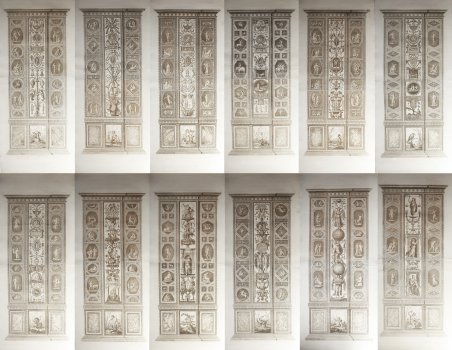
Serie completa di 12 incisioni all’acquaforte, 1774/6, firmate e datate in lastra in basso a destra. Magnifiche prove, impresse su carta vergata coeva con filigrana “scudo con giglio” (ove presente), con ampli margini, carta con barbe, in eccellente stato di conservazione. La famosa serie delle Logge di Raffaello che reca i nomi di Giovanni Volpato e Giovanni Ottaviani, datata 1772/6 ebbe una gestazione lunga e travagliata, giustificata dall’enorme mole di lavoro. La serie, a cui il Volpato deve gran parte della sua notorietà nell’ambiente romano del tempo, è la prima opera che affronta, in modo dettagliato e completo, la riproduzione degli ornati dei pilastri delle Logge affrescate da Raffaello. Uscirono in tre volumi tra il 1772 ed il 1776, frutto della collaborazione del pittore Gaetano Savorelli, dell’architetto Pietro Camporesi e dell’incisore Giovanni Ottaviani per la prima parte, cui dal 1772 si aggiunsero Ludovico Teseo e il Volpato, che firmarono le tavole della terza parte, raffigurante i pilastri. L’intervento di Volpato, che assunse in certo senso la direzione dell’opera legando il suo nome all’impresa, costituisce il motivo del suo trasferimento a Roma, probabilmente chiamato da Clemente XIV (1769-1774). Le tavole del Volpato, incise tra il 1774 ed il 1776 con la collaborazione del Teseo che si occupava dei rilievi, riproducono con grande libertà traduttiva i dodici contropilastri della Loggia. La scarsa visibilità della parte inferiore dell’affresco spinse l’artista ad applicare integrazioni di fantasia, come nel caso di alcuni pilastri dove sono inseriti elementi decorativi desunti dalle bordure di alcuni arazzi vaticani. Ciò non impedì tuttavia le vasta ed immediata risonanza che ebbe la raccolta, che costituì un importante repertorio figurativo da cui attingere motivi di decorazione, contribuendo al grande successo dei temi grotteschi del periodo neoclassico. Sono note delle prove con coloritura coeva; le prove destinate alla coloritura sono stampate con inchiostro marrone/bistro dai toni più delicati, come queste che presentiamo, e sono assolutamente più rare. Magnifico set, omogeneo, in eccellente stato di conservazione. A complete series of 12 etchings, 1774/6, signed and dated at lower right. Magnificent works, printed on contemporary laid paper with “shield with lily” watermark (if present), with wide margins, untrimmed, in excellent condition. The famous series of the Logge of Raphael, bearing the names of Giovanni Volpato and Giovanni Ottaviani, has been realized between 1772 and 1776; the process of realization was quite long, due to the proportion of the work. This series, which made Volpato quite famous in the Roman artistic environment of his time, is the first work that represents, minutely and completely, the pillars decorations of the Loggias painted by Raphael. Three volumes were published between 1772 and 1776, as the result of the cooperation of the painter Gaetano Savorelli, the architect Pietro Camporesi and the engraver Giovanni Ottaviani for the first part; in 1772 Ludovico Teseo and Volpato joined them and signed the plates of the third part, the one depicting the pillars. To work on this series, Volpato, who became in a way the project manager, moved to Rome, very likely upon pope Clement XIV request (1769-1774). Volpato’s plates, engraved between 1774 and 1776 together with Teseo who worked on the relieves, represent quite freely the twelve counter pillars of the Loggia. The scarce visibility of the lower part of the fresco brought the artist to integrate the missing parts with fictitious elements, as in the decorations of some pillars taken from the tapestries in the Vatican. Nevertheless, this did not affect the immediate and huge echo the collection had, for it represented an important figurative repertoire from which many other artists could draw inspiration and it gave a remarkable contribution to the circulation of the grotesque themes of the Neoclassical period. A few print proofs with contemporary colour are known; they have been printed with a more delicate brown/bister ink, like the ones we present hereby, and are far more rare. Beautyful set, in excellent condition. Cfr. Giorgio Marini, Volpato, pp. 187/198; Pezzini in "Raphael Invenit" pp. 105/6, 36/45. Dimensioni 480x1060 ognuna.