Lotta tra un putto e un cavallo marino
Lotta tra un putto e un cavallo marino | Stampe | MAGLIOLI Giovanni Andrea
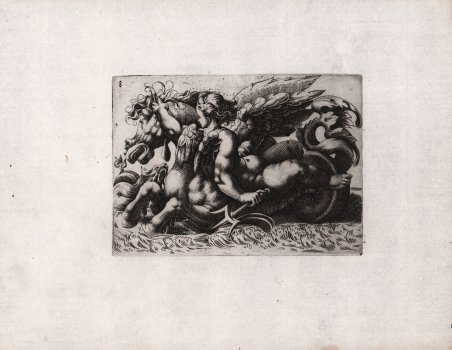
Lotta tra un putto e un cavallo marino
Lotta tra un putto e un cavallo marino | Stampe | MAGLIOLI Giovanni Andrea
Metodi di Pagamento
- PayPal
- Carta di Credito
- Bonifico Bancario
- Pubblica amministrazione
- Carta del Docente
Dettagli
- Anno di pubblicazione
- 1608
- Formato
- 130 X 100
- Incisori
- MAGLIOLI Giovanni Andrea
Descrizione
Bulino e acquaforte, 1608 circa, senza firma, con iscrizione in alto a sinistra "8". Esemplare del secondo stato, con l'imprint "Laurentius Vaccarius formis Rome 1608" cancellato ma ancora visibile sotto l’abrasione. L'incisione raffigura un putto e un cavalluccio marino realizzato da Giovanni Andrea Maglioli (attivo a Roma tra il 1580 e il 1610). Maglioli è un incisore italiano di cui si sa poco; nativo di Napoli, è accreditato di alcune elaborate incisioni con putti e animali marini di fantasia. Non catalogato da Bartsch, è stato studiato da Nagler e Peter Jessen nel Katalog der Ornamentstichsammlung der Staatlichen Kunstbibliothek. Le sue invenzioni sono state spesso copiate in passato, a testimonianza della popolarità dei suoi soggetti. Il foglio appartiene a una serie di mostri marini e putti in stile manierista; il debito con la scultura classica è evidente. Un putto afferra con la mano destra un tridente e con l'altra la criniera del mostro marino che sta cavalcando a guisa di cavallo con la lunga coda attorcigliata a spirale. Il tratto fine e la fitta intersezione di linee mostrano una grande abilità tecnica e una resa compositiva volta a esaltare la plasticità delle figure; i contrasti chiaroscurali creano un tono argenteo. Nel Katalog der Ornamentstichsammlung der Staatlichen Kunstbibliothek Berlin del 1939 Peter Jessen descriveva un totale di quattro serie e diverse stampe singole in possesso di Berlino, che comprendevano però anche alcune imitazioni. Infatti, le invenzioni di Maglioli furono spesso copiate da diversi artisti, come Jan Theodoor de Bry, Adam Fuchs e Gabriel Weyer, a dimostrazione della loro grande popolarità. A quanto pare, l'ordine delle singole stampe nelle suite era molto diverso, il che rende ancora più difficile riconoscere le caratteristiche stilistiche dell'opera stampata dell'artista. L'indirizzo di Lorenzo Vaccari conferma che la serie fu stampata a Roma. Superba impressione, stampata su carta vergata coeva senza filigrana, con ampi margini, una leggera piega della carta al centro, per il resto ottimo stato di conservazione. Bibliografia Nagler, Die Monogrammisten I; Berliner Ornamentstichkatalog. Engraving and etching, 1608 circa, without signature, inscribed in upper left '8'. Example of the second state, with the imprint “Laurentius Vaccarius formis Rome 1608” of Lorenzo Vaccari erased. The engraving depicts a putto and a seahorse made by Giovanni Andrea Maglioli (active in Rome between 1580 - 1610). Maglioli is an Italian engraver of whom little is known. Active in Rome and Naples in the late 1500s, he is credited with some elaborate engravings featuring putti and fantasy sea animals. Uncatalogued by Bartsch, studied by Nagler and Peter Jessen in the Berlin catalog of ornament engravings. His inventions have often been copied in the past reflecting the popularity of his subjects. The sheet belongs to a series of sea monsters and cherubs in the Mannerist style; the debt to classical sculpture is evident. A putto grasps a trident with his right hand and with the other the mane of the sea monster he is riding in the guise of a horse with its long tail twisted into a spiral. The fine stroke and dense intersection of lines show great technical skill and compositional rendering aimed at enhancing the plasticity of the figures; chiaroscuro contrasts create a silvery tone. In the 1939 Katalog der Ornamentstichsammlung der Staatlichen Kunstbibliothek Berlin Peter Jessen described a total of four series and several individual prints in Berlin’s possession, which also included a number of imitations, however. In fact, Maglioli’s inventions were frequently copied by different artists, such as Jan Theodoor de Bry, Adam Fuchs and Gabriel Weyer, indicating their great popularity. Apparently, the order of the individual prints in the suites differed greatly, which makes it even more difficult to recognize the stylistical characteristics of the artist’s printed work. Lorenzo Vaccari's address confirms that the series was printed in Rome. A superb impression, printed on contemporary laid paper without watermark, with large margins, a light paper crease in the middle, otherwise excellent condition. Bibliografia Nagler, Die Monogrammisten I; Berliner Ornamentstichkatalog. Cfr.