Old Chelsea, Out of Whistler's Window (Battersea Reach)
Old Chelsea, Out of Whistler's Window (Battersea Reach) | Stampe | HADEN Francis Seymour
Old Chelsea, Out of Whistler's Window (Battersea Reach)
Old Chelsea, Out of Whistler's Window (Battersea Reach) | Stampe | HADEN Francis Seymour
Metodi di Pagamento
- PayPal
- Carta di Credito
- Bonifico Bancario
- Pubblica amministrazione
- Carta del Docente
Dettagli
- Anno di pubblicazione
- 1869
- Formato
- 225 X 150
- Incisori
- HADEN Francis Seymour
- Soggetto
- Scuola Inglese & Americana
Descrizione
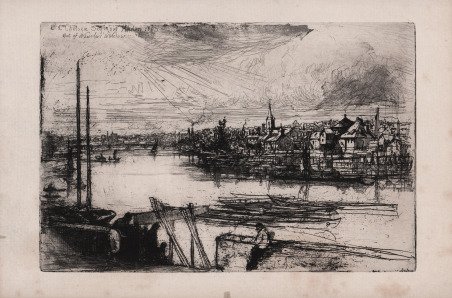
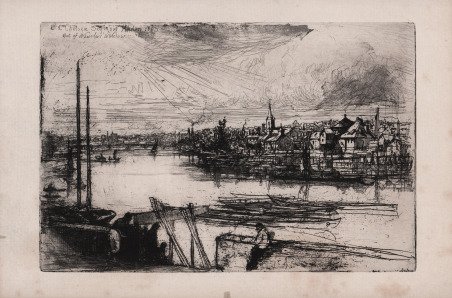
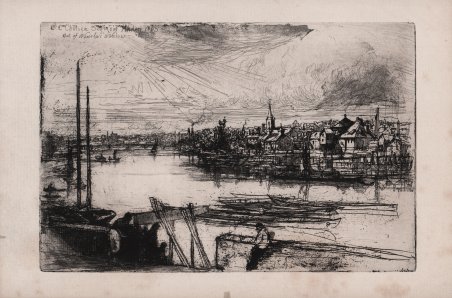
Veduta della riva di un fiume a Chelsea; in primo piano a sinistra, persone con cani, due che portano lunghi bastoni; chiatte ormeggiate vicino alla riva; la casa di Whistler vista a sinistra. Iscrizione in lastra, in alto a sinistra: "Whistler's House at Old Chelsea Seymour Haden ft. an[no] 1863". ' Acquaforte e puntasecca; secondo stato di due (Harrington); settimo stato di sette (Schneiderman). "All the foreground boats have vertical reflections. There is now a line at the base of the house most to the left, which extends almost to the margin of the plate. This plate 'wore out very soon and had to be destroyed before it had given its full quota of impressions. Published in Études à l'eau-forte (No. VIII.), under the title of 'Old Chelsea,' some copies having the First, others the Second State. Exhibited at the Royal Academy, 1865." [cf. Harrington, p. 28] "There are several preliminary drawings for this print […] similar in composition though the view point is from farther into the river. State VII. Published in Études à l'eau-forte (N. VIII). Line added at base of house on left and a few lines to indicate modeling at right on the wall. The smoke, rising from the chimney of the house, second from the right of Whistler's house, is no longer visible." [cf. Schneiderman, p. 143] Seymour Haden era l'improbabile combinazione di un chirurgo e un incisore. Sebbene abbia perseguito una carriera medica di grande successo, è ricordato soprattutto per i suoi lavori all'acquaforte e per i suoi scritti sull'acquaforte. Fece parte di un gruppo di artisti, tra cui James McNeill Whistler (1834-1903) e Alphonse Legros (1837-1911), il cui appassionato interesse per questo mezzo portò al cosiddetto revival dell'acquaforte, un periodo che durò fino al XX secolo. L'esaltazione dell'acquaforte per le sue intrinseche qualità spontanee raggiunse il suo apice durante questo periodo. Mentre la linea dell'ago da acquaforte, scrisse Haden, era "libera, espressiva, piena di vivacità", quella del bulino era "fredda, costretta, poco interessante" e "senza identità". Stampata su carta vergata coeva, con margini, condizioni perfette. Bibliografia Henry Nazeby Harrington ' The Engraved Work of Sir Francis Seymour Haden, P.R.E.: an illustrated and descriptive catalogue. Liverpool, 1910, cat. no. 54 ii, p. 28, ill; Richard S. Schneiderman ' A Catalogue Raisonné of the Prints of Sir Francis Seymour Haden. London, 1983, cat. no. 50 vii, p. 143, ill. View of a river bank in Chelsea; in the foreground at left, people with dogs, two carrying long sticks; barges moored near the bank; the house of Whistler seen to the left. Lettered in plate, lower left: "Whistler's House at Old Chelsea Seymour Haden ft. an[no] 1863". ' Etching and drypoint; second state of two (Harrington); seventh state of seven (Schneiderman). "All the foreground boats have vertical reflections. There is now a line at the base of the house most to the left, which extends almost to the margin of the plate. This plate 'wore out very soon and had to be destroyed before it had given its full quota of impressions. Published in Études à l'eau-forte (No. VIII.), under the title of 'Old Chelsea,' some copies having the First, others the Second State. Exhibited at the Royal Academy, 1865." [cf. Harrington, p. 28] "There are several preliminary drawings for this print […] similar in composition though the view point is from farther into the river. State VII. Published in Études à l'eau-forte (N. VIII). Line added at base of house on left and a few lines to indicate modeling at right on the wall. The smoke, rising from the chimney of the house, second from the right of Whistler's house, is no longer visible." [cf. Schneiderman, p. 143] Seymour Haden was the unlikely combination of a surgeon and an etcher. Although he pursued a very successful medical career, he is mostly remembered for his etched work as well as for his writings on etching. He was one of a group of artists, including James McNeill Whistler (1834–1903) and Alphonse Legros (1837–1911), whose passionate interest in the medium led to the so-called etching revival, a period that lasted well into the twentieth century. The extolling of etching for its inherent spontaneous qualities reached its pinnacle during this time. While the line of the etching needle, Haden wrote, was "free, expressive, full of vivacity," that of the burin was "cold, constrained, uninteresting," and "without identity." Printed on contemporary laid paper, with margins, perfect condition. Bibliografia Henry Nazeby Harrington ' The Engraved Work of Sir Francis Seymour Haden, P.R.E.: an illustrated and descriptive catalogue. Liverpool, 1910, cat. no. 54 ii, p. 28, ill; Richard S. Schneiderman ' A Catalogue Raisonné of the Prints of Sir Francis Seymour Haden. London, 1983, cat. no. 50 vii, p. 143, ill. Cfr.