Optare aliorum mortem (Nave dei folli)
Optare aliorum mortem (Nave dei folli) | Stampe | DURER Albrecht
Optare aliorum mortem (Nave dei folli)
Optare aliorum mortem (Nave dei folli) | Stampe | DURER Albrecht
Metodi di Pagamento
- PayPal
- Carta di Credito
- Bonifico Bancario
- Pubblica amministrazione
- Carta del Docente
Dettagli
- Anno di pubblicazione
- 1498
- Formato
- 150 X 202
- Incisori
- DURER Albrecht
Descrizione
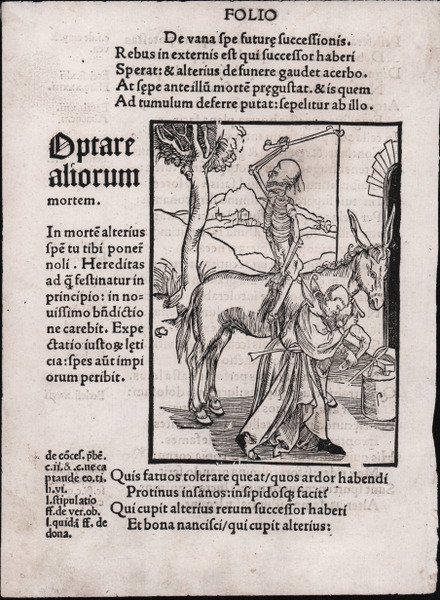
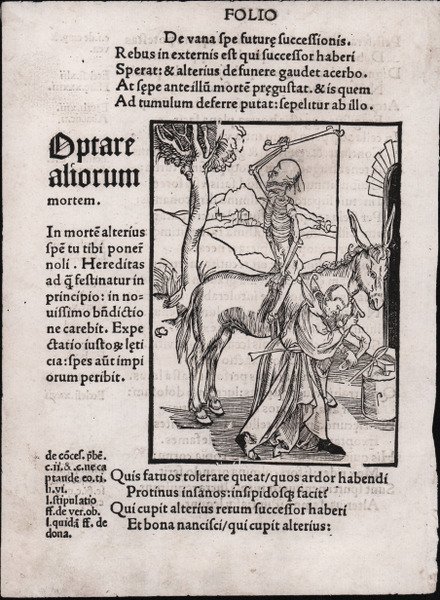
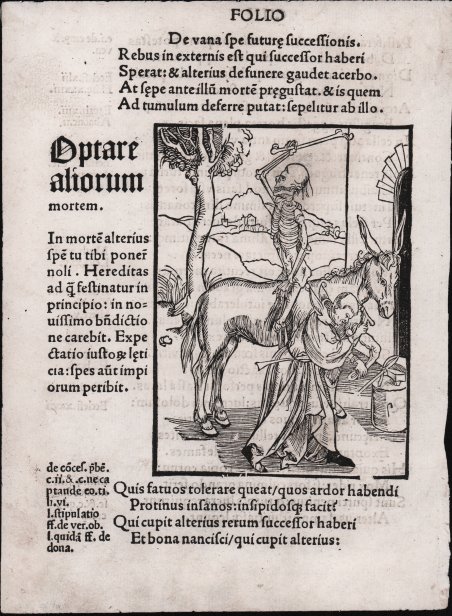
De vana spe futurae successionis (Il Fabbro Matto) Della Speranza di ereditare Xilografia, dall’opera Stultifera navis ( La Nave dei Folli) ' di Sebastian Brant edizione latina edita a Basilea da Johann Bergmann, de Olpe nel 1498. Traduzione latina curata da Jacobus Locher Philomusos. Sebastian Brant, l'autore de La Nave dei Folli nacque a Strasburgo 1457/58 e vi morì nel 1521. Nel 1475 ottenne una laurea in filosofia all'Università di Basilea. Nel 1489 aggiunse una laurea in giurisprudenza. Brant tenne corsi all'università in entrambe le discipline e fu molto ammirato dai suoi studenti. Ne La Nave dei Folli Brant afferma la sua visione del mondo, che vedeva popolato da pazzi ossessionati dalle loro stesse predilezioni, Satirico nel tono e moralizzante nell'intento, il libro divenne un bestseller immediato. Una versione pirata apparve in pochi mesi, pubblicata da Peter Wagner a Norimberga, il 1° luglio 1494. Passò attraverso sei edizioni tedesche autorizzate e sette pirata durante la vita di Brant, e non meno di trenta edizioni entro il 1630, comprese numerose traduzioni. Trithemius suggerì che avrebbe dovuto chiamarsi Divina Satira. ' La produzione letteraria di Brant non si limitò a La Nave dei Folli, poema in ottonari che pubblicò in tempo per il Carnevale 1494. I suoi scritti includevano un'edizione della Vulgata, edizioni di autori classici e dei padri della chiesa, inni e manuali di diritto. Nel 1494 scrisse il testo che accompagnava un'illustrazione del martirio di San Sebastiano, nel 1495 contribuì con una poesia elogiativa sul verso del frontespizio di un'edizione dei sermoni di Johannes Meder sul Figliol Prodigo - il soggetto di un'incisione di Dürer - e nel 1496 Brant scrisse il testo per il foglio che descriveva la nascita di un anormale maiale a otto zampe, un evento che incuriosì anche Dürer. Il ruolo di Dürer nelle illustrazioni de La nave dei folli è sempre stato riconosciuto. Rumohr sembra essere stato il primo ad affermare che Dürer "può aver contribuito a fornirne alcune". Burckhardt accreditò a Dürer un certo numero di xilografie. La qualità eterogenea delle illustrazioni è innegabile e chiaramente non è dovuta solo a differenze nella qualità del taglio. Le illustrazioni sono in totale 115, stampate da 106 blocchi (nove appaiono due volte). Nella seconda edizione di Basilea (1495) sei furono sostituite da altre (tre per ragioni tecniche o estetiche, tre in favore di una nuova iconografia). Altre due xilografie furono introdotte nell'edizione latina del 1497. Panofsky attribuisce a Dürer solo un terzo del totale, le altre non hanno "alcun legame apprezzabile" con lui. Panofsky ha osservato che solo alcuni dei blocchi minori portano la data 1494, deducendo che siano stati eseguiti da un altro artista dopo la partenza di Dürer. ' Winkler, che ha intrapreso un esame più approfondito delle illustrazioni, concluse che settantatré sono di Dürer, quindici dell'autore della xilografia "Heintznarr", sei dell'autore della xilografia "Gnad Herr", e il resto incerto. Con il consenso generale, Dürer lasciò Basilea prima che il compito fosse completato. Bellissimo esemplare, in condizioni perfette. Bibliografia Kurth, (1927), 49-62; TIB: 1001.513 Strauss, TWoodcut, n 13. , pp. 64 - 65 ; Meder p. 273; Panofsky, 436b. Of expecting inheritance (The Blacksmith Fool) From the Stultifera navis (Das Narrenschiff) - Latin edition, published in Basel: ' Johann Bergmann, de Olpe, 1 Mar. 1498. ' Sebastian Brant, the author of The Ship of Fools was born in Strassburg 1457/58 and died there in 1521. In 1475 he was granted a degree in philosophy from the University of Basel. In 1489 he added a degree in jurisprudence. Brant taught courses at the university in both disciplines and was greatly admired by his students. In The Ship of Fools Brant states his own view of the world, which he saw peopled by fools obsessed by their own predilections, Satirical in tone and moralizing in intent, the book became an instant bestseller. A pirated version appeared within a few months, issued by Peter Wagner in Nuremberg, 1 July 1494. It went through SIX authorized and seven pirated German editions during Brant's lifetime, and no less than thirty editions by 1630, including numerous translations. Trithemius suggested that it should have been called Divina Satira. Brant's literary works were not limited to The Ship of Fools, which he issued in time for Carnival 1494. His writings included an edition of the Vulgate, editions of classical authors and the church fathers, hymns and textbooks of law. In 1494 wrote the text accompanying an illustration of the martyrdom of St. Sebastian (see no. 15), in 1495 he contributed a laudatory poem on the verso of the title page of an edition of Johannes Meder's sermons on the Prodigal Son - the subject of a Dürer engraving -and in 1496 Brant wrote the text for the broadsheet describing the birth of an abnormal eight-legged pig, an event that also intrigued Dürer. Dürer's part in the illustrations of The Ship of Fools has always been acknowledged. Rumohr seems to have been the first to assert that Dürer "may have helped to provide some of them." Burckhardt credited Dürer with a number of the woodcuts. The heterogeneous quality of the illustrations is undeniable and clearly is not due merely to differences in the quality of the cutting. The illustrations total 115, printed from 106 blocks (nine appear twice), In the second Basel edition (1495) six were replaced by others (three for technical or aesthetic reasons, three in favor of a new iconography). Two more woodcuts were introduced in the Latin edition of 1497. Panofsky ascribed only about a third of the total to Dürer, the others having "no appreciable connection" with him. Panofsky observed that only some of the inferior blocks bear the date 1494, deducing that they were executed by another artist after Dürer's departure. ' Winkler, who undertook the most thorough examination of the illustrations, concluded that seventy-three are by Dürer, fifteen by the author of the "Heintznarr" woodcut, six by the author of the "Gnad Herr" woodcut, and the rest uncertain. By concensus, Dürer left Basel before the task was completed. Some lines of Brant's text in the prologue of The Ship of Fools prompted the opinion that he was responsible for the design of the illustrations: Embarking of his own accord And here I've pictured every dolt Should reading prove too difficult… But at best, Brant's instructions pertained to the particulars to be illustrated, not to the composition itself, because in the latter, the quality differs remarkably. However, in one respect there is certainty: the book was entirely new, and the illustrators could not rely on earlier models. This is not to say that prints of fools were unknown. Troops of fools were a common sight during Carnival masquerades. A fine example, perfect condition. Bibliografia Kurth, (1927), 49-62; TIB: 1001.513 Strauss, Woodcut, ' n 13.o ' , pp. 64 - 65 ; Meder p. 273; Panofsky, 436b. Cfr.