Poliometria Germaniae ac finimorum quorundam locorum Europae
Poliometria Germaniae ac finimorum quorundam locorum Europae | Stampe | HOMANN Johann Baptist

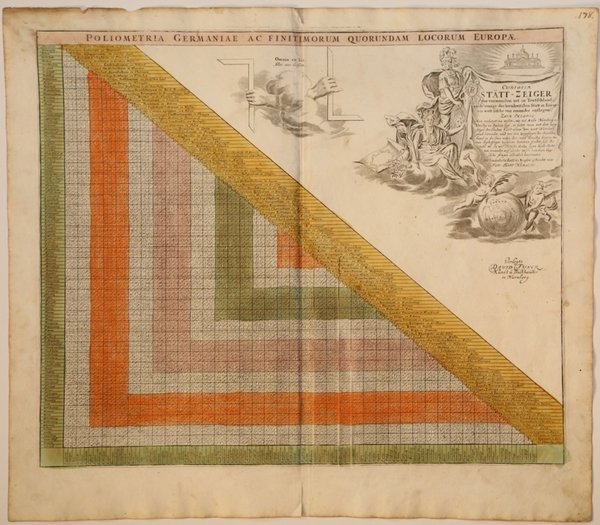

Poliometria Germaniae ac finimorum quorundam locorum Europae
Poliometria Germaniae ac finimorum quorundam locorum Europae | Stampe | HOMANN Johann Baptist
Metodi di Pagamento
- PayPal
- Carta di Credito
- Bonifico Bancario
- Pubblica amministrazione
- Carta del Docente
Dettagli
- Anno di pubblicazione
- 1716
- Luogo di stampa
- Norimberga
- Formato
- 590 X 500
- Incisori
- HOMANN Johann Baptist
Descrizione
Interessante grafico che indica le distanze tra le città tedesche e le principali città europee, realizzata da Homann per conto dell'editore David Funck, e quindi prima che Homann avviasse la sua attività editoriale. Molto decorativo il grande cartiglio decorativo allegorico, con in basso due putti accanto a un globo. Johann Baptist Homann è stato un geografo e cartografo tedesco; nel 1702 fondò la sua casa editrice. Homann acquisì fama come uno dei principali cartografi tedeschi, e nel 1715 fu nominato geografo imperiale dall'imperatore Carlo VI. Nello stesso anno fu anche nominato membro dell'Accademia Prussiana delle Scienze a Berlino. Nel 1716 Homann pubblicò il suo capolavoro Grosser Atlas ueber die ganze Welt. Numerose mappe furono redatte in collaborazione con l'incisore Christoph Weigel. Homann morì a Norimberga nel 1724. Gli successe suo figlio Johann Christoph (1703-1730). L'azienda continuò dopo la sua morte come azienda degli eredi Homann, gestita da Johann Michael Franz e Johann Georg Ebersberger. Dopo successivi cambiamenti nella gestione, l'azienda si sciolse nel 1852. ' Incisione in rame, coloritura coeva in ottime condizioni. Interesting thematic chart shows the traveling distances from various German and European cities. The sheet is richly embellished with a large title cartouche surrounded by allegorical figures and putti with a globe. David Funcke employed the young Homann as an engraver prior to the establishment of the Homann publishing empire. Johann Baptist Homann was a German geographer and cartographer; in 1702 he founded his own publishing house. Homann acquired renown as a leading German cartographer, and in 1715 was appointed Imperial Geographer by Emperor Charles VI. In the same year he was also named a member of the Prussian Academy of Sciences in Berlin. In 1716 Homann published his masterpiece Grosser Atlas ueber die ganze Welt; numerous maps were drawn up in cooperation with the engraver Christoph Weigel the Elder. Homann died in Nuremberg in 1724 and was succeeded by his son Johann Christoph (1703-1730). The company carried on upon his death as Homann heirs company, managed by Johann Michael Franz and Johann Georg Ebersberger. After subsequent changes in management the company folded in 1852. ' Copperplate, contemporary colors, in very good condition. Cfr.