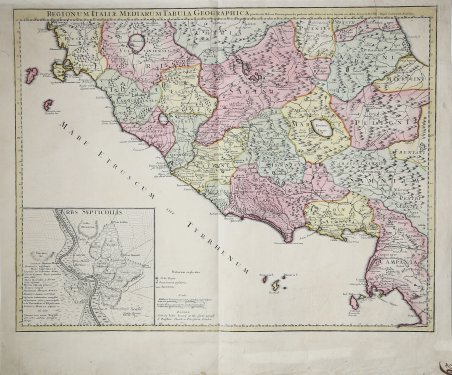
Regionum Italiae Mediarum Tabula Geographica.
Regionum Italiae Mediarum Tabula Geographica. | Stampe | SENEX John
Regionum Italiae Mediarum Tabula Geographica.
Regionum Italiae Mediarum Tabula Geographica. | Stampe | SENEX John
Metodi di Pagamento
- PayPal
- Carta di Credito
- Bonifico Bancario
- Pubblica amministrazione
- Carta del Docente
Dettagli
- Anno di pubblicazione
- 1712
- Luogo di stampa
- Londra
- Formato
- 600 X 470
- Incisori
- SENEX John
Descrizione
Regionum Italiae Mediarum tabula geographica pernoscendis Historiae Romanae primordiis praesertim utilis, sed et cui multa sequioris aevi addita. Auctore G. del'Isle, Regia Scientarum Academia. In basso a sinistra l’imprint editoriale: ' London Sold by Iohn Senex at the Globe against S. Dunstans Church in Fleetstreet London. Rara edizione inglese della carta dell’Italia centrale con Roma al centro del foglio di Guillaume de L’Isle. Un interessante inserto nell'angolo inferiore sinistro della carta illustra le caratteristiche topografiche e i primi insediamenti sui sette colli su cui fu fondata Roma (Urbs Septicollis). La carta non compare in nessuna delle edizioni dell’English Atlas ' della British Library (cfr. Shirley, II, pp. 938-943) e, pertanto, sembrerebbe essere una pubblicazione separata di Senex. L’indicazione del prezzo di vendita, posta alla fine del titolo, ' Sold by Iohn Senex over against St. Dunstans Church in Fleetstreet price 2.6, ' conferma che l’opera fosse posta in vendita singolarmente. John Senex (1678 – 1740) fu uno dei più importanti produttori di mappe ed editori inglesi della prima metà del XVIII secolo. Fu dapprima apprendista dell’importante libraio ed editore Robert Clavell, ma l’associazione con Jeremiah Seller e Charles Price lo portò alla carriera di geometra, cartografo, produttore di globi e di editore e venditore di carte geografiche. Il suo contributo allo sviluppo del commercio di mappe britannico fu tale che fu onorato (1728) dall’elezione a membro della Royal Society, sponsorizzata da alcuni dei più grandi scienziati del periodo. La sua carriera iniziale fu relativamente infelice; la società con Jeremiah Seller e Charles Price durò solamente 3 anni e si concluse con il fallimento, nel 1706. Da allora, fino a circa il 1710, lavorò solamente con Price, dal quale apprese e affinò l’arte incisoria. I due si dedicarono al progetto di un atlante del mondo, in concorrenza a quello del rivale Herman Moll. Quando la partnership terminò, Senex lavorò ad una propria raccolta cartografica, che venne pubblicata con il titolo di ' The English Atlas ' (1714); fu uno degli atlanti di maggior successo del secolo, venendo ristampato fino al 1760. Senex lavorò anche come incisore semi-ufficiale per la Royal Society, per il suo stampatore William Taylor, e per figure di spicco al suo interno, tra cui Edmund Halley e William Whiston. Pubblicò, quindi, diverse importanti mappe scientifiche, in particolare le mappe delle eclissi di Halley e Whiston (1715 e 1724). Questi suoi contatti scientifici gli fornirono essenziali ed innovativi elementi tecnici, utile per la sua vasta gamma di globi terrestri e celesti. Con queste solide fondamenta, Senex divenne il più prestigioso editore di mappe del tempo. Alla sua morte (1740) la tipografia venne diretta dalla vedova Mary, che continuò l’attività fino al 1755, quando si ritirò; William Herbert e Robert Sayer acquisirono i diritti per le opere cartografiche, mentre James Ferguson rilevò la parte che riguardava i globi. Acquaforte, finemente colorata a mano, in buono stato di conservazione. Regionum Italiae Mediarum tabula geographica pernoscendis Historiae Romanae primordiis praesertim utilis, sed et cui multa sequioris aevi addita. ' Auctore G. del'Isle, Regia Scientarum Academia. At lower left the imprint: ' London Sold by Iohn Senex at the Globe against S. Dunstans Church in Fleetstreet London. A rare English edition of Guillaume de l'Isle's map detailed map of the area of central eastern Italy around Rome, showing the regions in ancient times and including an inset map showing the seven hills of Rome. John Senex (1678 - 1740) was one of the most important English map makers and publishers of the first half of the 18th century. He was first apprenticed to the prominent bookseller and publisher Robert Clavell, but his association with Jeremiah Seller and Charles Price led him to a career as a surveyor, cartographer, globe maker, and map publisher and seller. His contribution to the development of the British map trade was such that he was honored (1728) by election to membership in the Royal Society, sponsored by some of the greatest scientists of the period. His early career was relatively unhappy; the society with Jeremiah Seller and Charles Price lasted only 3 years and ended in bankruptcy, in 1706. From then on, until about 1710, he worked only with Price, from whom he learned and refined the art of engraving. The two devoted themselves to the design of an atlas of the world, competing with that of rival Herman Moll. When the partnership ended, Senex worked on his own cartographic collection, which was published as The English Atlas (1714); it was one of the most successful atlases of the century, being reprinted until 1760. Senex also worked as a semi-official engraver for the Royal Society, for its printer William Taylor, and for prominent figures within it, including Edmund Halley and William Whiston. He then published several important scientific maps, most notably Halley and Whiston's eclipse maps (1715 and 1724). These scientific contacts of his provided him with essential and innovative technical elements, useful for his wide range of terrestrial and celestial globes. With this solid foundation, Senex became the most prestigious map publisher of the time. Upon his death (1740) the printing press was directed by his widow Mary, who continued the business until 1755, when she retired; William Herbert and Robert Sayer acquired the rights to the cartographic works, while James Ferguson took over the part dealing with globes. Copperplate with original colouring, good condition. Cfr.