Ritratto di vecchio rivolto a destra
Ritratto di vecchio rivolto a destra | Stampe | HERKOMER Hubert von
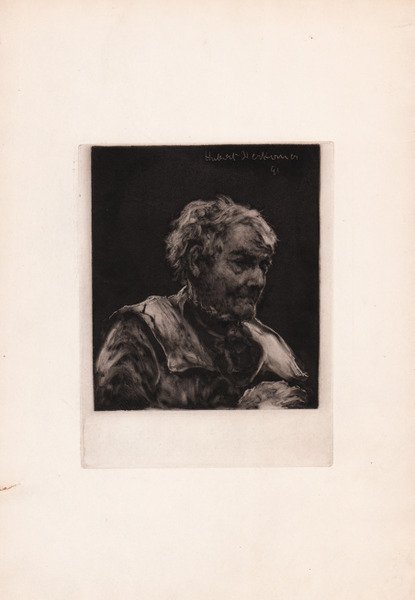
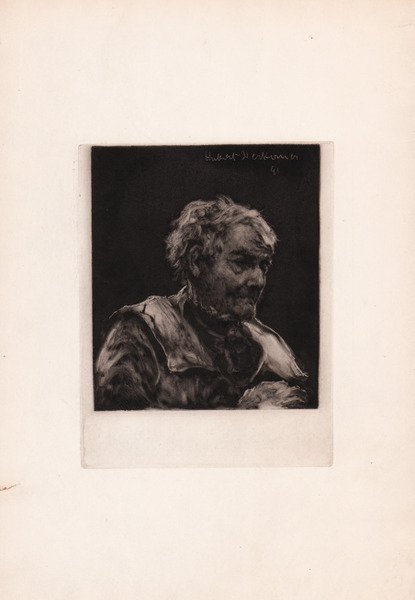
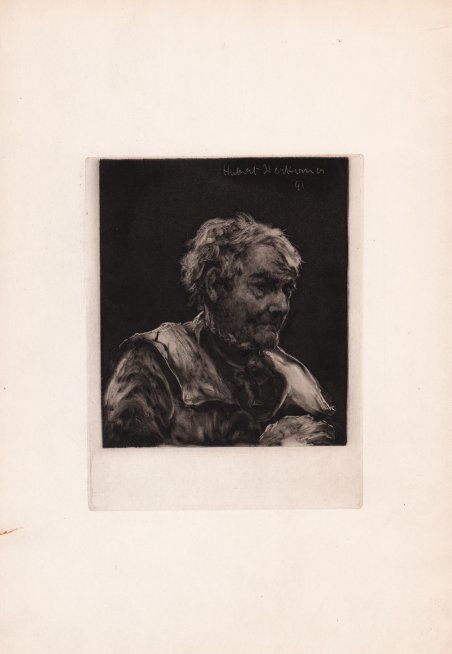
Ritratto di vecchio rivolto a destra
Ritratto di vecchio rivolto a destra | Stampe | HERKOMER Hubert von
Metodi di Pagamento
- PayPal
- Carta di Credito
- Bonifico Bancario
- Pubblica amministrazione
- Carta del Docente
Dettagli
- Anno di pubblicazione
- 1891
- Formato
- 125 X 160
- Incisori
- HERKOMER Hubert von
- Soggetto
- Scuola Inglese & Americana
Descrizione
Monotipo o herkomergravure, 1891, firmato e datato sulla lastra in alto a destra Hubert Herkomer '91. Una bella impressione, stampata su carta contemporanea, con margini, condizioni perfette. “Il monotipo è il mezzo di stampa più diretto. L'artista dipinge su una superficie liscia e impermeabile, mette un pezzo di carta bianca sopra il dipinto e applica una pressione in modo che l'immagine dipinta venga trasferita sulla carta. […] Durante il diciannovesimo secolo ci fu molto ingegno nel trovare un modo per gli stampatori di creare edizioni che fossero pittoriche come il monotipo. Generalmente, gli inventori sperimentavano un composto speciale che poteva essere applicato al dipinto dell'artista ancora umido, non appena eseguito su una lastra di rame. Quando la lastra veniva asciugata e galvanizzata, poteva essere inchiostrata come una lastra incisa e stampata più e più volte, fornendo la spontaneità del monotipo, ma con la ripetibilità di altri mezzi di stampa. Vari inventori inventarono processi simili, e alla fine del 1800 erano disponibili tre processi per coloro che desideravano fare una stampa che avesse alcune delle qualità visive di un monotipo, ma che potesse anche essere prodotta in un'edizione di stampe identiche: il galvanografo, l'elettrotinta e l'herkomergravure, dal nome del suo inventore, Hubert Herkomer (1849-1914). William Merritt Chase (americano, 1849-1916) introdusse Herkomer al processo del monotipo nel 1885. Herkomer sviluppò il suo processo nel 1897, ma ne scrisse per la prima volta nel 1892. Potrebbe essere stato nel 1902 che Herkomer ricambiò il favore di Chase introducendolo all'herkomergravure, quando Chase tornò in Inghilterra. Il processo implicava la spalmatura di inchiostro su una lastra di rame e la creazione dell'immagine con le dita e/o i pennelli, come nel processo del monotipo. Poi la lastra veniva spolverata con una combinazione di polveri speciali, asciugata e placcata. L'immagine risultante era un quasi monotipo" (cfr. Andrew Stevens, American Monotypes from the Baker/Pisano Collection, pp. 3-6). Sir Hubert von Herkomer era un artista britannico di origine tedesca, e anche un regista e compositore pioniere del cinema. Sebbene fosse un ritrattista di grande successo, soprattutto di uomini, è ricordato soprattutto per le sue prime opere che avevano un approccio realistico alle condizioni di vita dei poveri Bibliografia Herkomer, Hubert. Etching and Mezzotint Engraving: Lectures Delivered at Oxford. New York: Macmillan, 1892; Andrew Stevens, American Monotypes from the Baker/Pisano Collection, Exh. Cat., by Russell Panczenko, Andrew Stevens, and D. Frederick Baker, pp. 3-6. Monotype or herkomergravure, 1891, signed and dated on plate at the upper right Hubert Herkomer ’91. A fine impression, printed on contemporary wove paper, with margins, perfect condition. “Monotype is the most direct print medium. The artist paints on a smooth, impermeable surface, places a blank piece of paper on top of the painting, and applies pressure so that the painted image is transferred onto the paper. […] Through the nineteenth century there was much ingenuity expended on finding a way for printmakers to create editions that were as painterly as monotype. Generally, inventors came up with a special compound that could be applied to the still-wet artist’s painting executed on a copper plate. When the plate was dried and electroplated, it could then be inked like an etched or engraved plate and printed again and again, providing the spontaneity of the monotype, but with the repeatability of other print media. Various inventors came up with similar processes, and by the end of the 1800s three processes were available for those wishing to make a print that had some of the visual qualities of a monotype, but could also be produced in an edition of identical prints: the galvanograph, the electrotint, and the herkomergravure, named after its inventor, Hubert Herkomer (English, 1849–1914). Herkomer was a popular painter of portraits and social genre scenes, and an inveterate experimenter in the arts. William Merritt Chase (American, 1849–1916) introduced Herkomer to the monotype process in 1885. Herkomer developed his process by 1897, but first wrote about it in 1892. It may have been in 1902 that Herkomer returned Chase’s favor by introducing him to the herkomergravure, when Chase next returned to England. The process involved smearing ink onto a copper plate and creating the image with fingers and/or brushes, as with the monotype process. Then the plate was dusted with a combination of special powders, dried, and electroplated. The resulting image was a quasi-monotype” (cfr. Andrew Stevens, American Monotypes from the Baker/Pisano Collection, pp. 3-6). Sir Hubert von Herkomer was a German-born British artist, and also a pioneering film-director and composer. Though a very successful portraitist, especially of men, he is mainly remembered for his earlier works that took a realistic approach to the conditions of life of the poor. ' Bibliografia Herkomer, Hubert. ' Etching and Mezzotint Engraving: Lectures Delivered at Oxford. New ' York: Macmillan, 1892; Andrew Stevens, ' American Monotypes from the Baker/Pisano Collection, Exh. Cat., by Russell Panczenko, Andrew Stevens, and D. Frederick Baker, pp. 3-6. Cfr.