Tito Manlio
Tito Manlio | Stampe | GOLTZIUS Hendrick
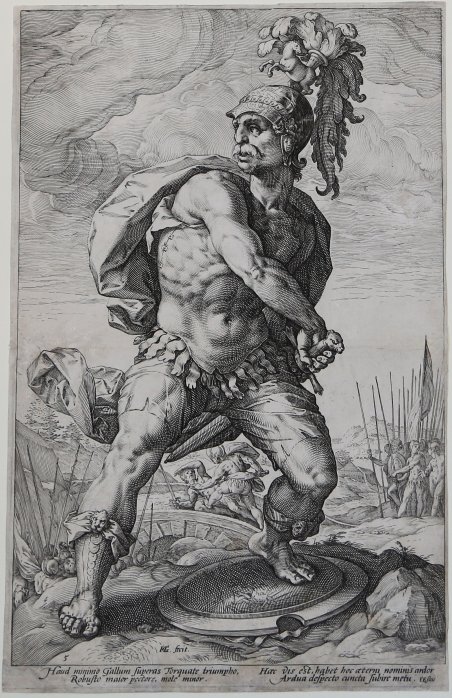
Tito Manlio
Tito Manlio | Stampe | GOLTZIUS Hendrick
Metodi di Pagamento
- PayPal
- Carta di Credito
- Bonifico Bancario
- Pubblica amministrazione
- Carta del Docente
Dettagli
- Anno di pubblicazione
- 1586
- Formato
- 232 X 368
- Incisori
- GOLTZIUS Hendrick
- Descrizione
- Hirschmann 1921 166; Hollstein 166.II; New Hollstein (Dutch & Flemish) 168.II (Hendrick Goltzius); Strauss 1977 235; Bartsch III.35.100.
Descrizione
Bulino, 1586, firmato in lastra, in basso a sinistra "HG. fecit." e numerato 5. Nel margine inferiore, due colonne con distici in latino di Franco Estius. Della seire “Eroi romani”.Bellissima prova, impressa su carta vergata coeva, con filigrana stemma coronato con giglio, completa oltre la linea del margine, piega di carta nella parte superiore del foglio e piccole e lievissimi ossidazioni in corrispondenza dello scudo, piccoli restauri nel margine inferiore e lungo il margine sinistro, per il resto in ottimo stato di conservazione.L’incisione raffigura l’eroe romano Tito Manlio Torquato a figura intera, nell’atto di sguainare la spada. Sullo sfondo, su un ponte, si distingue il leggendario episodio, narrato da Livio (Ab Urbe Condita, VII, 10) in cui Tito Manlio trionfò su un gigante Gallo, spogliandolo della collana, che a sua volta indossò e gli valse il soprannome di Torquato (da torques, collana).L’opera fa parte di una serie di dieci tavole, intitolata “Memorabilia aliquot Romana strenuitatitis exempla”, più nota come Gli Eroi Romani, che consiste di 8 rappresentazioni di eroi, numerate 1-8, un frontespizio e una tavola allegorica finale non numerata.L’opera, dedicata da Goltzius all’imperatore Rodolfo II, venne pubblicata ad Haarlem nel 1586. Tutte le tavole recano versi in latino, scritti dall’umanista e neolatinista Franco Estius. Engraving, 1586, signed on plate in lower left corner "HG. fecit." and numbered "5". Beautiful example, printed on contemporary laid paper with watermark “crowned coat of Arms with fleur-de-Lis”, trimmed to the paltearm, small expert reapairs at the left sideand at the lower right corner, otherwise in good condition.With two columns of text, each two lines "Haud minimo Gallum . subire metu" provided by Franco Estius. From the series Memorabilia aliquot Romanae strenuitatis exempla, better known as “The Roman Heroes”.The hero Titus Manlius Torquatus, whole-length, wearing a plumed helmet, leaning back with one foot on a shield and drawing his sword from its scabbard. In the background you can see how he defeats a gigantic Gaul on a bridge.In 361 BC, Titus Manlius fought in the army of Titus Quinctius Poenus against the Gauls The Gauls had a giant among them, who - presenting himself as the champion of his tribe - bragged about his force and invincibility, and challenged the Roman commander Manlius. In single combat, Manlius slaughtered his opponent. He took the dead giant's gold collar and wore it himself, which lead to his second (nick)name Torquatus (torques meaning collar).This print is part of a series of ten prints, consisting of an unnumbered titlepage, eight numbered representations of heroes and an unnumbered final print.The series, printed in Haarlem in 1586 was dedicated to Emperor Rudolph II. Cfr. Hirschmann 1921 166; Hollstein 166.II; New Hollstein (Dutch & Flemish) 168.II (Hendrick Goltzius); Strauss 1977 235; Bartsch III.35.100.