Velinum aere expressum per Fossam Curianam nunc Clementinam in Narem defluentem Interamnatium.
Velinum aere expressum per Fossam Curianam nunc Clementinam in Narem defluentem Interamnatium. | Stampe | ANTONINI Carlo
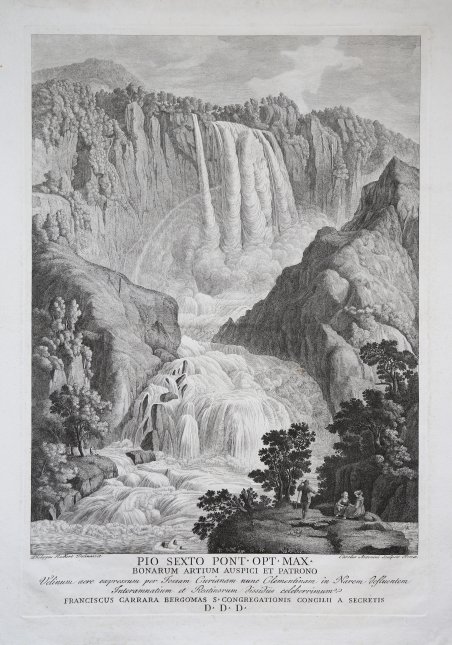
Velinum aere expressum per Fossam Curianam nunc Clementinam in Narem defluentem Interamnatium.
Velinum aere expressum per Fossam Curianam nunc Clementinam in Narem defluentem Interamnatium. | Stampe | ANTONINI Carlo
Metodi di Pagamento
- PayPal
- Carta di Credito
- Bonifico Bancario
- Pubblica amministrazione
- Carta del Docente
Dettagli
- Anno di pubblicazione
- 1790
- Luogo di stampa
- Roma
- Formato
- 420 X 610
- Incisori
- ANTONINI Carlo
Descrizione
Magnifica veduta della Cascata del Velino detta delle Marmore, incisa da Carlo Antonini (1740- 1821) da un acquarello di Jacob Philipp Hackert (1737-1807). La stampa è firmata in lastra, in basso a destra, da Carlo Antonini che, a sinistra, annota il nome del disegnatore della composizione, Jacob Philipp Hackert; sotto la parte figurata è posta una lunga dedica a papa Pio VI, firmata da Francesco Carrara, fratello del conte Giacomo e colto prelato che, nel 1775, era stato nominato Segretario della Congregazione del Concilio a Roma. Nel 1779 Francesco Carrara presentò al papa una dissertazione dedicata alle Cascate di Terni, intitolata "La caduta del Velino nella Nera"; e forse in quella occasione commissionò a Carlo Antonini questa incisione. Il disegno preparatorio, affidato al celebre paesista Philipp Hackert, è stato identificato con un foglio conservato presso il Kunstmuseum di Dusseldorf [Penna e inchiostro nero, pennello e lavaggio marrone, con gouache bianche e grafite; foglio: 52.2 x 39.9 cm]. Vista la dedica al Pontefice Pio VI, regnante dal 1775 al 1799, è da ritenersi questo il periodo di datazione più probabile per l'esecuzione di questa stampa. Carlo Antonini era molto legato al mecenatismo pontificio ed incise anche una serie di ritratti di cardinali per la "Storia dell'Abazia di Nonantola" del Tiraboschi Influenzato dai paesaggi di Claude Lorrain e dagli artisti olandesi del XVII secolo, il tedesco Jakob Philipp Hackert fu uno dei più grandi artisti di paesaggio con sede a Roma fine XVIII secolo. I suoi precisi rendering di siti belli e storici hanno attirato una clientela internazionale durante il Grand tour europeo. Questo disegno finito raffigura uno dei fenomeni naturali più spettacolari d'Italia Attraverso la tecnica dell'acquaforte, ma anche dell'acquerello e dell'olio su tela, gli artisti settecenteschi sono stati dei veri e propri reporter dell'epoca in grado di raccontare angoli di Roma e della sua provincia in maniera appassionata, completa e affascinante. Pittori entrati in contatto con Angelika Kauffman, artista svizzera specializzata nei ritratti che visse a lungo nella Capitale, in Via Sistina, assieme al secondo marito Antonio Zucchi. Attorno a lei si creò una vera e propria cerchia di intellettuali e artisti che transitando in Italia, non perdevano occasione di andarla a trovare. Friedrich Wilhelm Gmelin, Joseph Anton Koch, Johann Christian Reinhart e molti altri hanno immortalato, come vere e proprie fotografie, le Terme di Caracalla, l'Arco di Costantino, il Foro Romano, le basiliche di San Giovanni e di Santa Maria Maggiore con gli occhi di chi si trova davanti, per la prima volta, un paesaggio del tutto inedito e sconosciuto eppure toccante, dinanzi a cui il vero artista riesce ad esprimersi al meglio. È al pennello di Jacob Philipp Hackert che invece dobbiamo alcune delle più belle vedute della provincia romana, come "La cascata dell'Aniene a Tivoli" del 1769 o "Le cascate del Velino", realizzate tra il 1790 e il 1799. Suo anche "Il tempio della Sibilla a Tivoli", acquaforte del 1780 circa. Acquaforte, impressa su carta vergata coeva, con margini, eccellente stato di conservazione. Bibliografia Il paesaggio secondo natura, Jacob Philipp Hackert e la sua cerchia, A cura di: Paolo Chiarini, 1994, p. 216, n. 59. Magnificent view of the Velino Waterfall known as the Marmore Falls, engraved by Carlo Antonini (1740- 1821) from a watercolor by Jacob Philipp Hackert (1737-1807). The print is signed on the plate, lower right, by Carlo Antonini, who, on the left, notes the name of the draughtsman of the composition, Jacob Philipp Hackert; below the figured part is a long dedication to Pope Pius VI, signed by Francesco Carrara, brother of Count Giacomo and a learned prelate who, in 1775, had been appointed Secretary of the Congregation of the Council in Rome. In 1779 Francesco Carrara presented the pope with a dissertation dedicated to the Waterfalls of Terni, entitled "La caduta del Velino nella Nera"; and perhaps on that occasion he commissioned Carlo Antonini to make this engraving. The preparatory drawing, entrusted to the famous landscape painter Jacob Philipp Hackert, has been identified with a sheet preserved at the Kunstmuseum Dusseldorf [Pen and black ink, brush and brown wash, with white gouache and graphite; sheet: 52.2 x 39.9 cm]. Given the dedication to Pope Pius VI, who reigned from 1775 to 1799, this should be considered the most likely dating period for the execution of this print. Carlo Antonini was close to papal patronage and also engraved a series of portraits of cardinals for Tiraboschi's "Storia dell'Abazia di Nonantola". This work recalls the words written by the artist's close friend, Johann Wolfgang von Goethe, who declared that an artist should "give his work of art a content and a form through which it appears both natural and beyond Nature." Influenced by the landscapes of Claude Lorrain and seventeenth-century Dutch artists, the German Jakob Philipp Hackert was one of the most successful landscape artists based in late 18th-century Rome. His precise renderings of beautiful and historic sites attracted an international clientele on the European grand tour. This finished drawing depicts one of Italy's most spectacular natural phenomena, the Marmore waterfall at Terni, located north of Rome. Hackert carefully crafted the composition so that the detailed cliffs covered with foliage frame the tiered cascade from its soaring heights to its final emptying in the foreground. Hackert was known for traveling to the countryside on foot with large portfolios so that he could execute complete wash drawings like this one directly in nature. He probably drew this scene during one such sketching tour in 1776, or 1778. Through the technique of etching, as well as watercolor and oil on canvas, eighteenth-century artists were true reporters of the period capable of recounting corners of Rome and its province in passionate, comprehensive and fascinating ways. Painters came into contact with Angelika Kauffman, a Swiss artist specializing in portraits who lived for a long time in the capital, in Via Sistina, together with her second husband Antonio Zucchi. Around her was created a real circle of intellectuals and artists who, passing through Italy, did not miss an opportunity to visit her. Friedrich Wilhelm Gmelin, Joseph Anton Koch, Johann Christian Reinhart and many others immortalized, as true photographs, the Baths of Caracalla, the Arch of Constantine, the Roman Forum, the basilicas of St. John and St. Mary Major with the eyes of those who find themselves before, for the first time, a completely unseen and unknown yet touching landscape, before which the true artist is able to express himself at his best. It is to the brush of Jacob Philipp Hackert, on the other hand, that we owe some of the most beautiful views of the Roman province, such as "The Waterfall of the Aniene at Tivoli" of 1769 or "The Falls of the Velino," made between 1790 and 1799. Also his is "The Temple of the Sibyl at Tivoli," an etching from around 1780. Etching, printed on contemporary laid paper, with margins, excellent condition. Bibliografia Il paesaggio secondo natura, Jacob Philipp Hackert e la sua cerchia, A cura di: Paolo Chiarini, 1994, p. 2. Cfr.