Adm.Bacon,THE JUTLAND SCANDAL,1930[Navy,Marina,storia militare,battaglia,WW1
Adm.Bacon,THE JUTLAND SCANDAL,1930[Navy,Marina,storia militare,battaglia,WW1 | Libros antiguos y modernos |



Adm.Bacon,THE JUTLAND SCANDAL,1930[Navy,Marina,storia militare,battaglia,WW1
Adm.Bacon,THE JUTLAND SCANDAL,1930[Navy,Marina,storia militare,battaglia,WW1 | Libros antiguos y modernos |
Formas de Pago
- PayPal
- Tarjeta de crédito
- Transferencia Bancaria
- Pubblica amministrazione
- Carta del Docente
Detalles
Descripción
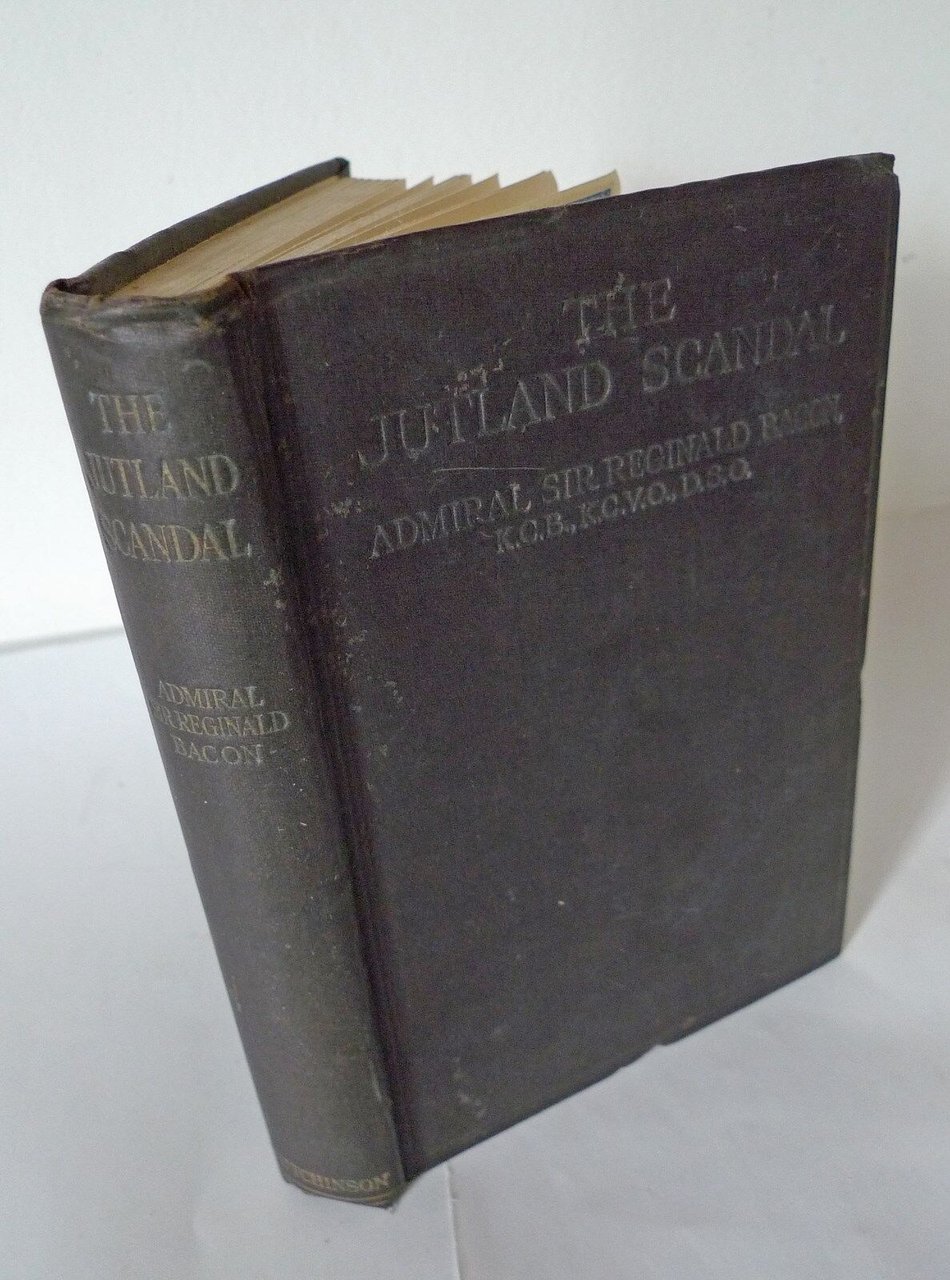
THE JUTLAND SCANDAL,
By Admiral Sir Reginald Bacon,
K.C.B. K.C.V.O., D.S.O.,
WITH 41 DIAGRAM.
LONDON: HUTCHINSON & CO. PATERNOSTER ROW,
senza data (anni '30?),
FOURTH EDITION,
copertina rigida, 19x13 cm., pp.151,
con 41 diagrammi,
testo in inglese,
peso: g.300
CONDIZIONI DEL LIBRO: ottime,
ex libris incollato alla prima pagina,
ex biblioteca (etichetta collocazione
e numeri a matita e a penna
in II di copertina e in prima pagina)
CONTENTSAuthor's Note .... . VII
PART I
I —The First Essential 1
In
Navy—Difficulty of grasping gradual progress—Ignorance of the British public
in Naval matters—How records of the old Navy cloud present-day vision—Jutland
and consequent disappointment—Belief largely a matter of preconception—Dis-
passionate study of the late war recommended—Simile with animal warfare—Commerce—
Commercial War—Its similarity with physical war—Necessity for the avoidance of
gambling— Love of human-beings of records of valour—When to encourage and
discourage excess of valour—War a business proposition.
:: —Nelson and his Times 8
Conditions in 1805—Reasons for French decadence at sea—Battle of the first of
June—Nelson—How Nelson of 1900 would differ from Nelson of 1800—His character—Unerring
judgment in action— Battle of St. Vincent—Battle of the Nile—Foley’s action—
Nelson’s action—Who doubled the line ?—Copenhagen—Nelson v. Nelsonic spirit—
Single-mindedness—His loyalty to his Commanders-in- Chief—Nelson touch—
Nelson and the Grand Fleet.
III —Ships, Guns, Torpedoes, Armour, Projectiles,
Submarines and Mines . . . .21
The Iron Duke compared with the Victory—The battleship—The armoured cruiser—
The light cruiser—The Destroyer—Guns— Development since Trafalgar—Long range
hitting—Ranging and observation of fire—The predominating value of gunnery—
The torpedo in action against a line of ships—The torpedo and its progress—When
ships chase—Destroyer attacks—Armour—Its progress—Difficulty of testing armour
and shell—The cause of the loss of our battle cruisers—Submarines—The proper
tactics to defeat submarine attacks—Mines in battle.
CHAPTER PAGE
IV.—A Few Simple Manœuvres . 37
How the ships of a fleet are arranged—Simplest form for cruising in wartime—
For battle—How ships are spaced apart—Deployment—How fleets are sidled towards
or away from an enemy— —Gun fire and tactics—How the guns of a ship are arranged—
Limits to the direction in which guns can be fired—How this limits the approach
of ships—Crossing the T—Tactical advantage and disadvantage—Direct deployment—
Definition of chasing.
PART II
V.—General Description of the Battle of
Jutland 50
Phase I. : The cruiser action—Phase II. : The loss of the Defence and Invincible—
Phase III. : The battlefleet action—The deployment—Had the deployment been on
the Western Division— How the German fleet was cut off from the Horn Reef—
The first smack—The second smack—The night—Escape of the German fleet.
VI.—Phase I.: The Battle Cruiser Action . 57
The German plan—Admiralty information—The fleet put to sea— The battle cruisers
sight the German cruisers—The dispersion of our cruiser fleet—The effect of not
closing up the fighting units —Action commenced—Loss of Indefatigable—5 th Battle
Squadron come into action—Loss of Queen Mary—Gallant Destroyer attack—
The German battlefleet sighted—The run North.
VII.—Phase II.: 66
Commodore Goodenough—Activities of the Invincible—The Chester in action—Invincible
damages German ships—Torpedo attack— Action of our destroyers—Gallant action of
the Shark—Gallantry of Commander Loftus Jones—Lieutenant-Commander Tovey of the
Onslow—The loss of the Defence—Narrow escape of the War- spite—Loss of the Invincible—
False impression of the situation conveyed to the German Admiral.
VIII.—Phase III.: The Battlefleet Action . 72
Deployment—Scouting—Errors in the position of the Battleship Fleet and Battle Cruiser
Fleet—Failure of Admiral Beatty to keep touch with the German battlefleet—Admiral
Jellicoe's consequent difficulty—The account given by the Official History—The
arguments for the deployment—How the enemy's T was crossed— The enveloping movement—
The argument against a general chase —The second smack—Sacrifice of the German battle
cruiser—The Destroyer attack—Admiral Beatty's signal re cutting off the enemy—
Its uselessness—The disposition for the night.
CONTENTS xvIX . Phase IV.: The Night Action ... 88
Destroyers' work at night—The pariah of the sea—Possible courses of the High Sea
Fleet—Conflicting telegrams and reports—Failure of Malaya and Valiant—Good work
of the Faulkenor—Sinks the Pommern—Escape of the High Sea Fleet—Destroyer actions
during the night—Commodore Tyrwhitt—His start and recall— Admiralty reasons.
PART III
X.-The Admiralty Narrative . . . . 101
Interest aroused—Sir Rosslyn Wemyss’s committee—Report suppressed -Unreliability
of memory—Rumours—Jutland Papers issued -Admiralty Narrative sent to Lord Jellicoe—
My association -Issue of the Narrative—Disappointment—Official History of the War—
Example of omission—Unfair statements regarding Lord Jellicoe—Unfair statements
regarding Rear-Admiral Evan Thomas—By whose authority ?—Effect on the Navy.
XI. -The Origin of the Book .... 109
Admiral Scheer's criticism of the Daily Express correspondent— Extracts from Mr.
Filson Young’s article, with explanatory notes -The “leader" on the article, with
explanatory notes.
XII.-The “If” that Sticks .... 119
The Admiralty telegrams—Effect on the public—Their disappointment -Critics of Lord
Jellicoe—Jutland not a glorious victory— Unfortunate treatment of the history of
Jutland by the Admiralty Lord Beatty’s failure to support his late Commander-in-Chief—
Comparison of Lord Jellicoe and Lord Beatty—Their pre-war experience—Mr. Churchill’s
reason for appointing Lord Beatty to command the Battle Cruiser Squadron—
Performance of Lord Jellicoe in War—Lord Beatty’s performance—His failures —
Training of the fleet—Failure of the Battle Cruisers in gunnery and in signal
efficiency—Conclusions drawn.
Appendix A.—Remarks on Closing up the Battle
Cruiser Fleet 141
Appendix B.—Some Further Remarks on the
Dogger Bank Action . . . .142
Appendix C.—The Break-through of the German
Fleet at Night 145
Appendix D.—Synopsis of British and German
Losses at the Battle of Jutland . 147
Index . . 149