Questo sito usa cookie di analytics per raccogliere dati in forma aggregata e cookie di terze parti per migliorare l'esperienza utente.
Leggi l'Informativa Cookie Policy completa.

Sei in possesso di una Carta del Docente o di un Buono 18App? Scopri come usarli su Maremagnum!

Libros antiguos y modernos

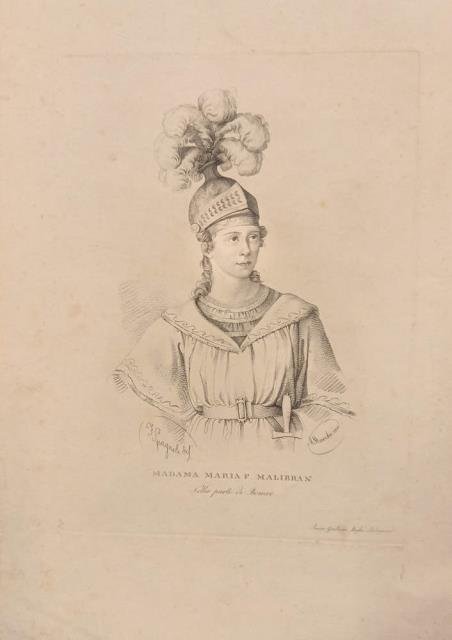
Incisione originale raffigurante la cantante lirica Maria F. Malibran nella parte di Romeo. (1832).

Presso Guglielmo Righi, 1832

220,00 €

Pera Studio Bibliografico

(Lucca, Italia)

Habla con el librero

Formas de Pago

Detalles

Año de publicación
1832
Lugar de impresión
Bologna
Editores
Presso Guglielmo Righi
Materia
MUSICA, STAMPE, INCISIONI, DISEGNI.
Sobrecubierta
No
Conservación
Bueno
Encuadernación
Tapa blanda
Copia autógrafa
No
Condiciones
Usado

Descripción

Incisione su rame in formato cm.34x23,5 incisa da A. Marchi da un disegno di F. Spagnoli. La celebre cantante viene raffigurata nel costume di scena di Romeo nell'opera "I Capuleti e i Montecchi" di Vincenzo Bellini. Bel ritratto a mezzobusto del grande soprano Maria Malibran (nata María Felicia García Sitches; Parigi, 24 marzo 1808 – Manchester, 23 settembre 1836), una delle voci più importanti della lirica del XIX secolo. "In the autumn of 1832, when Maria Malibran (1808–36) was at the height of her fame—recognized widely as one of the most accomplished and exciting prima donnas touring the international operatic circuit—she arrived at Bologna’s Teatro Comunale where she took on the trousers role of Romeo in Bellini’s I Capuleti e i Montecchi (Venice, 1830) for the first time. No different from other celebrated singers of her era, Malibran was accustomed to approaching unfamiliar scores with a sense of freedom, making use of aria insertions when necessary. What she and her co-star Giuliettas did with the final scene of I Capuleti e i Montecchi, the “tomb scene,” however, was extraordinary: they eliminated all of Bellini’s music and replaced it with the corresponding scene from the older, but still popular, Giulietta e Romeo by Nicola Vaccai (Milan, 1825). Like many other substitutions that occurred within the bel canto repertory, this one did not disappear when the final curtain of the season was drawn. Following the Bologna production, Malibran played Romeo on at least five other occasions, each time trading in Bellini’s music for Vaccai’s. What is more, beginning as early as 1833 other divas began to follow her lead, performing the opera “alla Malibran.” Librettos reveal that nearly two thirds of all productions between 1833 and 1857 featured the Vaccai ending. The practice of replacing Bellini’s music with Vaccai’s had become so common, in fact, that a piano-vocal score published by Ricordi includes Vaccai’s scene in an appendix. A note prefacing it reads: “To be substituted, if desired, as is generally done, for the last scene of Bellini’s opera” (Hilary Poriss sul sito "Musicology Now"). > Arrigoni, Bertarelli, 2511. Codice libreria 163780.
Logo Maremagnum es