Popular Sovereignty and the Crisis of German Constitutional Law: The Theory and Practice of Weimar Constitutionalism
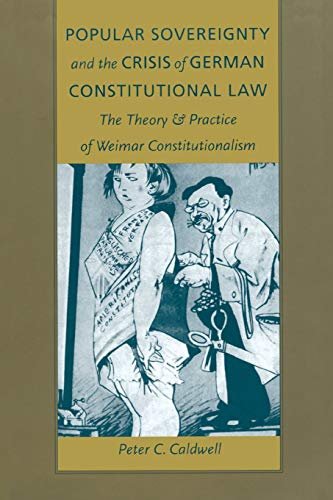
Popular Sovereignty and the Crisis of German Constitutional Law: The Theory and Practice of Weimar Constitutionalism
Formas de Pago
- PayPal
- Tarjeta de crédito
- Transferencia Bancaria
- Pubblica amministrazione
- Carta del Docente
Detalles
- Autor
- Caldwell Peter C.
- Editores
- Duke University Press 1997
- Descripción
- S
- Sobrecubierta
- False
- Conservación
- Como nuevo
- Encuadernación
- Tapa blanda
- Copia autógrafa
- False
- Primera edición
- False
Descripción
8vo, br. ed. pp.318. Popular Sovereignty and the Crisis of German Constitutional Law is a historical analysis of competing doctrines of constitutional law during the Weimar Republic. It chronicles the creation of a new constitutional jurisprudence both adequate to the needs of a modern welfare state and based on the principle of popular sovereignty. Peter C. Caldwell explores the legal nature of democracy as debated by Weimarís political theorists and constitutional lawyers. Laying the groundwork for questions about constitutional law in todayís Federal Republic, this book draws clear and insightful distinctions between strands of positivist and anti-positivist legal thought, and examines their implications for legal and political theory. Caldwell makes accessible the rich literature in German constitutional thought of the Weimar period, most of which has been unavailable in English until now. On the liberal left, Hugo Preuss and Hans Kelsen defended a concept of democracy that made the constitution sovereign and, in a way, created the "Volk" through constitutional procedure. On the right, Carl Schmitt argued for a substantial notion of the "Volk" that could overrule constitutional procedure in a state of emergency. Rudolf Smend and Heinrich Triepel located in the constitution a set of inviolable values of the political community, while Hermann Heller saw in it a guarantee of substantial social equality. Drawing on the work of these major players from the 1920s, Caldwell reveals the various facets of the impassioned constitutional struggles that permeated German legal and political culture during the Weimar Republic.
