Libros antiguos y modernos
ENSCHEDÉ, Johannes (1708-1780)
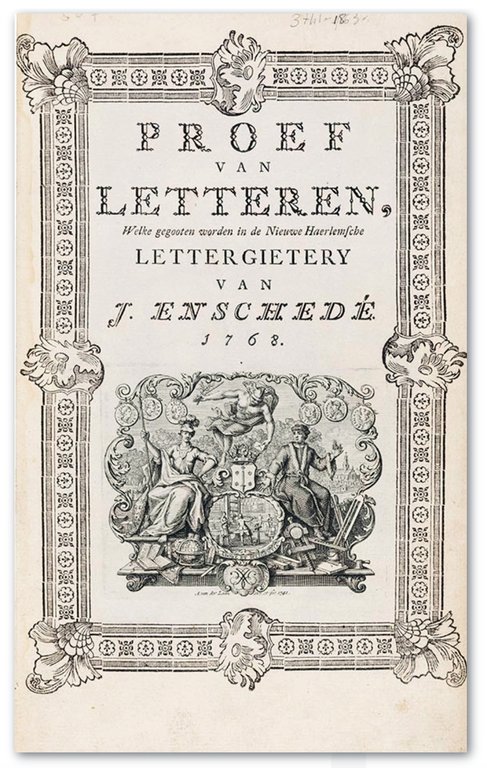
Proef van Letteren, welke gegooten worden in de Nieuwe Haerlemsche Lettergietery van J. Enschedé
J. Enschedé, 1768
3800,00 €
Govi Libreria Antiquaria
(Modena, Italia)
Los gastos de envío correctos se calculan una vez añadida la dirección de envío durante la creación del pedido. El vendedor puede elegir uno o varios métodos de envío: standard, express, economy o in store pick-up.
Condiciones de envío de la Librería:
Para los productos con un precio superior a 300 euros, es posible solicitar un plan de pago a plazos al Maremagnum. El pago puede efectuarse con Carta del Docente, Carta della cultura giovani e del merito, Administración Pública.
Los plazos de entrega se estiman en función de los plazos de envío de la librería y del transportista. En caso de retención aduanera, pueden producirse retrasos en la entrega. Los posibles gastos de aduana corren a cargo del destinatario.
Pulsa para saber másFormas de Pago
- PayPal
- Tarjeta de crédito
- Transferencia Bancaria
-
-
 Descubre cómo utilizar
tu Carta del Docente -
 Descubre cómo utilizar
tu Carta della cultura giovani e del merito
Detalles
Descripción
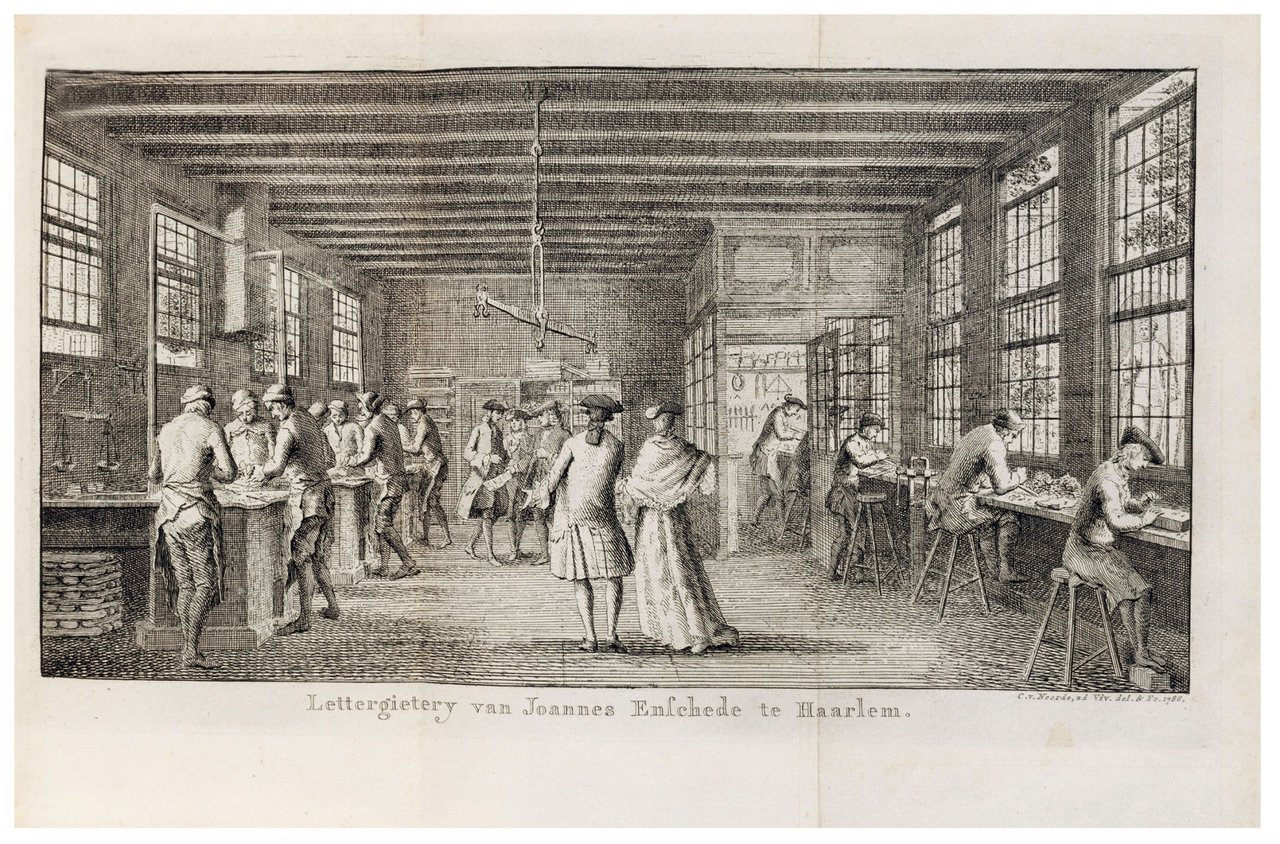
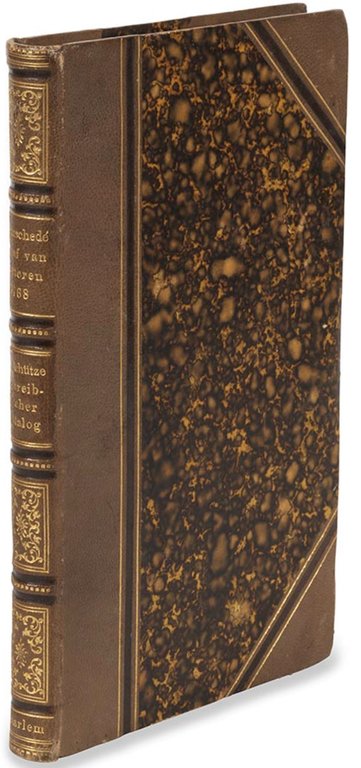
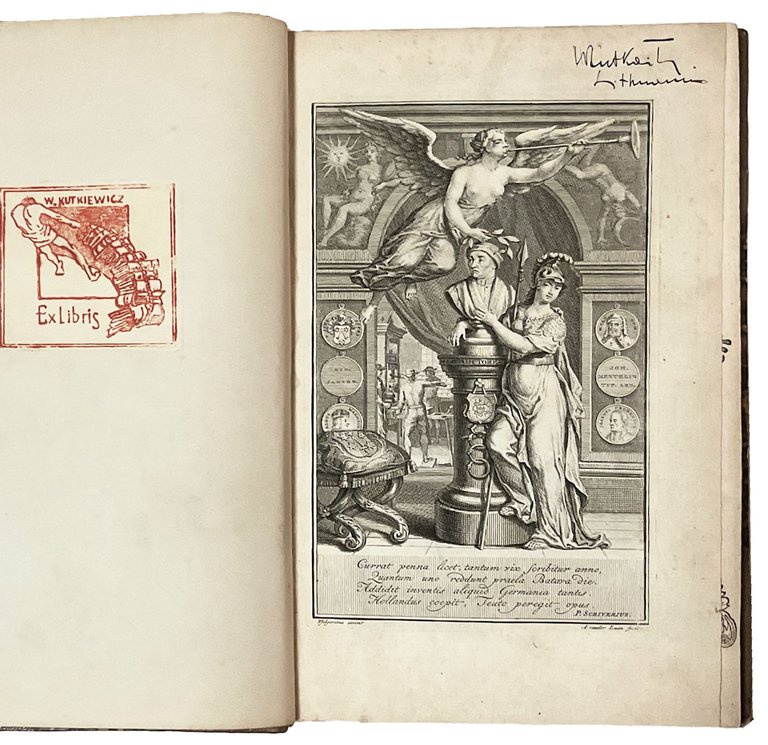
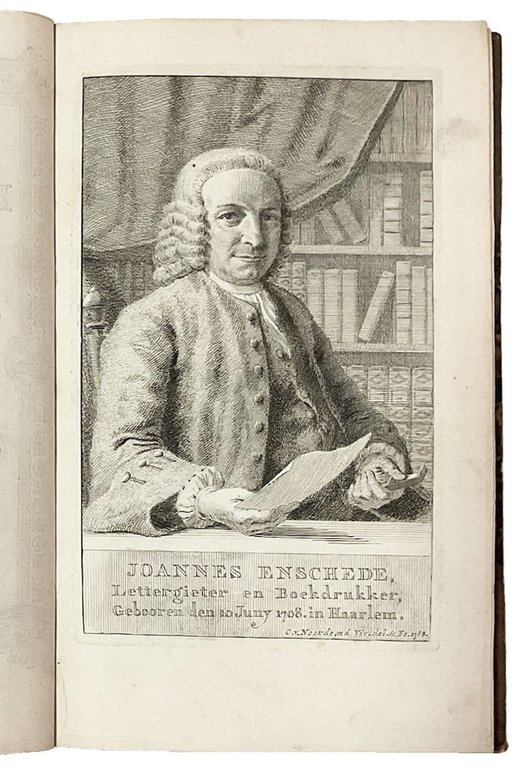
Large 8vo (212x127 mm). Ornamental frontispiece engraved by A. van der Laan after Taco Hajo Helgersma, title page with engraved vignette by A. van der Laan, engraved portrait of Johann Enschedé by C. van Noorde, 2 engravings of the statues of Lourens Janszoon Coster and Adrianus Junius, [32] pp. of introduction, engraved portrait of Johann Michael Fleischmann by C. van Noorde dated 1769, [74] leaves of specimens printed on recto only (includign the often missing ‘Canon Hebreeuwsch'), engraving of another statue of Coster by A. van der Laan after Jelgersma, [4] leaves of supplement with additional specimens printed on recto only (Oude Hollandse letteren zynkde eerstellingen der Boek-Drukkonst), 8 pp. (Lyst der Pryzen), engraved folding view by C. van Noorde of the interior of Enschedé's typefoundry workshop, dated 1768. The preface is printed in Fleischmann's cursive script. Title page and each page within a woodcut border. 19th-century half morocco, richly gilt spine, marbled pastedowns. On the front pastedown bookplate Andrzeja Awiuszewskiego, on the front flyleaf verso bookplate W. Kutkiewicz printed in red, and on the frontispiece later ownership entry. A very good copy.
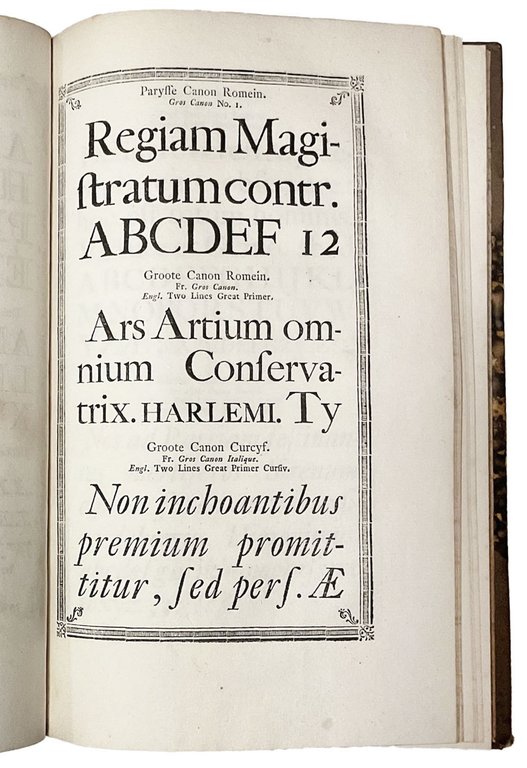
First edition of this beautiful type specimen sample book showcasing the designs of the type founder Johann Martin Fleischmann. Fleischmann worked for the Enschedé type foundry from 1743 onwards and created antique typefaces and Gothic letters. The former were of great importance in the development of printed typefaces, particularly the ‘Enschedé typeface' he designed, which strongly influenced the development of printing types in England.
“This is a very interesting and fine specimen-book of all the characters then in the Enschedé foundry. It contains finely-engraved copperplate portraits of the printer J. Enschedé; Junius, the propagator of the Koster legend; another of the celebrated type-cutter, Fleischman; and one of Koster, all being by C. van Noorde. It also gives the view of the two statues of Koster and Junius which Enschedé placed in his own garden, and which still remain there. At the end is a large view of the principal room of the foundry. The titles of the founts are given in Dutch, French, English, and German” (Bigmore & Wyman).
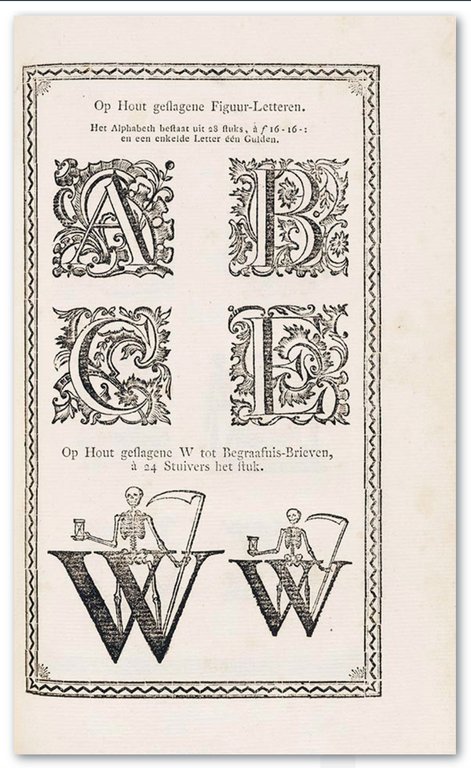
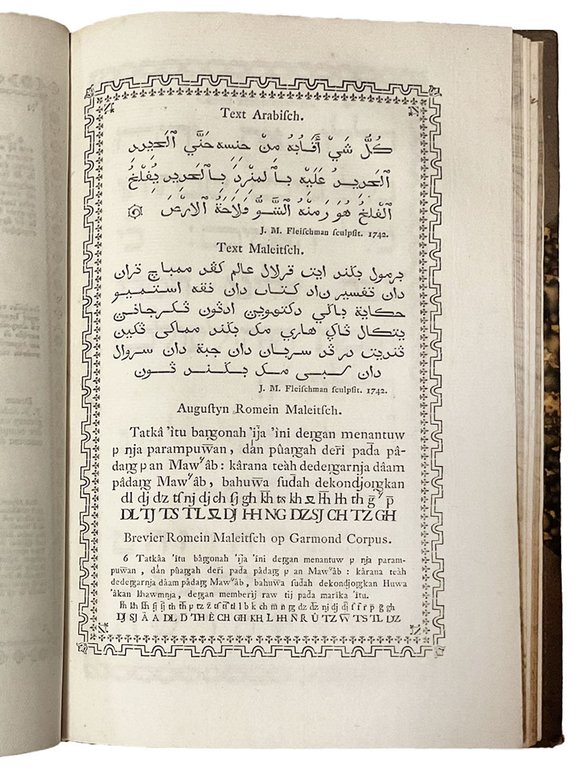
The book includes specimens of music types, capital letters, exotic fonts (Greek, Arabian, Hebrew and Armenian), typographical ornaments and black-letter types of the fifteenth and sixteenth centuries. J.M. Fleischmann died just before the publication of the book, and his work and merits are described at length in the foreword by J. Enschedé.
“Fleischman, a German, was employed by the Enschedes in the eighteenth century to cut types for their foundry, and his signature is found beneath many fonts shown in their specimen-books. In his hands their output was somewhat changed, though not much bettered. His types are singularly devoid of style, and usually show a drift toward the thinner, weaker typography which was coming in Holland as everywhere else. But Fleischman's work was much the fashion in the eighteenth century, and it made such excellent fonts as Van Dyck's appear hopelessly obsolete. In 1810, when Didot type was the mode, Van Dyck's matrices and types were, without much thought, thrown into the meltingpot -a “gesture” no doubt regretted by later members of the Enschedé family. Various books and broadside specimens of types and ornaments were published by the Enschedés. One of the earliest books was the Epreuve des Caractècres, qui se fondent dans la Nouvelle Fonderie de Lettres d'Isaac et Jean Enschedé à Haarlem. Augmentée & perfectionée jusquà lìAn 1744. The preface alludes to the abilities of Rudolph Wetstein as a printer and type-founder, and mentions that the Enschedés bought his foundry in 1743; Wetstein having died the year before. The Greek types are mentioned with special pride; and the deep cutting of counters, and
