Regole della Thoscana lingua di M. Vincentio Menni Perugino, con un Breve modo di Comporre varie sorti di Rime
Regole della Thoscana lingua di M. Vincentio Menni Perugino, con un Breve modo di Comporre varie sorti di Rime | Libros antiguos y modernos | MENNI, Vincenzo (d. 1570)

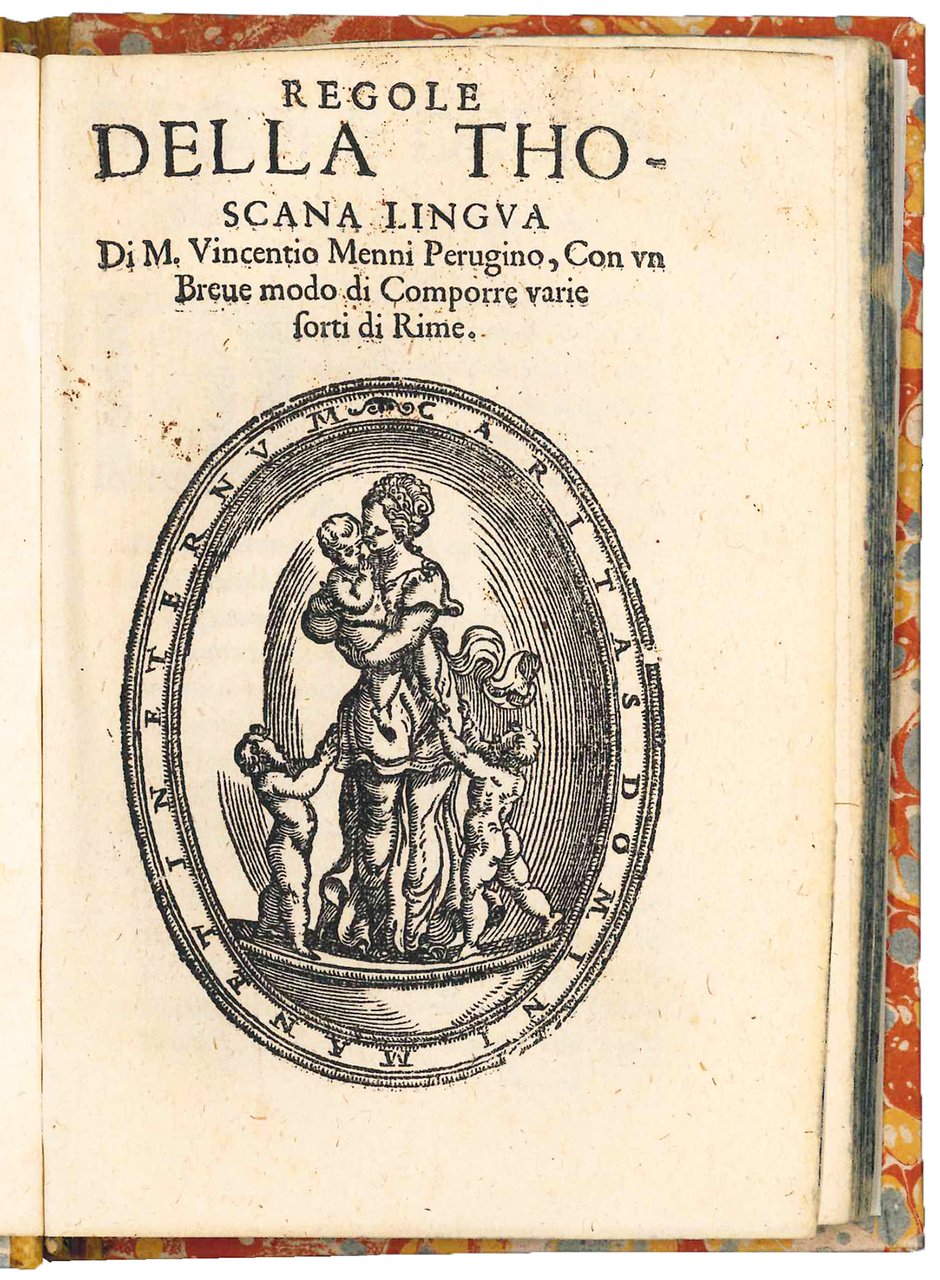


Regole della Thoscana lingua di M. Vincentio Menni Perugino, con un Breve modo di Comporre varie sorti di Rime
Regole della Thoscana lingua di M. Vincentio Menni Perugino, con un Breve modo di Comporre varie sorti di Rime | Libros antiguos y modernos | MENNI, Vincenzo (d. 1570)
Formas de Pago
- PayPal
- Tarjeta de crédito
- Transferencia Bancaria
- Pubblica amministrazione
- Carta del Docente
Detalles
- Año de publicación
- 1568
- Lugar de impresión
- Perugia
- Autor
- MENNI, Vincenzo (d. 1570)
- Editores
- Andrea Bresciano
- Materia
- Quattro-Cinquecento
- Conservación
- Bueno
- Idiomas
- Italiano
- Encuadernación
- Tapa dura
- Condiciones
- Usado
Descripción
RARE ITALIAN GRAMMAR PRINTED IN PERUGIA
8vo (154x103 mm). 38, [2] leaves. Collation: A-K4. The last leaf is a blank. Large woodcut printer's on the title page and at the end. Colophon on l. K3r. Modern quarter vellum, panel covered in marbled paper, blue edges. Some marginal staining towards the end, small lack of paper to the lower blank margin of l. E4, otherwise a good copy.
First and only edition of this compendium of the third book of Pietro Bembo's Prose (1525). Of the Prose, Menni preserves the wording of grammatical terms and all the criteria, but goes to the point of specifying which vowels are superior and which are inferior. One issue is taken from Tolomei's Cesano, namely that which refers to the exception of certain words ending in a consonant rather than a vowel (in, con, per, etc.). Just as Petrarch is the model of the ancients, so Sannazzaro and Bembo are the “luminaries of modern poetry.” The author's intention is to reduce the complex rules of the Tuscan language into a short manual, intended for readers who are not familiar with Latin grammar. An addition at the end contains brief precepts on how to compose various types of rhyme (cf. C. Trabalza, Storia della grammatica italiana, Milan, 1908, p. 133).
“En tout cas, toscano s'impose dès lors pour désigner la langue littéraire, un succès remarquable. Corso (Fondamenti del parlar Thoscano), premier non Toscan à employer l'adjectif en titre de sa grammaire, Tani (Avertimenti sopra le regole Toscane con la Formatione de Verbi, & variation delle voci), Florio (Regole della lingua thoscana), Alessandri (Il paragone della lingua toscana et castigliana), Menni (Regole della thoscana lingua, con un breve modo di comporre varie sorti di rime), plus tard, Salviati (Regole della toscana favella) et Guazzo (Avertimenti intorno allo scriver thoscano) - outre Tolomei (Il Cesano de la lingua toscana) - reprennent tous toscano, à l'instar de del Rosso, tandis que Giambullari, en bon académicien florentin, préfère le terme fiorentino: De la lingua che si parla et scrive in Firenze, alias Regole della lingua fiorentina (précédées en 1549 de Origine della lingua fiorentina, altrimenti Il Gello, Firenze, Torrentino). Nous voilà donc face à un phénomène qui tient du paradoxe: les seuls auteurs qui ne manquent jamais de préciser dans le titre que leur ouvrage traite de grammaire toscane (ou éventuellement florentine) sont justement ceux qui auraient pu s'em dispenser, à savoir les Toscans […], alors que, inversement, les grammairiens issus des autres régions d'Italie, longtemps n'ont pas jugé utile une telle indication géographique, ou l'ont délibérément évitée, avant de s'y rallier par la suite” (L. Vallance, Les grammairiens italiens face à leur langue (XVe-XVIe s.), Berlin-Boston, 2019, pp. 44-45 and 22).
Menni is also known for having translated the Bucolics (Perugia, Bianchini, 1544) and the first six books of Virgil's Aeneid (Perugia, Bresciano, 1558-1567) into the vernacular.
Edit 16, CNCE46959; USTC, 842062; A. Quondam, Nascita della grammatica: appunti e materiali per una descrizione analitica, in: “Quaderni Storici”, 13, no. 38 (2), 1978, p. 591.