Sopra il turbine che la notte tra gli XI, e XII Giugno del MDCCXLIX danneggiò una gran parte di Roma dissertazione del P. Ruggiero Giuseppe Boschovich della Compagnia di Gesù [...]
Sopra il turbine che la notte tra gli XI, e XII Giugno del MDCCXLIX danneggiò una gran parte di Roma dissertazione del P. Ruggiero Giuseppe Boschovich della Compagnia di Gesù [...] | Libros antiguos y modernos | BOSCOVICH, Ruggiero Giuseppe (1711-1787)
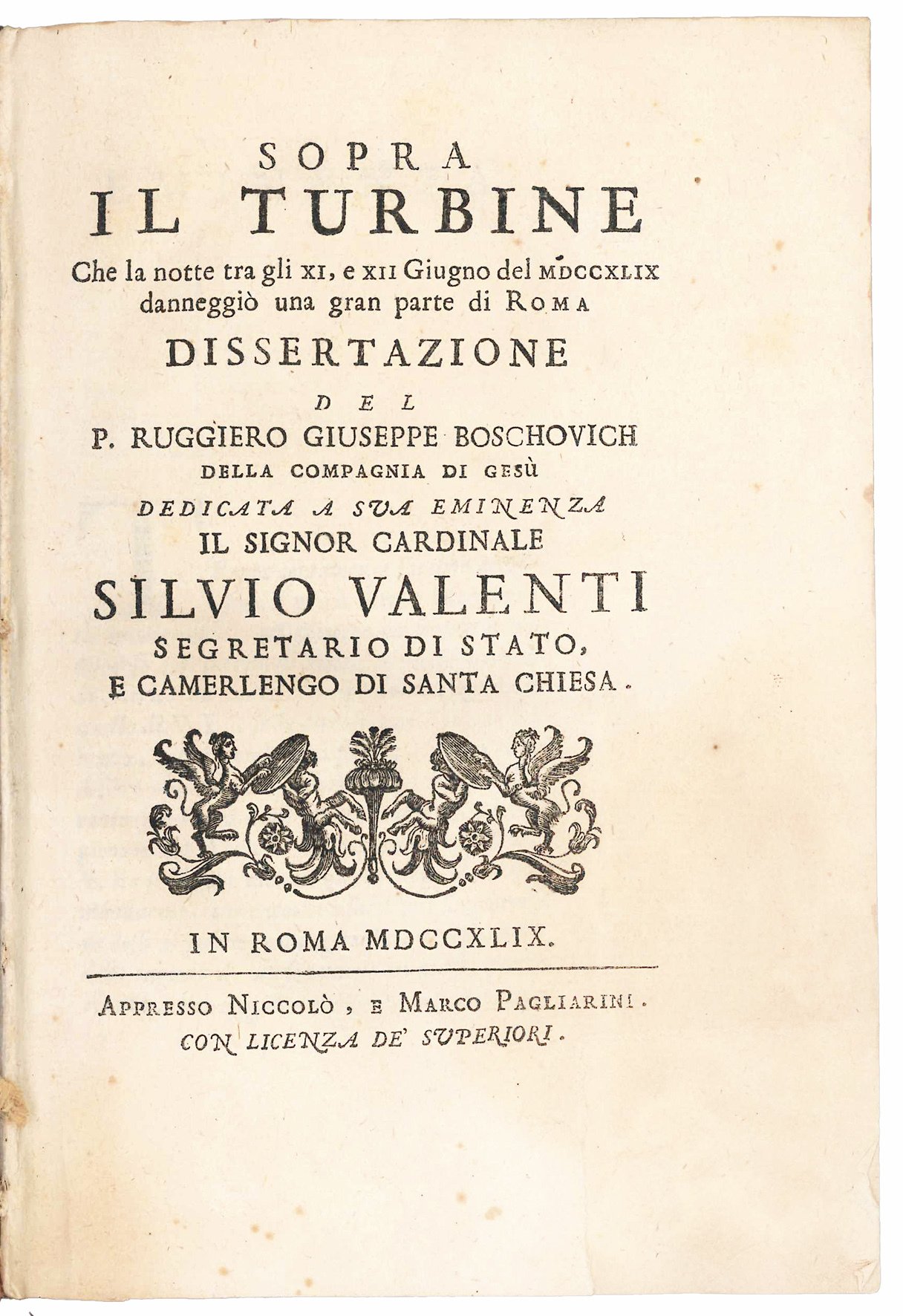
Sopra il turbine che la notte tra gli XI, e XII Giugno del MDCCXLIX danneggiò una gran parte di Roma dissertazione del P. Ruggiero Giuseppe Boschovich della Compagnia di Gesù [...]
Sopra il turbine che la notte tra gli XI, e XII Giugno del MDCCXLIX danneggiò una gran parte di Roma dissertazione del P. Ruggiero Giuseppe Boschovich della Compagnia di Gesù [...] | Libros antiguos y modernos | BOSCOVICH, Ruggiero Giuseppe (1711-1787)
Formas de Pago
- PayPal
- Tarjeta de crédito
- Transferencia Bancaria
- Pubblica amministrazione
- Carta del Docente
Detalles
- Año de publicación
- 1749
- Lugar de impresión
- Roma
- Autor
- BOSCOVICH, Ruggiero Giuseppe (1711-1787)
- Editores
- Niccolò & Marco Pagliarini
- Materia
- settecento
- Conservación
- Bueno
- Idiomas
- Italiano
- Encuadernación
- Tapa dura
- Condiciones
- Usado
Descripción
8vo (206x142 mm). 224, [8] pp. The last leaf is a blank. Woodcut ornament on the title page. Woodcut initials, head- and tail-pieces. Later cardboards. Small restoration to the title page not affecting the text, some pale staining and browning, overall a good copy with wide margins.
First edition of this scientific text in which the author describes the damage caused to Rome by a tornado that struck the city on the night of 11-12 June 1749, and analyses the movement and characteristics of tornadoes in terms of Stephen Hales' theory of “fixed air”.
Ruggero Boscovich (Ruder Josip Boskovic) was born in Dubrovnik, at the time called Ragusa. His father was Serbian, his mother was from Bergamo, Italy. He had his first education at the Collegium Ragusinum, directed by Italian Jesuits. Then, in 1725, he was sent as a novice to the Roman college of S. Andrea delle Fratte. Three years later he moved to the Collegio Romano and started teaching logic and mathematics, taking the chair that had beloned to his teacher, O. Borgondio. In the following years he published many writings on physics, mathematics and astronomy, becoming the major supporter of Newton in his order. In 1744, when he was ordained, Boscovich was already a renowned scientist all over Europe. In 1746 he became a member of the Bologna Academy and in 1748 of Académie Française. Between 1750 and 1752 he made several geodetic surveys with the aim of drawing up a map of the territory of the Pope's state and measuring the meridian arc between Rome and Rimini.
From 1757, probably due to friction with some brothers of his order, Boscovich was gradually removed from teaching and employed only for diplomatic missions. In that year he was sent to Vienna as a representative of the Lucchesi in a dispute over hydraulic works against the Florentines, who had sent as their expert father Leonardo Ximenes. His stay at the Habsburg court went on for over a year. In Vienna in 1758 Boscovich published his masterpiece, the Philosophiae naturalis theoria redacta ad unicam legem virium in natura existentium, a work that marks the birth of atomic physics. In 1759 he visited Paris and Versailles, and made the acquaintance of the encyclopedists, with whom he shared a mutual hostility. In 1760 he arrived in England, where he was welcomed by the English scientific word and accepted as a member by the Royal Society. In 1761 he was sent by the Royal Society to Constantinople to observe the transit of Venus scheduled for September that year. Boscovich arrived too late, but remained on the Bosphorus for over six months, then in 1762, bound for St. Petersburg, he reached Warsaw. In 1763 he was back in Rome.
In 1764 Boscovich was appointed professor of mathematics and astronomy at the University of Pavia and undertook the construction of the new Brera observatory, of which he became the director. In 1768 he moved to the Palatine Schools in Milan. In 1773, when his order was suppressed, he resigned from all his positions and moved to Paris, where he started working for the French navy. In 1782 Boscovich came back to Italy, spending his last years in Pescia, Florence, Bassano, and Milan, where he died on February 1787 (cf. Z. Marcovic, Ruder Josip Boskovic, in: “Dictionary of Scientific Biography”, Ch.C. Gillespie, ed., New York, 1970, II, pp. 326-332).
Italian Union Catalogue, IT\ICCU\UFIE\003005; Riccardi, I, pp. 176-177; Roberts & Trent, p. 44.