Adorazione dei Magi
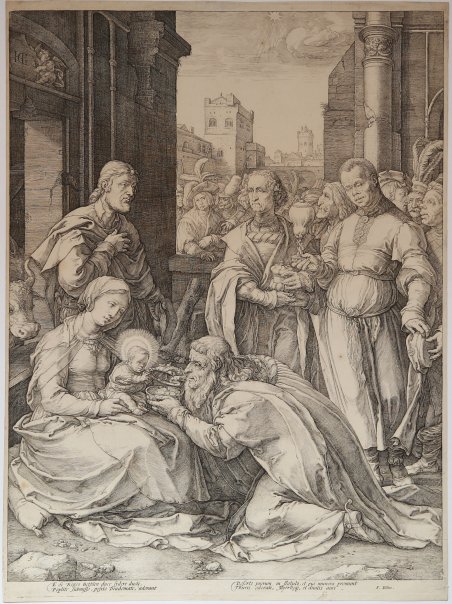
Adorazione dei Magi
Formas de Pago
- PayPal
- Tarjeta de crédito
- Transferencia Bancaria
- Pubblica amministrazione
- Carta del Docente
Detalles
- Año de publicación
- 1594
- Formato
- 350 X 460
- Grabadores
- GOLTZIUS Hendrick
Descripción
Bulino, 1593, firmata con il monogramma in alto a sinistra nell'immagine HG. Terzo stato, di cinque, con il numero 5 aggiunto in basso a sinistraSplendido esemplare, impresso su carta vergata contemporanea, con filigrana “giglio e armi di Strasburgo” (simile a Briquet 22244), margini sottili, alcune pieghe di carta, nel complesso in ottimo stato di conservazione. Dalla serie "La vita della Vergine"Per questa scena, Goltzius segue la maniera di Lucas van Leyden In questo caso, la somiglianza con il modello è molto vicina. Il principale cambiamento è la scelta del formato verticale al posto di quello orizzontale di Van Leyden. Pertanto, la qualità narrativa è meno pronunciata. La coppia principale - la Vergine e il Cristo bambino - è quasi identica nelle due rappresentazioni, così come il volto del Re Nero. Hirschmann osserva che Goltzius ha preso il volto del secondo re dalla versione di van Leyden per il suo Mago inginocchiato. Hirschmann, inoltre, considera questa lastra come l'ultima della serie in ordine di esecuzione. Ma poiché i versi sono ancora una volta, di F. Estius, sembra più probabile che questo foglio sia stato prodotto prima dei due seguenti, che recano versi di Shonaeus.Al verso, timbro di collezione di Albert Van Look (L.3752). Engraving, 1593, signed with monogram at upper left in the image HG. Third state, of five, with the numberal 5 added on the lower leftMagnificient example, printed on contemporary laid paper, with “Fleur-de-lis and Arms of Strasbourg” (similar to Briquet 22244), thin margins, some paper folds generally in very good condition.From the series “Life of Virgin”By following the manner of Lucas van Leyden for this scene from the life of the Virgin, Goltzius presents the fourth example of an engraving in the style of a famous artist. In this instance, the similarity to the model is very close. The principal change is the choice of a vertical format instead of van Leyden's horizontal one. Therefore, the narrative quality is less pronounced. The main pair - the Virgin and the Infant Christ- is almost identical in the two renderings, as is the countenance of the Black King. Hirschmann observed that Goltzius took the face of the second king from van Leyden's version and used it for his own kneeling Magus. He is critical of the narrow-waisted figures, not found in Lucas van Leyden's works. Moreover, Goltzius' customarily exquisite burin work, in this instance, seems to gloss over the somewhat dry and silvery quality that distinguishes Lucas engravings from those of Dürer. Hirschmann attributed these "shortcomings" to a hurried execution of this sheet, perhaps in order to complete this series in time for the Frankfurt Fair For this reason, he considered this subject the last of the series in order of execution. But because the verses are once more, and for the last time in the series, by F. Estius, it seems more likely that this sheet was produced before the following two, which bear verses by Shonaeus.Collection mark of Albert Van Look (L.3752) on verso. Cfr. Bartsch, 19; Strauss, n. 320 p. 582
