Allegoria della Musica e della Pittura
Allegoria della Musica e della Pittura | Grabados | WAGNER Joseph (Giuseppe)
Allegoria della Musica e della Pittura
Allegoria della Musica e della Pittura | Grabados | WAGNER Joseph (Giuseppe)
Formas de Pago
- PayPal
- Tarjeta de crédito
- Transferencia Bancaria
- Pubblica amministrazione
- Carta del Docente
Detalles
- Año de publicación
- 1739
- Formato
- 385 X 310
- Grabadores
- WAGNER Joseph (Giuseppe)
Descripción
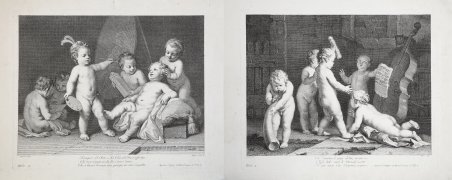
Coppia di incisioni allegoriche firmate da Joseph Wagner, tratte da due celebri dipinti di Jacopo Amigoni, stampate a Venezia dallo stesso Wagner verso il 1739/40. a) Allegoria della Musica Acquaforte e bulino, firmata in lastra in basso a destra. Iscrizioni: “De’ bambini il vagir addita e insegna / Ch’il dolce suon de musicali accenti / Né più teneri cuor s’imprime, e regna.”, “Amiconi Pinx.”, “Wagner Sculp.”, “N°67.1”, “Appresso J. Wagner in Merz. Venetia C.P.E.S.”. b) Allegoria della Pittura Acquaforte e bulino, firmata in lastra in basso a destra. Iscrizioni: “Lunga è l’Arte, e la Vita al Fin s’affretta. / Chi non comincia da suoi tener’anni / Che a buon termin mai giunga, in van s’aspetta.”, “Amigoni Pinx.”, “Wagner Sculp.”, “N°67.2”, “Appresso J. Wagner in Merz. Venetia C.P.E.S.” “Nel 1739 George Vertue (1684-1756) scriveva nei suoi Note books: “Joseph Wagner engrever […] lately he has engraved two plates a sheet each representing several Boyes – very freely and well done masterly” (Vertue ed. 1951-52). Il poligrafo inglese si riferiva a due stampe tratte da dipinti di Jacopo Amigoni (1682-1752), raffiguranti le allegorie della Musica e della Pittura, che sarebbero dunque state eseguite durante la permanenza di Wagner a Londra, ma che ci sono note solo nei successivi stati stampati a Venezia. Le tavole sono un perfetto manifesto di quell’ “enfance répendue partout”, caratteristica peculiare dell’estetica rococò. Nella prima i protagonisti sono cinque puttini intenti a cantare e a suonare, mentre nella seconda vediamo un novello Apelle che, circondato da assistenti, ritrae Campaspe adagiata un cuscino. Splendidi i dettagli del gatto appollaiato sul mobile che fissa lo spettatore dalla penombra e del bambino che sistema con cura l’acconciatura alla modella. I dipinti del veneziano vennero battuti all’asta a Londra nel 1979 (Christie’s 4.51979, lotto 18): la Musica ora si trova in una collezione privata di Reggio Emilia, mentre la Pittura fa parte della collezione del conte di Wemyss a Gosford House (Manfredi 2004). Un’altra versione di quest’ultima, che presenta però alcune differenze compositive, faceva parte della collezione bolognese del cantante Farinelli (1705-1782), amico intimo di Amigoni (Scarpa Sonino 1994). Wagner riesce, utilizzando una vasta gamma di segni e modulando la morsura, a ricreare i toni vellutati tipici della pittura del veneziano e si dimostra abile nella resa del morbido chiaroscuro che caratterizza i prototipi. È certo che a un certo punto questi fogli vennero stampati Venezia assieme ad altre due incisioni raffiguranti la Sacra Sindone con quattro angioletti e Gesù bambino dormiente, accomunabili a queste per la presenza di bambini come soggetti, ma molto diverse per quanto riguarda la tematica. Delle incisioni si conoscono due stati, il primo che presenta i numeri di serie “e.1” ed “e.2”, con i quali esse si trovano catalogate assieme alle due incisioni sopra citate, sotto il titolo “Puttini di Amiconi”, nel catalogo di vendita stampato prima del 1760 (Griffiths 1993) e il secondo che presenta invece i numeri di serie caratterizzati dal “67” con i quali le troviamo inventariate, sempre con le altre due stampe, nel secondo Cattalogo delle Stampe, pubblicato dopo il 1768” (cfr. Chiara Lo Giudice, Joseph Wagner incisore e imprenditore nell’Europa del Settecento, pp. 253-255). Le incisioni sono assolutamente rare; come riportato dalla tesi della Lo Giudice che descrive gli esemplari noti nelle collezioni: Braunschweig, Herzog Anton Ulrich-Museum, inv. JWagner AB 3.55-3.56; Londra, Victoria & Albert Museum, inv. 26756 e 24961.2; Venezia, Museo Correr, inv. Correr 11 n. 4417 e 5 n. 1512. Magnifiche prove, impresse su carta vergata coeva, con margini, leggera piega di carta centrale nell’allegoria dell’arte, matita sanguigna la verso a ricalco delle incisioni, per il resto. Pair of allegorical engravings signed by Joseph Wagner, taken from two famous paintings by Jacopo Amigoni, printed in Venice by Wagner himself around 1739/40. (a) Allegory of Music. Etching and engraving, signed in plate at lower right. Inscriptions: " De’ bambini il vagir addita e insegna / Ch’il dolce suon de musicali accenti / Né più teneri cuor s’imprime, e regna.”, “Amiconi Pinx.”, “Wagner Sculp.”, “N°67.1”, “Appresso J. Wagner in Merz. Venetia C.P.E.S.”. (b) Allegory of Painting. Etching and engraving, signed in plate at lower right. Inscriptions: “Lunga è l’Arte, e la Vita al Fin s’affretta. / Chi non comincia da suoi tener’anni / Che a buon termin mai giunga, in van s’aspetta.”, “Amigoni Pinx.”, “Wagner Sculp.”, “N°67.2”, “Appresso J. Wagner in Merz. Venetia C.P.E.S.” In 1739, George Vertue (1684-1756) wrote in his Note books, "Joseph Wagner engrever [.] lately he has engraved two plates a sheet each representing several Boyes - very freely and well done masterly" (Vertue ed. 1951-52). The English polygraph was referring to two prints taken from paintings by Jacopo Amigoni (1682-1752), depicting the allegories of Music and Painting, which would thus have been executed during Wagner's stay in London, but are known to us only in the later printed states in Venice. The plates are a perfect manifesto of that "enfance répendue partout," a characteristic feature of Rococo aesthetics. In the first the protagonists are five cherubs intent on singing and playing music, while in the second we see a novice Apelle who, surrounded by assistants, portrays Campaspe reclining a pillow. The details of the cat perched on the furniture staring at the viewer from the half-light and the child carefully arranging the model's hairstyle are splendid. The Venetian's paintings were auctioned in London in 1979 (Christie's 4.51979, lot 18): the Music is now in a private collection in Reggio Emilia, while the Painting is part of the Earl of Wemyss's collection at Gosford House (Manfredi 2004). Another version of the latter, which has some compositional differences, however, was part of the Bologna collection of the singer Farinelli (1705-1782), a close friend of Amigoni (Scarpa Sonino 1994). Wagner succeeds, by using a wide range of marks and modulating the morsure, in recreating the velvety tones typical of the Venetian's painting and proves adept at rendering the soft chiaroscuro that characterizes the prototypes. It is certain that at some point these sheets were printed Venice along with two other engravings depicting the Holy Shroud with four little angels and the sleeping infant Jesus, comparable to these in the presence of children as subjects, but very different in subject matter. Two states are known of the engravings, the first having the serial numbers "e.1" and "e.2 ", with which they are found catalogued together with the two above-mentioned engravings, under the title "Puttini di Amiconi," in the sales catalog printed before 1760 (Griffiths 1993), and the second that presents instead the serial numbers characterized by "67" with which we find them inventoried, again with the other two prints, in the second Cattalogo delle Stampe, published after 1768 (cf. Chiara Lo Giudice, Joseph Wagner engraver and entrepreneur in eighteenth-century Europe, pp. 253-255). The prints are absolutely rare; as reported in Lo Giudice's thesis describing known examples in collections: Braunschweig, Herzog Anton Ulrich-Museum, inv. JWagner AB 3.55-3.56; London, Victoria & Albert Museum, inv. 26756 and 24961.2; Venice, Museo Correr, inv. Correr 11 no. 4417 and 5 no. 1512. Magnificent proofs, printed on contemporary laid paper, with margins, slight central paper crease in art allegory, sanguine pencil the verso tracing the engravings, otherwise in very good condition. Bibliografia Chiara Lo Giudice, Joseph Wagner incisore e imprenditore nell’Europa del Settecento, pp. 253-255, n. Cfr.