Allegoria della Religione
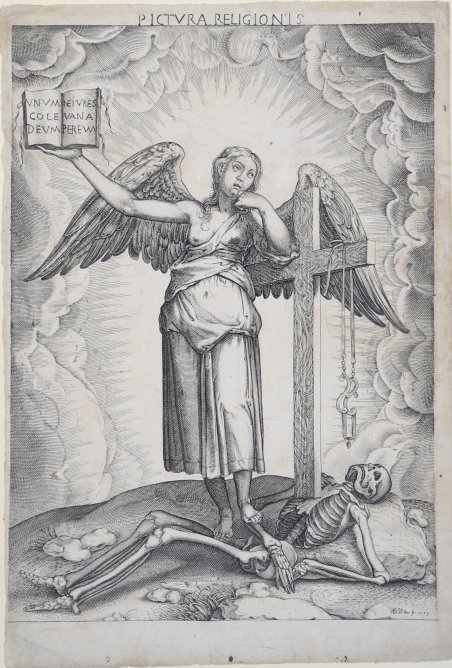
Allegoria della Religione
Formas de Pago
- PayPal
- Tarjeta de crédito
- Transferencia Bancaria
- Pubblica amministrazione
- Carta del Docente
Detalles
- Año de publicación
- 1597
- Formato
- 315 X 220
- Grabadores
- VITUS Domenico
Descripción
Acquaforte, 1597, firmata in lastra in basso. Bellissima prova, impressa su carta vergata coeva, con margini, in ottimo stato di conservazione.Eseguita nel clima della Controriforma, l’opera è fortemente simbolica e rappresenta una personificazione della religione cristiana. In sembianze femminili e circondata da aureola, la Religio tiene con la mano destra un volume aperto, su cui sono incisi il primo e il secondo dei Comandamenti. Il suo abbigliamento è semplice, a indicare il disprezzo per gli eccessi mondani; il seno nudo a esprimere la purezza. Il gomito è appoggiato alla croce, da cui pende una briglia, simbolo della passione e resurrezione di Cristo quali elementi guida della chiesa e della vita cristiana. Sotto i suoi piedi, la morte, a indicare la vittoria del bene sul male, della luce sulle tenebre. La tecnica esecutiva è volutamente essenziale, in quanto la finalità dell’opera non è estetica ma didattica. L’attenzione dello spettatore deve essere tutta rivolta al messaggio della figura, non alla sua bellezza estetica. È interessante notare che, la stessa iconografia ricorre in incisioni di maestri fiamminghi contemporanei, come Pieter Baltens e Crispijn de Passe I, documentando in tal modo la circolazione culturale tra il Nord Europa e l'Italia. Degno di nota è il fatto che l'immagine della Religio ha le sue origini in un emblema protestante contenuto nella seconda edizione dei Poemata di Theodore de Bèze, il successore di Calvino. Molto poco si conosce della vita e opere di Domenico Vitus. Monaco dell’Abbazia benedettina di Vallombrosa, svolse un ruolo centrale nella diffusione a rispetto delle principali riforme introdotte da papa Gregorio XII nel clima della Controriforma.Tra il 1576 e il 1586 curò un’opera a stampa sui pricipali temi religiosi discussi all’epoca.Nagler sottolinea che l’opera di Vitus fu influenzata da Agostino Veneziano e Giorgio Ghisi. Alcune delle sue incisioni furono realizzate per lo Speculum di Antonio Lafrery.Opera molto rara. Virtually nothing is known about the life and work of Domenico Vitus. He was a monk at the Vallombrosa Benedictine Abbey in Tuscany which played a very active role in enforcing the major ecclesiastical reforms introduced by Pope Gregory XIII during the Counter-Reformation. Between 1576 and 1586 Vitus created a small printed oeuvre on largely religious themes. Nagler draws attention to the fact that Vitus was influenced in his work as an engraver by Agostino Veneziano and Giorgio Ghisi. He also produced a number of engravings for the Speculum of the Roman publisher Antonio Lafreri.The Pictura Religionis is missing from Nagler’s list. The work has been executed in a rough and rather crude engraving technique, which was not intended to achieve any aesthetic effect but rather to serve didactic and religious purposes, which was fully in keeping with the aims of the Counter-Reformation. The formal austerity of the execution matches the earnestness of the message. The work features a personification of religion. A winged, partially bare-breasted female figure, who is surrounded by a halo, holds in her right hand an open book, in which the first and second commandments in the Bible are inscribed as a motto. Leaning with her right elbow on the cross, from the crossbeam of which hangs a bridle, she tramples death underfoot. The simple clothing of Religio symbolises her contempt for worldly goods. Her bare breast stands for purity and the cross for peace. With her wings she teaches mankind to strive heavenwards and with the halo she drives out spiritual darkness. The bridle cautions moderation, while the pose adopted by Religio symbolises victory over death (see Ilja M. Veldman, Crispijn de Passe and his progeny (1564–1670). A Century of Print Production, Rotterdam 2001, p. 115). Interestingly enough, the same iconography can be found on engravings by contemporary Flemish masters, such as Pieter Baltens (Hollstein 9) and Crispijn de Passe I (Holl 628), thus documenting the exchange of ideas that took place between Northern Europe and Italy. Also worthy of note is the fact that the portrayal of Religio has its roots in a Protestant emblem contained in the second edition of the Poemata by Theodore de Bèze, the successor to Calvin. Vitus did not take over de Bèze’s accompanying Latin verse, but instead filled the open book with the two quotations from the Decalogue.A superb, clear and nuanced impression with thread margins. Minor defects, otherwise in very good condition. Cfr. Le Blanc 11
