Apollo
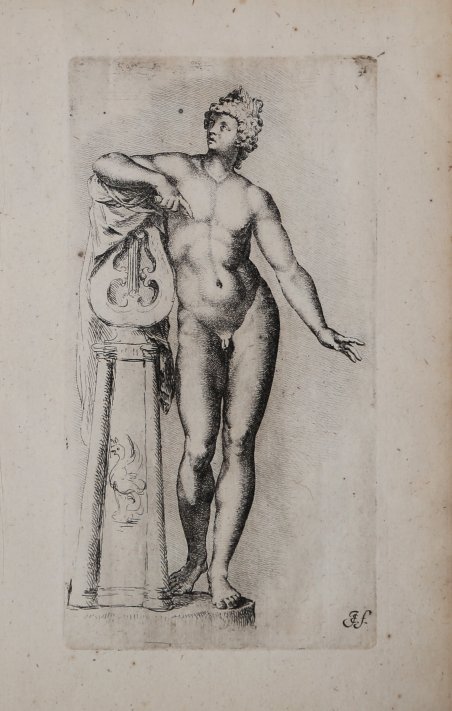
Apollo
Formas de Pago
- PayPal
- Tarjeta de crédito
- Transferencia Bancaria
- Pubblica amministrazione
- Carta del Docente
Detalles
- Año de publicación
- 1670
- Formato
- 120 X 230
- Grabadores
- de BISSCHOP Jan
Descripción
Acquaforte, 1670 circa, firmata in lastra con il monogramma. Una bella impressione, stampata su carta vergata coeva, con margini, ottime condizioni. La tavola è tratta da Signorum veterum icones, una collezione di sculture e statue romane di Jan de Bisschop (Johannes Episcopius) pubblicata per la prima volta nel 1668. Questa suite di 100 stampe di de Bisschop comprende sculture classiche conservate in collezioni olandesi e italiane nel XVII secolo. Le statue antiche erano molto apprezzate come opere d’arte, in particolare dagli artisti che ne ammiravano la loro rappresentazione di anatomia, drappeggi e pose. Questa suite comprende alcune delle sculture più importanti, da vari punti di vista, alle quali l’artista ebbe accesso. Alcune delle sculture classiche riprodotte nel Signorum veterum icones provengono dalle collezioni seicentesche di Gerrit Uylenburgh e Hendrik Scholten, alle quali de Bisschop aveva accesso diretto. La sequenza dell’opera è rigorosamente conforme alla tradizione classica: le prime illustrazioni riguardano le parti del corpo (questa sezione è stata lasciata incompiuta alla morte prematura di de Bisschop): statue complete, seguite da pose e suggerimenti per composizioni con più di una figura. Le stampe avevano lo scopo di fornire agli artisti esempi di pose ideali. Dai dipinti di Adriaen van der Werrff e Nicolaes Verkolje, è chiaro quanto siano stati influenti questi studi nello sviluppo della pittura classica olandese alla fine del XVII secolo. Etching, 1670 circa, signed on plate with the monogram. A fine impression, printed on contemporary laid paper, with margins, very good condition. The plate si taken from Signorum veterum icones, a collection of Roman sculptures & statues by Jan de Bisschop (Joh. Episcopius), first published in 1668. This suite of 100 prints by de Bisschop comprises of classical sculptures housed in Dutch and Italian collections in the seventeenth century. Ancient statues were highly regarded as works of art, in particular by artists who admired their representation of anatomy, drapery and poses. This suite includes some of the most important sculptures, from various view points, from which the artist could study. Some of the classical sculptures reproduced in de Bisschop’s Icones were from the seventeenth-century collections of Gerrit Uylenburgh and Hendrik Scholten, to which de Bisschop had direct access. The sequence of the Icones adhered strictly to the classical tradition: first the individual parts of the body were illustrated (this section was left unfinished at de Bisschop’s premature death), then completesculptures, followed by poses and suggestions for compositions with more than one figure. The prints were intended to provide artists with examples of ideal poses. From the paintings of Adriaen van der Werrff and Nicolaes Verkolje, it is clear just how influential these studies were in the development of Dutch classical painting during the late 17th century. Cfr. Bibliografia: Universal Catalogue of Books on Art I, p. 117; Bibliothèque Nationale 150, 337; Thieme-Becker 22, 235; Hollstein, Dutch & Flemish etchings, engravings and woodcuts c.1450-1700.6; Le Blanc, Charles, Manuel de l'Amateur d'Estampes 1550-1820.5.
