Detalles
Lugar de impresión
Anversa
Descripción
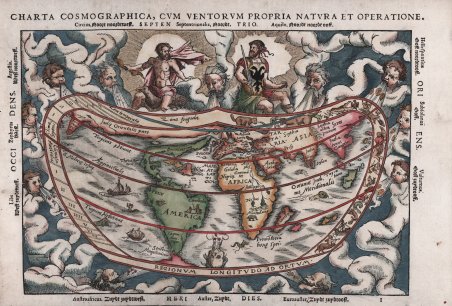
Magnifico planisfero a proiezione cordiforme tronca (a forma di cuore), circondata da una cornice allegorica raffigurante putti soffianti a simbolo dei venti, figure mitiche e nuvole. Tra queste immagini di teste soffianti, tre cadaveriche simboleggiano i presunti venti meridionali che portano la peste. Si tratta della seconda versione di questa mappa, che apparve per la prima volta nel 1544 nella ' Cosmographia ' di Apian, che si basava su una mappa del mondo più grande preparata da Reiner Gemma Frisius nel 1540 a Lovanio, di cui non esiste un esempio noto secondo Shirley (voce 82). La mappa comprende un passaggio a Nord-Ovest, sopra il quale si trova un'affascinante proiezione asiatica. Il Nord America, chiamato ' Baccalearum ' per la sua pesca del merluzzo. Lo stretto di Magellano rappresenta l'unico passaggio tra il Sud America e un discreto continente meridionale. Peter Apian, conosciuto anche con il suo nome latino Petrus Apianus, era un professore di matematica ed era conosciuto come un grande astronomo. Queste competenze, unite al suo interesse per la geografia, portarono alla creazione di una propria tipografia a Landshut. Il libro di testo di Apian, ' Cosmographicus Liber, fu pubblicato per la prima volta nel 1524. La quarta edizione (1529) e le edizioni successive furono curate dalla sua allieva Gemma Frisius, che inserì il proprio mappamondo nella pubblicazione del 1544. Una delle poche carte cordiformi del mondo che è possibile reperire nel mercato antiquario. ' Xilografia, finemente colorata a mano, area perfettamente restaurata nel Mare Pacifico, per il resto in ottime condizioni. Bibliografia R. W. Shirley, The Mapping of the World, ' n. 96. A scarce and interesting woodblock map on a truncated cordiform (heart-shaped) projection surrounded by a vividly engraved border of windheads, mythical figures and clouds. ' Amongst these gargoyle images are three cadaverous heads blowing the supposedly plague-carrying southerly winds. The map is said to have been based on one, now lost, by Gemma Frisius and was published in Peter Apian's "Cosmographia". Peter Apian, also known by his Latin name Petrus Apainus, was a professor of mathematics and was known as a great astronomer. These skills combined with his interest in geography led to the establishment of his own printing press in Landshut. Apian's textbook ' Cosmographicus Liber ' was first published in 1524. The fourth edition (1529) and later editions were edited by his pupil Gemma Frisius, who inserted his own world map in the 1545 publication. Three very similar woodblock versions of the map are noted, the first published in 1544 with this being the second, identified by the addition of names for Europe, England and Scotland. It is one of the earliest obtainable maps to show a complete, although very narrowed, outline for the entire New World. The second state of this World map which first appeared in the 1544 in Apian's Cosmographia, which was based on a larger map of the world prepared by Gemma Frisius in 1540 in Louvain, of which there is no known example according to Shirley (Entry 82). The map includes a Northwest passage, above which is a fascinating Asian projection. North America, called Baccalearum for its Cod fisheries. The narrow Straits of Magellan represent the only passage between South America and an understated Southern Continent. The map is embellished by sea monsters, mermaids, windheads, etc. An excellent example of a cordiform world map. A fine example with great later hand colour, wide margins, perfectly repaired areas in the Pacific, else a nice example. Bibliografia R. W. Shirley, The Mapping of the World, ' n. 96. Cfr.
 Descubre cómo utilizar
 Descubre cómo utilizar