Claudii et Traiani Impp. Admirabilium Portum Ostiensium Orthographia per Stephanum Duperach Architectvm Ivxta Antiqva Vestig
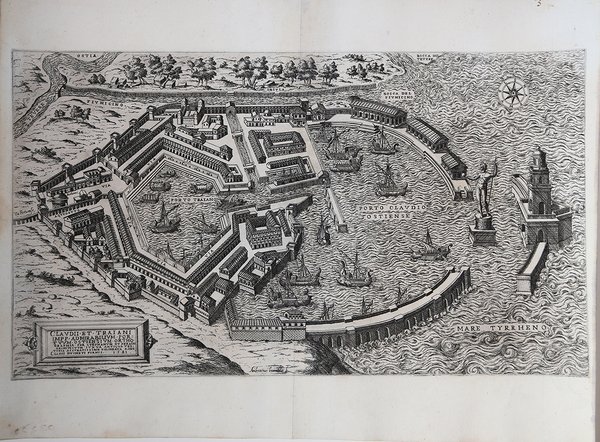
Claudii et Traiani Impp. Admirabilium Portum Ostiensium Orthographia per Stephanum Duperach Architectvm Ivxta Antiqva Vestig
Formas de Pago
- PayPal
- Tarjeta de crédito
- Transferencia Bancaria
- Pubblica amministrazione
- Carta del Docente
Detalles
- Año de publicación
- 1581
- Lugar de impresión
- Roma
- Formato
- 520 X 300
- Grabadores
- DUCHET (Duchetti) Claudio
Descripción
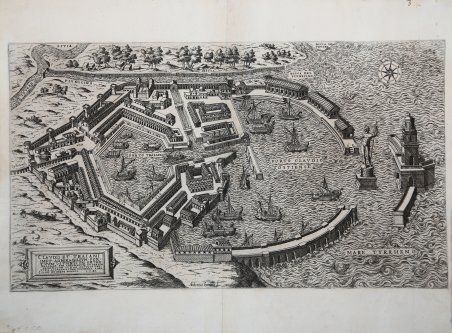
Magnifico esemplare del primo stato (di tre) della pianta di Ostia incisa da Ambrogio Brambilla per l'editore Claudio Duchetti. In basso a sinistra, in un riquadro, il titolo: ' CLAUDII ET TRAIANI IMPP. ADMIRABILIUM PORTUUM OSTIENSIUM ORTHOGRAPHIA PER STEPHANUM DU PERACH ARCHITECTUM IUXTA ANTIQUA VESTIGIA ACCURATISSIME DELINEATA ROME CLADII DUCHETI FORMIS ' 1581. In basso al centro la firma ' Ambrosius brambila f. In alto a destra, nel mare, una rosa dei venti con il nord-est a sinistra. Acquaforte e bulino, dimensioni mm 300x520. Si tratta di una ricostruzione storica che raffigura il porto voluto dall’imperatore Claudio, poi ampliato da Traiano. I lavori iniziarono tra il 42 ed il 46, e fu realizzato ' un porto aperto a ponente, protetto da due moli. Tuttavia, i continui insabbiamenti che subiva, indussero a ulteriori lavori che portarono alla costruzione di un ulteriore bacino interno, ad oriente, terminato sotto l’imperatore Traiano nell’anno 103. L’opera, sebbene a carattere topografico, rientra nel filone delle antichità romane, finalizzate a far conoscere al grande pubblico la maestosità delle architetture romane. ' E' una replica della pianta del Duperac - Lafreri, incisa da Ambrogio Brambilla per l’editore Claudio Duchetti. La lastra del Lafreri era stata assegnata, nella divisione ereditaria, a Stefano Duchetti. Questa probabilmente fu la ragione che indusse Claudio a realizzare una nuova lastra dedicata alla ricostruzione del porto di Traiano. L'opera viene inserita nelle edizioni di Duchetti dello ' Speculum Romanae Magnificentia. Lo “Speculum” ebbe origine nelle attività editoriali di Antonio Salamanca e Antonio Lafreri. Durante la loro carriera editoriale romana, i due editori stranieri - che hanno lavorato insieme tra il 1553 e il 1563 - hanno avviato la produzione di stampe di architettura, statuaria e vedutistica della città legate alla Roma antica e moderna. Le stampe potevano essere acquistate individualmente da turisti e collezionisti, ma venivano anche acquistate in gruppi più grandi che erano spesso legati insieme in un album. Nel 1573, Lafreri commissionò a questo scopo un frontespizio, dove compare per la prima volta il titolo "Speculum Romanae Magnificentiae". Alla morte di Lafreri, due terzi delle lastre di rame esistenti andarono alla famiglia Duchetti (Claudio e Stefano), mentre un altro terzo fu distribuito tra diversi editori. L’opera è inserita nel catalogo della vedova di Giacomo Gherardi (n. 178 descritta come “il Porto d’hostia reale”) e fu acquistata (1602) da Giovanni Orlandi e successivamente (1614) da Hendrick van Schoel.Bibliografia Bifolco-Ronca (2018): tav. 1166, I/III; ' Destombes (1970): nn. 88-88a; Ganado (1994): p. 213, n. 65; Hülsen (1921): p. 147, n. 25i; Marigliani (2016): n. II.2; Pagani (2012): p. 80; cfr. Rubach (2016): n. 282; Tooley (1983): nn. 426c-426d; ' Witcombe (2008): p. 319, n. 5.12. Magnificent example of the first state (of three) of the Ostia map, engraved by Ambrogio Brambilla for the publisher Claudio Duchetti. At the bottom left, the title: ' CLAUDII ET TRAIANI IMPP. ADMIRABILIUM PORTUUM OSTIENSIUM ORTHOGRAPHIA PER STEPHANUM DU PERACH ARCHITECTUM IUXTA ANTIQUA VESTIGIA ACCURATISSIME DELINEATA ROME CLADII DUCHETI FORMIS 1581.At the bottom center the signature "Ambrosius brambila f." At the top right, in the sea, a compass rose with the north-east to the left. Etching and engraving. This map is a copy of the Duperac - Lafreri' map, engraved by Ambrogio Brambilla for the publisher Claudio Duchetti. It is a historical reconstruction by the archaeologist Pirro Ligorio, which depicts the port wanted by Emperor Claudius, later enlarged by Trajan. The work began between 42 and 46, and it was made an open port to the west, protected by two piers. However, the continuous silting up that it underwent, led to further works that led to the construction of a further inner basin, to the east, finished under the Emperor Trajan in the year 103. The work, although topographic, is part of the Roman antiquities, aimed at making known to the general public the majesty of Roman architecture. ' The ' Speculum ' (The Mirror of Roman Magnificence), found its origin in the publishing endeavors of Antonio Salamanca and Antonio Lafreri. During their Roman publishing careers, the two foreign publishers - who worked together between 1553 and 1563 - initiated the production of prints recording art works, architecture and city views related to Antique and Modern Rome. The prints could be bought individually by tourists and collectors, but were also purchased in larger groups which were often bound together in an album. In 1573, Lafreri commissioned a title page for this purpose, which is where the title 'Speculum Romanae Magnificentiae' first appears. Lafreri envisioned an ideal arrangement of the prints in 7 different categories, but during his lifetime, never appears to have offered one standard, bound set of prints. Instead, clients composed their own selection from the corpus to be bound, or collected a group of prints over time. When Lafreri died, two-third of the existing copper plates went to the Duchetti family (Claudio and Stefano), while another third was distributed among several publishers. The Duchetti appear to have standardized production, offering a more or less uniform version of the Speculum to their clients. The popularity of the prints also inspired other publishers in Rome to make copies however, and to add new prints to the corpus. Bibliografia Bifolco-Ronca (2018): tav. 1166, II/III; ' Destombes (1970): nn. 88-88a; Ganado (1994): p. 213, n. 65; Hülsen (1921): p. 147, n. 25i; Marigliani (2016): n. II.2; Pagani (2012): p. 80; cfr. Rubach (2016): n. 282; Tooley (1983): nn. 426c-426d; ' Witcombe (2008): p. 319, n. 5.12. Cfr.
