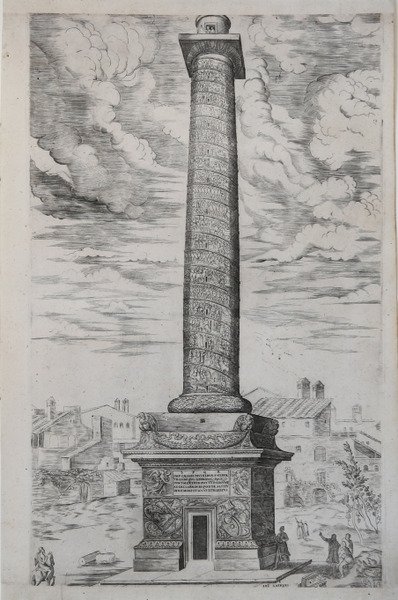
Bulino, 1544, firmato e datato in basso a destra: «ANT LAFRERY SEQUANI FORMIS». Parte dello "Speculum Romanae Magnificentiae". Esemplare nel primo stato di tre, avanti l'indirizzo di Paolo Graziani e, quindi, di Pietro de Nobili (entrambi sconosciuti ad Hulsen). Nel basamento della colonna si legge: "S. P. Q. R. IMP. CAESARI DIVI NERVAE. F. NERVAE. TRAIANO AVG. GERMANIC. DACICO PONT. MAX. TRIB. POT. XVII. COS. VI. PP AD. DECLARNDVM. QVANTAE AL-TITV DINIS MONS ET LOCVS SITE GESTVS" Si tratta dell’edizione della Colonna Traiana successiva a quella per i tipi di Salamanca del 1540. La colonna coclide occupa in verticale tutto lo spazio della lastra, l’immagine è inserita in un contesto urbano. La stampa rappresenta con sufficiente precisione lo stato del monumento antico. Nonostante l’apparente somiglianza tra l’incisione del Lafréry e quella del Salamanca in realtà sono differenti la scala di misurazione, le proporzioni e il punto di vista infatti l’incisione del Lafréry si pone da un punto di vista più basso riproducendo un effetto più grandioso della base che appare più grande, inoltre c’è una sostanziale diversità delle figurine in basso e il tratteggio del cielo si differenzia notevolmente, ed infine le scene della colonna sono opposte a quelle rappresentate dal Salamanca. «Questa colonna […] Paolo III la levò alle monache della quale si servivano per campanile, e la campana era su nella finestra dello stremo di essa colonna» (Anonimo chigiano G. II 64, p. 319, cfr. Marigliani n. IV.11). L’opera appartiene allo ' Speculum Romanae Magnificentiae, la prima iconografia della Roma antica. ' Nell'Indice Lafreri viene descritta al numero 140 come "Colonna di Traiano della parte di fuori, con la demostrazione della parte di dentro.". Nell'inventario di Stefano Duchetti, 1581b (“La Colona Trajana di fora”; Pagani 2008a, p. 15, r. 55); 1584 (“La colonna Troianna di Guera”; Lincoln 2000, p. 185). Lo ' Speculum ' ebbe origine nelle attività editoriali di Antonio Salamanca e Antonio Lafreri (Lafrery). Durante la loro carriera editoriale romana, i due editori - che hanno lavorato insieme tra il 1553 e il 1563 - hanno avviato la produzione di stampe di architettura, statuaria e vedutistica della città legate alla Roma antica e moderna. Le stampe potevano essere acquistate individualmente da turisti e collezionisti, ma venivano anche acquistate in gruppi più grandi che erano spesso legati insieme in un album. Nel 1573, Lafreri commissionò a questo scopo un frontespizio, dove compare per la prima volta il titolo Speculum Romanae Magnificentiae. Alla morte di Lafreri, due terzi delle lastre di rame esistenti andarono alla famiglia Duchetti (Claudio e Stefano), mentre un altro terzo fu distribuito tra diversi editori. Claudio Duchetti continuò l’attività editoriale, implementando le lastre dello Speculum con copie di quelle “perdute” nella divisione ereditaria, che fece incidere al milanese Amborgio Brambilla. Alla morte di Claudio (1585) le lastre furono cedute – dopo un breve periodo di pubblicazione degli eredi, in particolare nella figura di Giacomo Gherardi - a Giovanni Orlandi, che nel 1614 vendette la sua tipografia al fiammingo Hendrick van Schoel. Stefano Duchetti, al contrario, cedette le proprie matrici all’editore Paolo Graziani, che si associò con Pietro de Nobili; il fondo confluì nella tipografia De Rossi passando per le mani di editori come Marcello Clodio, Claudio Arbotti e Giovan Battista de Cavalleris. Il restante terzo di matrici della divisione Lafreri fu suddiviso e scisso tra diversi editori, in parte anche francesi: curioso vedere come alcune tavole vengano ristampate a Parigi da Francois Jollain alla metà del XVII secolo. Diverso percorso ebbero alcune lastre stampate da Antonio Salamanca nel suo primo periodo; attraverso il figlio Francesco, confluirono nella tipografia romana di Nicolas van Aelst. Altri editori che contribuirono allo Speculum furono i fr. Engraving, 1544, signed and dated at bottom right: "ANT LAFRERY SEQUANI FORMIS". Part of the "Speculum Romanae Magnificentiae". Example of the first state of three, before the address of Paolo Graziani and, therefore, of Pietro de Nobili (both unknown to Hulsen). In the base of the column we read: "S. P. Q. R. IMP. CAESARI DIVI NERVAE. F. NERVAE. TRAIAN AVG. GERMANIC. DACICO PONT. MAX. TRIB. POT. XVII. COS. VI. PP AD. DECLARNDVM. QVANTAE AL-TITV DINIS MONS ET LOCVS SITE GESTVS". This is the edition of the Trajan Column following the one for the Salamanca types of 1540. The cochlide column occupies vertically the entire space of the plate, the image is inserted in an urban context. The print represents with sufficient precision the state of the ancient monument. Despite the apparent similarity between the engraving of the Lafréry and that of the Salamanca, in reality the scale of measurement, proportions and point of view are different. In fact, the engraving of the Lafréry is placed from a lower point of view reproducing a more grandiose effect of the base that appears larger, moreover there is a substantial diversity of the figurines below and the hatching of the sky differs greatly, and finally the scenes of the column are opposite to those represented by the Salamanca. (cf. Marigliani n. IV.11). The work belongs to the Speculum Romanae Magnificentiae, the earliest iconography of ancient Rome. ' In the Index Lafreri is described at number 140 as "Colonna di Traiano della parte di fuori, con la demostrazione della parte di dentro." The Speculum originated in the publishing activities of Antonio Salamanca and Antonio Lafreri (Lafrery). During their Roman publishing careers, the two editors-who worked together between 1553 and 1563-started the production of prints of architecture, statuary, and city views related to ancient and modern Rome. The prints could be purchased individually by tourists and collectors, but they were also purchased in larger groups that were often bound together in an album. In 1573, Lafreri commissioned a frontispiece for this purpose, where the title Speculum Romanae Magnificentiae appears for the first time. Upon Lafreri's death, two-thirds of the existing copperplates went to the Duchetti family (Claudio and Stefano), while another third was distributed among several publishers. Claudio Duchetti continued the publishing activity, implementing the Speculum plates with copies of those "lost" in the hereditary division, which he had engraved by the Milanese Amborgio Brambilla. Upon Claudio's death (1585) the plates were sold - after a brief period of publication by the heirs, particularly in the figure of Giacomo Gherardi - to Giovanni Orlandi, who in 1614 sold his printing house to the Flemish publisher Hendrick van Schoel. Stefano Duchetti, on the other hand, sold his own plates to the publisher Paolo Graziani, who partnered with Pietro de Nobili; the stock flowed into the De Rossi typography passing through the hands of publishers such as Marcello Clodio, Claudio Arbotti and Giovan Battista de Cavalleris. The remaining third of plates in the Lafreri division was divided and split among different publishers, some of them French: curious to see how some plates were reprinted in Paris by Francois Jollain in the mid-17th century. Different way had some plates printed by Antonio Salamanca in his early period; through his son Francesco, they goes to Nicolas van Aelst's. Other editors who contributed to the Speculum were the brothers Michele and Francesco Tramezzino (authors of numerous plates that flowed in part to the Lafreri printing house), Tommaso Barlacchi, and Mario Cartaro, who was the executor of Lafreri's will, and printed some derivative plates. All the best engravers of the time - such as Nicola Beatrizet (Beatricetto), Enea Vico, Etienne Duperac, Ambrogio Brambilla, and others ' - were called to Rome and employed for the intaglio of the works. All these publishers-engravers and mer. Cfr. B. Rubach, Ant. Lafreri Formis Romae (2016), n. 287, I/II; A. Alberti, L’indice di Antonio Lafrery (2010), n. 54, I/III; Marigliani, Lo splendore di Roma nell’Arte incisoria del Cinquecento (2016), n. IV.11; C. Hülsen, 1921, p. 148, 30, F; R. Lanciani, 19


 Descubre cómo utilizar
 Descubre cómo utilizar