Colosseo
Colosseo
Formas de Pago
- PayPal
- Tarjeta de crédito
- Transferencia Bancaria
- Pubblica amministrazione
- Carta del Docente
Detalles
- Año de publicación
- 1550
- Formato
- 530 X 365
- Grabadores
- BEATRICETTO Nicolas Beatrizet detto
Descripción
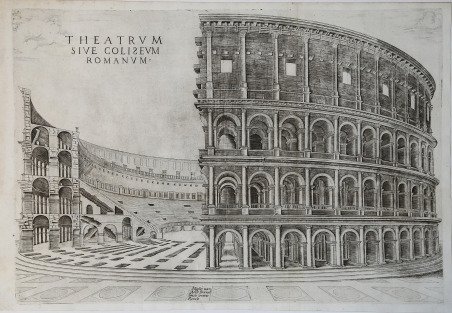
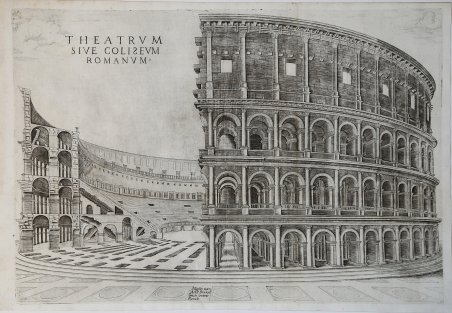
Spaccato del Colosseo, ricostruzione. Bulino, privo di data e firma. ' Iscritto in alto al centro: «THEATRVM SIVE COLISEVM ROMANVM», in basso al centro: «Nicolai van Aelst Bruxellensis formis Romae». La lastra, tagliata nel soggetto e con numerose abrasioni di iscrizioni ancora visibili, ci lasca credere che sia la ristampa di una matrice più antica, forse dell’originale probabilmente inciso da Beatrizet edito da Lafreri, leggermente ridotta nel formato – forse poiché rovinata - e al quale viene aggiunto il titolo «THEATRVM SIVE COLISEVM ROMANVM». Questo il primo stato della lastra https://www.antiquarius.it/it/lafreri-speculum-romanae-magnificentiae/13915-colosseo.html La tiratura Van Aelst non descritta né da Rubach né da Alberti. Rubach descrive tre stati dell’opera; dopo la morte del Lafreri la lastra venne ereditata da Stefano Duchetti e quindi venduta all’editore Paolo Graziani (1585) che nel 1586 si unì a Pietro de Nobili. Proprio del De Nobili è nota una seconda ristampa della lastra. In seguito, la matrice vene acquistata da Marcello Clodio, che la ristampa (circa 1589). Probabilmente Nicolas van Aelst venne in possesso della lastra; all’edizione di van Aelst seguì quella di Giacomo De Rossi, verso la metà del XVII secolo. Secondo Silvia Bianchi “La tavola è copia nello stesso verso di quella attribuita a Nicolas Béatrizet e reca in alto a sinistra un’iscrizione su tre righe con il titolo […] l’indirizzo di Giovanni Giacomo De Rossi alla Pace all’insegna di Parigi (non noto a Hülsen) sostituisce il precedente indirizzo di Nicolas Van Aelst, abraso La filigrana del nostro esemplare “giglio nel cerchio con lettera C” ci indica che la tiratura è riconducibile al primo trentennio del XVII secolo. Secondo questa nostra ricostruzione storica, dunque, si tratterebbe del quarto stato di cinque dell’opera. Ricostruzione del Colosseo in sezione e proiezione orizzontale. L’incisione deriva da quella pubblicata per i tipi di Antonio Salamanca nel 1538, probabilmente su disegno di Domenico Giuntalodi e incisione di Girolamo Fagiuoli. Molto richiesta, la stampa fu poi riedita in formato più ridotto da Antonio Lafréry, con probabile intaglio di Nicolas Beatrizet. L’edificio sorse sul luogo dello stagno artificiale che era ai piedi della Domus Aurea. I lavori sotto l’imperatore Vespasiano arrivarono sino al terzo ordine e furono completati dal figlio Tito, che nell’anno 80 d.C. ordinò una seconda spettacolare inaugurazione protrattasi per cento giorni nei quali furono uccise circa 5000 fiere. Una curiosa nota su riti di negromanzia che nel Cinquecento si svolgevano nel Colosseo viene da Benvenuto Cellini: «Andaticene al Culiseo, quivi paratosi il prete a uso di negromante, si mise a disegnare i circuli in terra con le più belle cirimonie che immaginar si possa al mondo; e ci aveva fatto portare profummi preziosi e fuoco, ancora profummi cattivi. Come e’ fu in ordine, fece la porta al circulo; e presoci per mano, a uno a uno ci messe drento al circulo; di poi compartì gli uffizii; detta il pintàculo in mano a quell’altro suo compagno negromante, agli altri dette la cura del fuoco per e’ profummi; poi messe mano agli scongiuri. Durò questa cosa più d’una ora e mezzo; comparse parecchi legione, di modo che il Culiseo era tutto pieno. Io che attendevo ai profummi preziosi, quando il prete cognobbe esservi tanta quantità, si volse a me e disse: “Benvenuto, dimanda lor qual cosa”. Io dissi che facessino che io fussi con la mia Angelica siciliana. Per quella notte noi non avemmo risposta nessuna; ma io ebbi bene grandissima satisfazione di quel che io desideravo di tal cosa». L’opera appartiene allo ' Speculum Romanae Magnificentiae, la prima iconografia della Roma antica. ' Lo ' Speculum ' ebbe origine nelle attività editoriali di Antonio Salamanca e Antonio Lafreri (Lafrery). Durante la loro carriera editoriale romana, i due editori - che hanno lavorato ins. Engraving, undated and signed. Work part of the Speculum Romanae Magnificentiae. Inscribed at the top center: "THEATRVM SIVE COLISEVM ROMANVM". Inscribed at the bottom center: "Nicolai uan Aelst Bruxellensis formis Romae". The plate, cut in the subject and with numerous abrasions of inscriptions still visible, let us believe that it is the reprint of an older copperplate, perhaps of the original probably engraved by Beatrizet and published by Lafreri, slightly reduced in size - perhaps because ruined - and to which is added the title "THEATRVM SIVE COLISEVM ROMANVM". This is the first state of the plate https://www.antiquarius.it/it/lafreri-speculum-romanae-magnificentiae/13915-colosseo.html The Van Aelst issue is not described either by Rubach or Alberti. Rubach describes three states of the work; after Lafreri's death the plate was inherited by Stefano Duchetti and then sold to the publisher Paolo Graziani (1585) who in 1586 joined Pietro de Nobili – of which is known a second reprint of the plate. Later on, the plate was purchased by Marcello Clodio, who reprinted it (about 1589). Probably Nicolas van Aelst came in possession of the plate; to the edition of van Aelst followed that of Giacomo De Rossi, around the half of the XVII century. The watermark of our example "lily in the circle with letter C" indicates us that it was printed in the first thirty years of the XVII century. According our historical reconstruction, therefore, it would be the fourth state of five of the work. According to Silvia Bianchi "The work is a copy in the same verse as the one attributed to Nicolas Béatrizet and bears at the top left an inscription on three lines with the title [.] the address of Giovanni Giacomo De Rossi (not known in Hülsen) replaces the previous address of Nicolas Van Aelst, abraded. Reconstruction of the Colosseum in section and horizontal projection. The engraving derives from the one published for the types by Antonio Salamanca in 1538, probably on a drawing by Domenico Giuntalodi and engraving by Girolamo Fagiuoli. Much in demand, the print was then reissued in smaller format by Antonio Lafréry, with probable carving by Nicolas Beatrizet. The building was built on the site of the artificial pond that was at the foot of the Domus Aurea. The works under the emperor Vespasian reached the third order and were completed by his son Titus, who in the year 80 A.D. ordered a second spectacular inauguration that lasted for one hundred days during which about 5000 fairs were killed.». This print comes from the Speculum Romanae Magnificentiae (The Mirror of Roman Magnificence). The Speculum found its origin in the publishing endeavors of Antonio Salamanca and Antonio Lafreri. During their Roman publishing careers, the two foreign publishers - who worked together between 1553 and 1563 - initiated the production of prints recording art works, architecture and city views related to Antique and Modern Rome. The prints could be bought individually by tourists and collectors, but were also purchased in larger groups which were often bound together in an album. In 1573, Lafreri commissioned a title page for this purpose, which is where the title ‘Speculum Romanae Magnificentiae’ first appears. Lafreri envisioned an ideal arrangement of the prints in 7 different categories, but during his lifetime, never appears to have offered one standard, bound set of prints. Instead, clients composed their own selection from the corpus to be bound, or collected a group of prints over time. When Lafreri died, two-third of the existing copper plates went to the Duchetti family (Claudio and Stefano), while another third was distributed among several publishers. The Duchetti appear to have standardized production, offering a more or less uniform version of the Speculum to their clients. The popularity of the prints also inspired other publishers in Rome to make copies however, and to add new prints to the corpus. Beautiful proof, printed on . Cfr.
