Commo di Imperatoris gladiatoris habitum gestantis imago
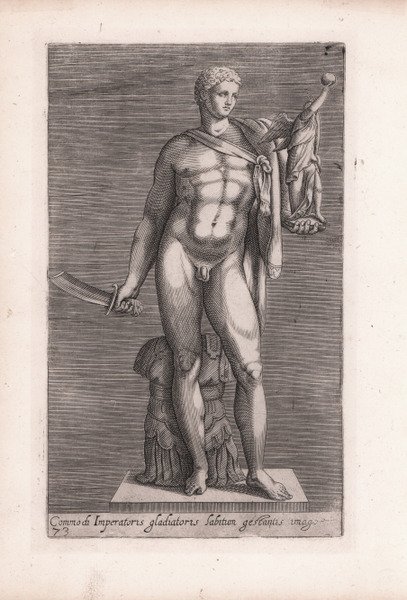
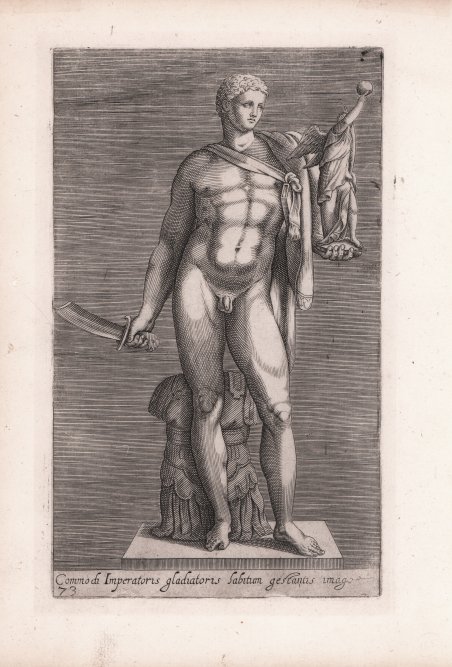
Commo di Imperatoris gladiatoris habitum gestantis imago
Formas de Pago
- PayPal
- Tarjeta de crédito
- Transferencia Bancaria
- Pubblica amministrazione
- Carta del Docente
Detalles
- Año de publicación
- 1584
- Lugar de impresión
- Roma
- Formato
- 135 X 220
- Grabadores
- CAVALIERI Giovanni Battista de’
Descripción
Opera tratta dall’Antiquarum statuarum urbis Romae…Io. Baptista de Cavalleris authore, la prima raccolta sistematica di illustrazioni di sculture antiche conservate nelle collezioni romane, che si deve all’opera dell’incisore e disegnatore Giovanni Battista Cavalieri (1525 circa - 1601) nella seconda metà del XVI secolo. Il repertorio, punto di riferimento per gli studi antiquari, conobbe grande diffusione e contribuì ad orientare l'interesse degli studiosi dell'epoca verso la statuaria antica. Il numero delle tavole, circa 50 nelle prime edizioni (databili circa al 1561/62) venne ampliato successivamente; prima del 1584 furono pubblicati i libri I e II con 100 incisioni numerate di sculture, organizzate per collezioni di appartenenza. Nel 1594 videro la luce il III e IV volume dell’opera, in cui comparvero altre 100 nuove tavole, stavolta ordinate in base all’iconografia dei soggetti. Le sculture sono raffigurate su sfondi neutri, privi di riferimenti architettonici. L’opera, con il titolo ' Antiquarum statuarum Urbis Romae primus, ' senza data, venne dedicata prima a Ottone Truchsess von Walburg – prima in qualità di diacono di S. Maria in Trastevere (1561/62) e poi di cardinale di Albano (1562/70). In seguito, con il titolo ' Antiquarum statuarum Urbis Romae primus et secundus liber ' il frontespizio reca la dedica al cardinale Ludovico Madruzzo, ed è databile al 1584/85. Nel 1594, con il titolo ' Antiquarum Statuarum Urbis Romae tertius et quartus liber, escono cento nuove tavole con dedica al cardinale G. Paluzzi degli Albertoni, del giugno 1593. Si tenga presente che, mentre nei primi due libri le statue erano pubblicate secondo le collezioni, nel terzo e quarto sono raggruppate per soggetto. La raccolta contiene, oltre alle incisioni di Giovanni Battista Cavalieri alcune tavole firmate da Cherubino Alberti, Orazio de Santis e altri famosi incisori dell’epoca. Giovanni Battista de Cavalieri o Cavalleris fu incisore, stampatore e editore. Originario di Villa Lagarina, nei pressi di Trento, risulta attivo a Venezia (dal 1559) e a Roma, dove nel 1577 apri una bottega nel quartiere Parione. Risiedeva nel vicolo di Palazzo Savelli, con uno studio vicino all’abitazione. Divenne cognato del celebre editore Lorenzo Vaccari. Realizzo lastre per Antonio Salamanca, Antonio Lafreri e Bartolomeo Faleti. Iniziò a pubblicare le sue opere intorno al 1560, ma sempre in partnership con altri: nel 1567 con Perino Zecchini e nel 1576 con Lorenzo Vaccari. Nel 1577 assunse uno stampatore, Francesco Cornuti, pubblicando opere di suoi contemporanei, tra cui Francesco Salviati, Daniele da Volterra, Raffaello, Michelangelo, Polidoro da Caravaggio, Livio Agresti e Baccio Bandinelli. ' Bulino, stampato su carta vergata coeva, in ottimo stato di conservazione. Bibliografia Thomas Ashby, ' Antiquae Statuae urbis Romae, in ' Papers of the British School at Rome, IX (1920), pp. 109-158; S. Weber, ' Artisti trentini ed artisti che operarono nel Trentino, Trento 1933, pp. 72 ss. Plate taken from the ' Antiquarum statuarum urbis Romae.Io. Baptista de Cavalleris authore, ' the first systematic collection of illustrations of ancient sculptures preserved in Roman collections, which is due to the work of the engraver and draftsman Giovanni Battista Cavalieri (1525 circa - 1601) in the second half of the 16th century. The repertory, a point of reference for antiquarian studies, was widely circulated and contributed to direct the interest of scholars of the time towards ancient statuary. The number of plates, about 50 in the first editions (datable to about 1561/62) was subsequently enlarged; before 1584 books I and II were published with 100 numbered engravings of sculptures, organized according to the collections they belonged to. In 1594 come to the light of the III and IV volume of the work, in which appeared other 100 new tables, this time ordered according to the iconography of the subjects. The sculptures are depicted on neutral backgrounds, without architectural references. The work, with the title ' Antiquarum statuarum Urbis Romae primus, ' undated, was first dedicated to Ottone Truchsess von Walburg - first as deacon of S. Maria in Trastevere (1561/62) and then as cardinal of Albano (1562/70). Later, with the title ' Antiquarum statuarum Urbis Romae primus et secundus liber, ' the frontispiece is dedicated to Cardinal Ludovico Madruzzo, and can be dated 1584/85. In 1594, with the title ' Antiquarum Statuarum Urbis Romae tertius et quartus liber, ' one hundred new plates were published with a dedication to Cardinal G. Paluzzi degli Albertoni, dated June 1593. Please note that, while in the first two books the statues were published according to collections, in the third and fourth are grouped by subject. The collection contains, in addition to the engravings of Giovanni Battista Cavalieri some plates signed by Cherubino Alberti, Orazio de Santis and other famous engravers of the time. Giovanni Battista de Cavalieri or Cavalleris was an engraver, printer and publisher. Born in Villa Lagarina, near Trento, is active in Venice (since 1559) and Rome, where in 1577 opened a workshop in the Parione district. He resided in the alley of Palazzo Savelli, with a studio near the house. He became brother-in-law of the famous publisher Lorenzo Vaccari. He made plates for Antonio Salamanca, Antonio Lafreri and Bartolomeo Faleti. He began to publish his works around 1560, but always in partnership with others: in 1567 with Perino Zecchini and in 1576 with Lorenzo Vaccari. In 1577 he hired a printer, Francesco Cornuti, publishing works by his contemporaries, including Francesco Salviati, Daniele da Volterra, Raphael, Michelangelo, Polidoro da Caravaggio, Livio Agresti and Baccio Bandinelli. Engraving, printed on contemporary laid paper, in excellent condition. Bibliografia Thomas Ashby, ' Antiquae Statuae urbis Romae, in ' Papers of the British School at Rome, IX (1920), pp. 109-158; S. Weber, ' Artisti trentini ed artisti che operarono nel Trentino, Trento 1933, pp. 72 ss. Cfr.
