Dissegno del Campo Cattolico Sotto Casale
Dissegno del Campo Cattolico Sotto Casale | Grabados | DE ROSSI Giuseppe
Dissegno del Campo Cattolico Sotto Casale
Dissegno del Campo Cattolico Sotto Casale | Grabados | DE ROSSI Giuseppe
Formas de Pago
- PayPal
- Tarjeta de crédito
- Transferencia Bancaria
- Pubblica amministrazione
- Carta del Docente
Detalles
- Año de publicación
- 1628
- Lugar de impresión
- Roma
- Formato
- 245 X 313
- Grabadores
- DE ROSSI Giuseppe
Descripción
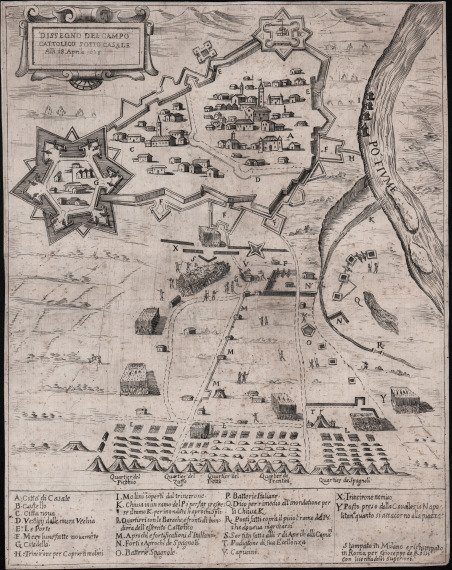
DISSEGNO DEL CAMPO / CATTOLICO SOTTO CASALE / Alli i8 Aprile i628. Veduta obliqua degli accampamenti spagnoli e italiani al 18 aprile 1628, nelle prime fasi del primo assedio di Casale Monferrato, 28 marzo 1628-16 marzo 1629. Guerra di successione mantovana (1628-1631); parte della Guerra dei Trent'anni (1618-48). Orientato con ovest-sud-ovest in alto. Si tratta di una rarissima stampa d’occasione, nata per documentare il primo assedio della città nel 1628. Venne pubblicata a Milano e Roma da Giuseppe de’ Rossi (1560-1639), come si legge in basso a destra: Stampato in Milano e ristampato in Roma per Gioseppe de Rossi con licentia delli Superiori. La fortezza di Casale Monferrato occupava una forte posizione strategica al margine settentrionale della regione alpina, dove il Po creava un varco nella catena montuosa che confinava con la pianura lombarda. Divenne un obiettivo centrale nella guerra di successione mantovana, che era scoppiata tra i pretendenti rivali al Ducato di Mantova della famiglia Gonzaga, la cui linea maschile diretta si era estinta nel dicembre 1627. Nel 1628 fu tenuta dagli italiani per il pretendente di origine francese Carlo di Gonzaga, duca di Nevers, il cui rivale era Ferrante II Gonzaga (1563-5 agosto 1630), duca di Guastala, sostenuto dal Sacro Romano Impero. Il primo assedio da parte dell'esercito spagnolo, comandato da Gonzalo Fernández de Córdoba, governatore di Milano, fu abbandonato dopo un anno, quando i francesi varcarono le Alpi in forze, occupando la città e la fortezza con cinque reggimenti di piedi e sei compagnie di cavalleria al comando di Jean Caylar d'Anduze de Saint-Bonnet, marchese di Toiras (1585-1636), il cui stemma è in alto al centro di questa veduta. Toiras, l'"eroe della resistenza agli inglesi sull'Île de Ré" nel 1627 (cfr. 722025), fu presente a entrambi gli assedi e il suo successo lì e altrove fu premiato con la nomina a maréchal de France nel 1630. Il secondo assedio spagnolo fu affidato al comando di Ambrosio Spinola, che morì durante le trattative successive alla capitolazione della città (anche se la cittadella resistette). La successione passò infine al duca di Nevers. Acquaforte e bulino, stampata su carta vergata coeva, rifilata al rame, minime ossidazioni, restauri perfettamente eseguiti agli angoli inferiore e superiore destro, per il resto in ottimo stato di conservazione. Opera rarissima. Bibliografia M. McDonald, The Print Collection of Cassiano dal Pozzo. Part II, Architecture, Topography and Military Maps, 3 vols, London 2019, cat. no. 2874. DISSEGNO DEL CAMPO / CATTOLICO SOTTO CASALE / Alli i8 Aprile i628. A middle to high oblique view of the Spanish and Italian siegeworks and encampments as at 18 April 1628 in the early stages of the first siege of Casale Monferrato, 28 March 1628-16 March 1629. ' War of the Mantuan Succession (1628-1631); part of the ' Thirty Years War (1618-48). Oriented with west-south-west to top. This is a very rare broad-sheet, created to document the first siege of the city in 1628. It was published in Milan and Rome by Giuseppe de' Rossi (1560-1639), bottom right, below print at the end of the key: Stampato in Milano e ristampato / in Roma per Gioseppe de Rossi / con licentia delli Superiori. The fortress of Casale Monferrato commanded a strong strategic position on the northern edge of the alpine region, where the Po created a gap in the mountain range bordering on the Lombardy plain. It became a pivotal target in the War of the Mantuan Sucession which had broken out amongst rival claimants to the Gonzaga family’s Dukedom of Mantua, the direct male line of which had become extinct in December 1627. It was held in 1628 by Italians for the French-born claimant, Charles di Gonzaga, Duke of Nevers, whose rival claimant was Ferrante II Gonzaga (1563-5 August 1630), the Duke of Guastala, backed by the Holy Roman Empire. The first siege by the Spanish army, commanded by Gonzalo Fernández de Córdoba, the governor of Milan was abandoned by them after a year when the French crossed the Alps in force, occupying the town and fortress with five regiments of foot and six cavalry companies under the command of Jean Caylar d’Anduze de Saint-Bonnet, Marquis de Toiras (1585-1636) whose coat of arms are top centre of this view. Toiras, the ‘hero of the resistance to the English on the Île de Ré’ in 1627 (see 722025) was present at both sieges and his success there and elsewhere was rewarded with the appointment of maréchal de France in 1630. The second Spanish siege was entrusted to the command of Ambrosio Spinola who died during the negotiations following the capitulation of the town (though the citadel held out). The Succession finally fell to the Duke of Nevers. Etching and engraving, printed on contemporary laid paper, trimmed to copperplate, minimal oxidation, perfectly executed restorations to lower and upper right corners, otherwise in very good condition. Very rare work. Bibliografia M. McDonald, The Print Collection of Cassiano dal Pozzo. Part II, Architecture, Topography and Military Maps, 3 vols, London 2019, cat. no. 2874. Cfr.