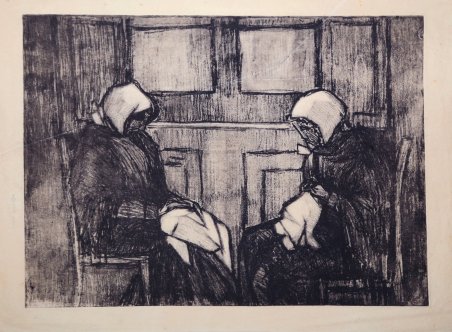
Vernice mole, circa 1900, priva di firma. Bellissima prova, impressa su carta avorio, con margini, lieve piega di carta obliqua, pe ril resto in ottimo stato di conservazione. L’opera fa parte dei celebri ritratti di donne bretoni, principalmente fonti di pittura ma anche soggetto di acqueforti, puntesecche e litografie. Charles Cottet, di impostazione post-impressionista ma di orientamento chiaramente naturalista, fu uno dei fondatori del gruppo della "Bande noire". Nel 1886 fece il suo primo viaggio in Bretagna. Viaggiò a piedi e scoprì per prima la penisola di Crozon, percorrendola tutta. Quelle terre e quel mare lo ispirarono particolarmente ed egli iniziò a tornarvi ogni anno per diverso tempo a dipingere paesaggi e persone. Per molte volte soggiornò anche nell'isola di Ouessant. In quel periodo, con il titolo di "Il paese del mare", completò una serie di quadri che illustravano gli aspetti più caratteristici e pittoreschi della rude vita dei pescatori. Dal 1900 al 1910 Cottet fece parte e contribuì a formare un gruppo di artisti soprannominato "Banda nera", a causa delle critiche che essi formulavano nei confronti della grande luminosità delle opere impressioniste. Ne facevano parte, fra gli altri, Lucien Simon, Edmond Aman-Jean, André Dauchez, George Desvallières e Maurice Denis. La tavolozza di questi pittori - più o meno influenzati dal realismo e dalle tinte severe di Gustave Courbet - e quindi anche la gamma cromatica di Cottet, era di fatto composta da tinte scure, ombrose, a volte persino cupe, o comunque tutt'altro che sgargianti. Le visioni della Bretagna contadina di Cottet appaiono serotine e terrose, e le sue marine mostrano sempre cieli corrucciati. Le sue composizioni, però, non risultano mai tristi, bensì pensose, riflessive, forse consapevoli. Eccezionali, e quindi anche particolarmente felici, appaiono pertanto gli squarci di sole sui muri bianchi delle case e nei paesaggi dai vasti cieli, sempre assai moderatamente luminosi. Della gente Cottet colse spesso aspetti intensi, come il dolore, il lutto, la riservatezza. Rara. Soft paint, circa 1900, unsigned. Beautiful proof, printed on cream paper, with margins, slight paper crease oblique, otherwise in excellent condition. The work is part of the famous portraits of Breton women, mainly sources of painting but also subject of etchings, drypoints and lithographs. Charles Cottet (12 July 1863 – 30 September 1925) was a French painter, born at Le Puy-en-Velay and dead in Paris. A famed post-impressionist, Cottet is known for his dark, evocative painting of rural Brittany and seascapes. He led a school of painters known as the Bande noire or 'Nubians' group (for the sombre palette they used, in contrast to the brighter Impressionist and Postimpressionist paintings) and was friends with such artists as Auguste Rodin. Cottet studied at the École des Beaux-Arts, and under Puvis de Chavannes and Roll, while also attending the Académie Julian (where fellow students formed Les Nabis school of painting, with which he was later associated). He travelled and painted in Egypt, Italy, and on Lake Geneva, but he made his name with his sombre and gloomy, firmly designed, severe and impressive scenes of life on the Brittany coast. Cottet exhibited at the Salon of 1889, but on a trip to Brittany in 1886 he had found his true calling. For the next twenty years he painted scenes of rural and harbor life, portraying a culture Parisians still found exotic. He is especially noted for his dark seascapes of Breton harbors at dawn, and evocative scenes from the lives of Breton fishermen. He was close friends with Charles Maurin, and his group included the painter Félix-Émile-Jean Vallotton. Cottet has often been associated with the picturesque seaside symbolism of the Pont-Aven School, though Vallotton famously painted Cottet as a leader of Les Nabis, beside Pierre Bonnard, Édouard Vuillard, and Ker-Xavier Roussel, in his Five Painters (1902-3; Kunstmuseum Winterthur). Cottet was more explicitly the leader of his own small movement, the Bande noire of the 1890s, which included Lucien Simon and André Dauchez, all influenced by the realism and dark colours of Courbet. Rare. Cfr.

 Descubre cómo utilizar
 Descubre cómo utilizar