Due Sibille e un angelo
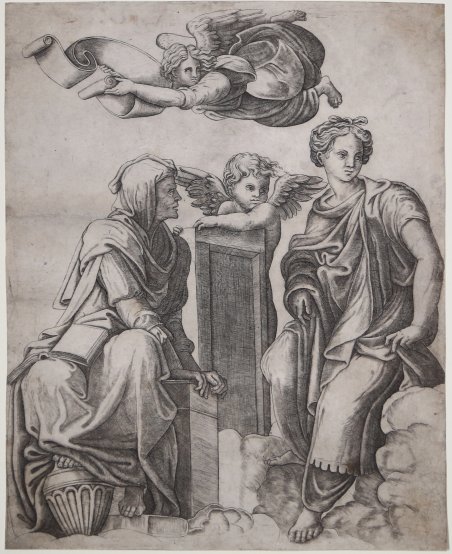
Due Sibille e un angelo
Formas de Pago
- PayPal
- Tarjeta de crédito
- Transferencia Bancaria
- Pubblica amministrazione
- Carta del Docente
Detalles
- Año de publicación
- 1520
- Formato
- 254 X 319
- Grabadores
- BRESCIA Giovanni Antonio da
- Descripción
- Bartsch XV.48.5 (as School of Raimondi after Raphael); Hind V.46.29; Levenson, Oberhuber, and Sheehan, no. 96; Zucker in TIB 1984, 2511.016; Cirillo Archer in TIB 1995, 2801.056.
Descripción
Bulino, 1520 circa, privo di data, firma e di qualsiasi iscrizione.Magnifica prova, impressa su carta vergata coeva, rifilata alla linea marginale, piega di carta e minimi restauri visibili al verso, per il resto in ottimo stato di conservazione.L'attribuzione di questa stampa non firmata, che Bartsch aveva catalogato tra quelle anonime della cerchia di Marcantonio Raimondi, appare certa; si tratta di una delle numerose incisioni che Giovanni Antonio da Brescia realizzò su disegni di Raffaello. Riproduce, in controparte, le due sibille con un angelo e un putto della sezione a destra dell'affresco nella chiesa romana di Santa Maria della Pace, eseguito negli anni 1511- 12.L'incisione di Giovanni Antonio non sembra possa essere stata realizzata prima del 1520 circa. Il tratteggio sottile e regolare è, infatti, caratteristico del suo stile più tardo, e l'incisione è particolarmente vicina al "Laocoonte", dove gli elementi architettonici in particolare vengono eseguiti allo stesso modo. Giovanni Antonio apportò piccole modifiche al modello, tra le quali figurano l'aggiunta delle nuvole e l'omissione delle iscrizioni latine e greche.Ettlinger ha recentemente dimostrato che l’identità assegnata alle sibille di Raffaello è di origine settecentesca, quindi la tradizionale identificazione delle due sibille nell'incisione come la Frigia e la Tiburtina è incerta. Engraving, 1520 circa, unlettered.Magnificient proof, printed on contemporary laid paper, trimmed close to platemark, papaer fold and small repairs aon the back side, otherwise very good condition.The attribution of this unsigned print, which Bartsch had catalogued with the anonimous followers of Marcantonio, appears to be certain. One of several engravings that Giovanni Antonio made after designs by Raphael, it reproduces in reverse the two sibyls with an angel and a putto from the right-hand section of the master’s fresco in Santa Maria della Pace, Rome, executed in the years 1511-12.Giovanni Antonio’s engraving, may not have been produced until around 1520 circa. It’s characteristic of his later manner, in its fine and regular crosshatching the engraving is especially close to “Laocoon”, where the architectural elements in particular are handled in the same way.Giovanni Antonio made a number of small modifications to his model, chief among which are the addition of the clouds and the omission of the Latin and Greek inscriptions on the slablike plaque and the scroll.Raphael’s sibyls were once assigned definite identities, but Ettlinger has recently shown that these are of eighteenth-century origin, thus the traditional identification of the two in the engraving as Phrygian and Tiburtine is at best uncertain. Cfr. Bartsch XV.48.5 (as School of Raimondi after Raphael); Hind V.46.29; Levenson, Oberhuber, and Sheehan, no. 96; Zucker in TIB 1984, 2511.016; Cirillo Archer in TIB 1995, 2801.056.
