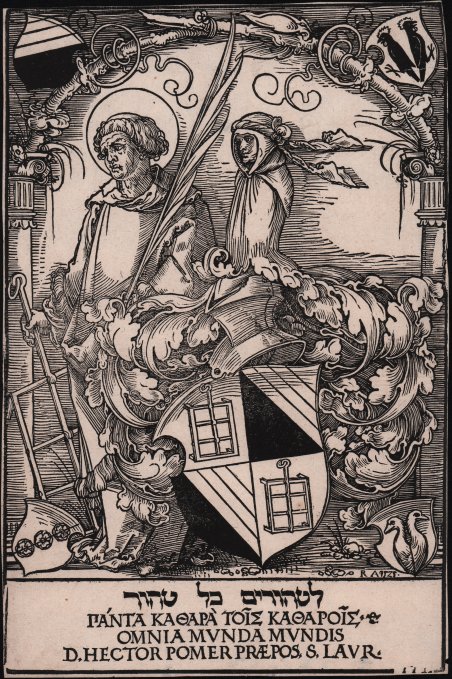
Stemma araldico di Hector Pömer; uno scudo con le armi di Pömer e la graticola di San Lorenzo, raffigurato sotto un arco con cimiero, elmo e mantello. Ai quattro angoli piccoli stemmi con le armi di Pömer, Rummel, Schmiedmaier e Bergmeister. Xilografia firmata R A e datata 1525 nel blocco. In basso testo in ebraico, greco e latino. La scritta in latino recita: OMNIAM MUNDA MUNDIS/ D. HECTOR POMER PRAEPOS S. LAUR. Magnifica prova, particolarmente nitida e contrastata, stampata su carta vergata coeva con filigrana "scudo con corona", con bordo completo, minuscolo restauro all'angolo superiore destro, per il resto in ottime condizioni. La catalogazione di quest'opera è estremamente controversa; è stata prima attribuita ad Albrecht Durer da Bartsch, poi a Hans Sebald Beham da Pauli. Zurwesten l'ha recentemente inserita nuovamente tra le opere di Durer, considerandola il pezzo più importante del maestro nel campo degli ex-libris. Oggi gli esperti concordano sul fatto che Durer stesso abbia preparato il disegno di quest'opera, successivamente intagliato da Hieronymus Andreae Resch, come dimostra il monogramma "R A 1525" [Resch, anno 1525]. Tuttavia, l'opera è assegnata a Hans Sebald Beham nelle principali collezioni museali (BM, Rijks Museum ecc.). Nell'Europa settentrionale del primo Rinascimento, un nutrito gruppo di artisti era solito realizzare numerosi ex-libris, molto richiesti dai personaggi famosi per identificare il possesso di libri e opere d'arte. A partire dall'anno 1490, abbiamo avuto molti esempi del genere, soprattutto dalla scuola di Norimberga e in particolare dai cosiddetti Piccoli Maestri; le qualità estetiche di questi contrassegni ebbe un grande sviluppo negli anni, aumentando il numero di ornamenti e la perfezione dell'intaglio. Hector Pomer era un sacerdote della chiesa di San Lorenzo a Norimberga; per questo motivo qui troviamo San Lorenzo raffigurato con la graticola e la palma del martirio, secondo l'iconografia classica. Dodgson commenta che il monogramma RA è stato associato a Hieronymus Andreae o Resch fin dall'inizio del XIX secolo, anche se non è chiaro perché Andreae abbia scelto di firmarsi con queste iniziali. Un magnifico esemplare di questa xilografia. Bibliografia Pauli 1901-11 / Hans Sebald Beham: Ein Kritisches Verzeichniss seiner Kupferstiche Radirungen und Holzschnitte (1352); Hollstein / German engravings, etchings and woodcuts c.1400-1700 (1352); Dodgson 1903, 1911 / Catalogue of Early German and Flemish Woodcuts in the BM, 2 vols (I.484.159); Bartsch / Le Peintre graveur (VII.169.163); O'Dell 2003 / Deutsche und österreichische Exlibris 1500-1599 im Britischen Museum (304); Bilder-Katalog zu Max Geisberg, der deutsche Einblatt-Holzschnitt in der 1. Hälfte des XVI. Jahrhunderts : 1600 verkleinerte Wiedergaben, cat.nr. 316. The arms of Hector Pömer; an escutcheon with the Pömer arms and the gridiron of St Laurence, with crest, helm and mantling. Placed under an arch, St. Laurence standing on the left. In the four corners small escutcheons with the arms of Pömer, Rummel, Schmiedmaier and Bergmeister. Below a strip with a Hebrew, Greek and Latin motto and the name. Woodcut signed R A and dated 1525 in the block. Below one line of Hebrew, one line of Greek and two lines of Latin. The Latin reading: OMNIAM MUNDA MUNDIS/ D. HECTOR POMER PRAEPOS S. LAUR.' Magnificent work, particularly disputed, printed on contemporary laid paper with “shield with crown” watermark, with complete borderline, tiny restoration on the upper right corner, in excellent conditions. The cataloguing of this work is extremely controversial; it has been first ascribed to Albrecht Durer by Bartsch; then to Hans Sebald Beham by Pauli. Zurwesten has lately included it again in Durer’s work, considering it the most important piece of the master in the field of ex-libris. Nowadays, the experts agree that Durer himself prepared the drawing of this work, afterwards carved by Hieronymus Andreae Resch, as it is shown by the monogram “R A 1525” (Resch, year 1525). However, the work is assigned to Hans Sebald Beham in major museum collections (BM, Rijks Museum etc.). In the northern Europe of the first Renaissance, a large group of artists was used to realize many ex-libris, much in demand among famous people to identify their possession of books and pieces of art. Starting from the year 1490, we have had many examples of the genre, mainly from the school of Nuremberg and particularly from the so-called Little Masters; their aesthetic qualities have had a great development in the years, increasing the number of ornaments and the perfection of the carving. Hector Pomer was a Priest of the church of St. Laurence in Nuremberg; that is why here we find St. Laurence portrayed with the gridiron and the palm of martyrdom, according to the classical iconography. Dodgson comments that the monogram RA has been associated with Hieronymus Andreae or Resch since the early nineteenth century, although it is not clear why Andreae should have chosen to sign with those initials. For use as a bookplate, see O'Dell for earlier literature; also P.Youatt (ed) 'Introduction to Deutsche und Oesterreichische Exlibris 1500-1599' in The Bookplate Journal, Vol 11, no. 2, 2013, p. 109 and fig. 25. Excellent work. Bibliografia Pauli 1901-11 / Hans Sebald Beham: Ein Kritisches Verzeichniss seiner Kupferstiche Radirungen und Holzschnitte (1352); Hollstein / German engravings, etchings and woodcuts c.1400-1700 (1352); Dodgson 1903, 1911 / Catalogue of Early German and Flemish Woodcuts in the BM, 2 vols (I.484.159); Bartsch / Le Peintre graveur (VII.169.163); O'Dell 2003 / Deutsche und österreichische Exlibris 1500-1599 im Britischen Museum (304); Bilder-Katalog zu Max Geisberg, der deutsche Einblatt-Holzschnitt in der 1. Hälfte des XVI. Jahrhunderts : 1600 verkleinerte Wiedergaben, cat.nr. 316. Cfr.
 Descubre cómo utilizar
 Descubre cómo utilizar