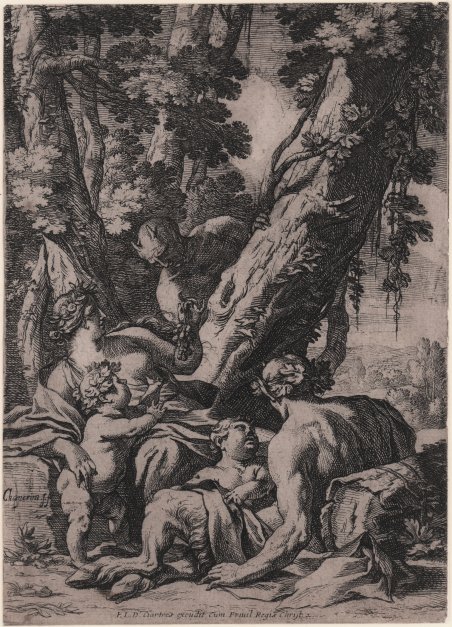
Donna che riposa, con due bambini e un satiro, all'ombra di un albero; la donna, che tiene in mano un grappolo d'uva, parla con un satiro in piedi dietro l'albero. Acquaforte e bulino, circa 1640.Magnifica prova, impressa su carta vergata coeva, rifilata al rame, in buono stato di conservazione. Appartiene alla serie denominata "Recueil de diverses Bacchanales", incisa da Chaperon e Dorigny (tra gli altri) e raffigurante scene dionisiache; le tavole descritte da Robert-Dumesnil (IV.254.12-17) sono tutte anonime ed è quindi difficile attribuirle con certezza. Nicolas Chaperon fu annoverato da Pierre-Jean Mariette tra i più abili allievi di Simon Vouet. Dopo aver completato l'apprendistato nella grande bottega parigina di Vouet, Chaperon fu sedotto dal raffinato classicismo di Nicolas Poussin, che forse incontrò a Parigi e che certamente conobbe a Roma. Intorno al 1640-2, Chaperon si recò a Roma dove lavorò sotto la guida di Poussin per François Sublet de Noyers nella Galleria Farnese. La tecnica di Chaperon era così debitrice di Poussin che dipinti del primo periodo, come il suo Nutrimento di Giove (Ackland Art Museum), sono stati attribuiti come opere di Poussin fino al XIX secolo. Il loro rapporto professionale a Roma fu di breve durata e nel 1644 Chaperon era documentato a Malta, forse a seguito di una disputa con il maestro. Nel 1649 Chaperon tornò a Roma, dove pubblicò una serie di incisioni dopo gli affreschi di Raffaello nelle Loggie Vaticane, generalmente considerate le più belle incisioni dopo il celebre ciclo. Chaperon, come Poussin, trascorrerà gli ultimi anni a Roma e non tornerà più in patria. Rara. Bibliografia Inventaire du Fonds Français: Bibliothèque Nationale, Département des Estampes, Paris, 1930, 57; Robert-Dumesnil VI.231.57.I. Etching with engraving, circa 1640.Draped woman resting with two young children and a satyr in the shade of a tree; the woman, holding a bunch of grapes in her hand, is talking to a satyr standing behind the tree.A fine impression, printed on contemporary laid paper, trimmed to the borderline, good condition.Form the set called 'Recueil de diverses Bacchanales', engraved by Chaperon and Dorigny (among others) and representing dionysiac scenes; the plates described by Robert-Dumesnil (IV.254.12-17) are all anonymous and it is therefore difficult to attribute them with certitude. Nicolas Chaperon was ranked by Pierre-Jean Mariette among Simon Vouet's most accomplished pupils. After completing his apprenticeship in Vouet's large Paris workshop, Chaperon was seduced by the refined classicism of Nicolas Poussin, whom he may have met in Paris and certainly knew in Rome. In around 1640-2, Chaperon travelled to Rome where he worked under Poussin for François Sublet de Noyers in the Galleria Farnese. Chaperon's technique was so indebted to Poussin that paintings by the former, such as his Nurture of Jupiter (Ackland Art Museum, Chapel Hill, NC; fig. 1), were engraved as works by Poussin as late as the nineteenth century. Their professional relationship in Rome was short-lived, and by 1644 Chaperon was documented in Malta, possibly as a result of a dispute with the master. In 1649 Chaperon returned to Rome, where he published a series of engravings after Raphael's frescoes in the Vatican Loggie, generally considered the finest engravings after the celebrated cycle. Chaperon, like Poussin, would spend his final years in Rome, never returning to his native country. Bibliografia Inventaire du Fonds Français: Bibliothèque Nationale, Département des Estampes, Paris, 1930, 57; Robert-Dumesnil VI.231.57.I. Cfr.

 Descubre cómo utilizar
 Descubre cómo utilizar