Frontespizio delle Vedute
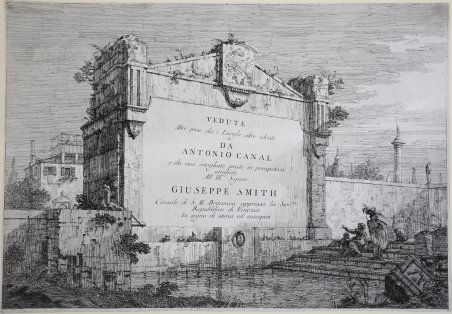
Frontespizio delle Vedute
Formas de Pago
- PayPal
- Tarjeta de crédito
- Transferencia Bancaria
- Pubblica amministrazione
- Carta del Docente
Detalles
- Año de publicación
- 1740
- Formato
- 422 X 290
- Grabadores
- CANALETTO Giovanni Antonio Canal detto
- Materia
- Frontespizi e Allegorie
Descripción
Acquaforte, circa 1740, firmata in lastra in basso al centro. Bellissima prova del secondo stato di due, con il titolo scritto, impressa su carta vergata coeva con filigrana “tre lune” (Bromberg 11), rifilata al rame, piccolo restauro all’angolo superiore destro, per il resto in ottimo stato di conservazione. Il primo stato di questo squillante frontespizio che condensa la tematica della serie, è conosciuto in un unico esemplare con la dedica di pugno del Canaletto. Esso fa parte di un album contenente le incisioni canalettiane appartenuto ad Anton Maria Zanetti, oggi conservato al Kupferstichkabinett di Berlino. Sempre nello stesso museo è anche conservato un disegno ad inchiostro bruno che rappresenta una composizione fantastica e che può considerarsi come la prima idea per la stesura del frontespizio. L’opera appartiene alle ' Vedute altre prese da i luoghi altre ideate… serie delle acqueforti dedicate al console ed amico Joseph Smith, la cui esecuzione va dal 1740 al 1744 circa. Si inserisce nello sviluppo artistico del Canaletto non come parentesi marginale, ma come un momento essenziale di alcuni problemi stilistici, che troveranno la loro piena realizzazione nei primi capolavori eseguiti nel soggiorno inglese. La serie raggruppa fogli che evocano un itinerario che partendo dalla laguna, cioè da Marghera, passando per Mestre, risale il corso del Brenta fino a Padova, non solo inscenata nel cosmorama del Prà della Valle ma in una veduta che segna il passaggio tra la realtà dei luoghi e la fantasia del capriccio. Se il Portico con la lanterna, indubbiamente una delle prove più alte dell’arte incisoria del Canaletto, è una veduta di piena fantasia, l’acquaforte con la cosiddetta Casa del 1741, ricongiunta con la Casa del colonnato, è l’evocazione di una città, che se pur manca di precisi riferimenti topografici, è intrisa di atmosfera veneziana. Giovanni Antonio Canal detto Canaletto (Venezia 17 ottobre 1697 – Venezia 19 aprile 1768) fu il più illustre protagonista del vedutismo veneziano del Settecento. Grazie a contatti con amatori e collezionisti inglesi in viaggio a Venezia o residenti nella città lagunare, Canaletto beneficia di grande notorietà in Inghilterra presso la più alta aristocrazia e perfino la famiglia reale. Attorno al 1730 suo agente esclusivo è un inglese, il console Joseph Smith: divenuto mercante di quadri, questi si adopera con abilità e tenacia per introdurre il suo protetto nel mercato britannico delle opere d’arte, il più florido al tempo. Titolare di una grande bottega e affiancato da innumerevoli assistenti, Canaletto è artista e abile imprenditore. Nelle opere del Canaletto la città lagunare era raffigurata con grande oggettività: le sue composizioni erano sempre rigorosamente studiate attraverso numerosi disegni preparatori, tratti direttamente dal vero. La “veduta” fu uno dei generi più caratteristici della pittura del Settecento. Si differenzia dal paesaggio (altro genere molto diffuso nel XVIII secolo) per la rappresentazione oggettiva di luoghi e architetture, realizzata attraverso una prospettiva ben studiata. Venezia fu il centro di maggior produzione di “vedute”, con alcune personalità di grande spicco. Magnifica prova. ' Bibliografia Bromberg p. 37, 1; Succi, Da Carlevaris ai Tiepolo, p. 97, 67. Etching, circa 1740, signed at the bottom center. Excellent impression, of the second state of two, with the title written, printed on contemporary laid paper "three moons" watermark (Bromberg 11), trimmed to the platemark, small restoration to the upper-right corner, otherwise excellent conditions. The first state of this title is known in a single copy with a manuscript dedication of Canaletto's. It is part of an album containing the Canaletto engravings that belonged to Anton Maria Zanetti, now preserved at the Kupferstichkabinett in Berlin. In the same museum is also preserved a brown ink drawing that represents a fantastic composition, and which can be regarded as the first idea for this title page. The work belongs to the ' Vedute altre prese da i luoghi altre ideate. series of etchings dedicated to the consul and friend Joseph Smith, whose execution goes from about 1740 to 1744. It is part of the artistic development of Canaletto not as a marginal parenthesis, but as an essential moment of some stylistic problems, which will find their full realization in the first masterpieces executed in his English stay. The series groups together sheets that evoke an itinerary that starting from the lagoon, that is from Marghera, passing through Mestre, goes up the course of the Brenta to Padua, not only staged in the cosmorama of Prà della Valle but in a view that marks the passage between the reality of places and the fantasy of caprice. If the Portico with the lantern, undoubtedly one of the highest proofs of Canaletto's engraving art, is a view of full fantasy, the etching with the so-called House of 1741, rejoined with the House of the colonnade, is the evocation of a city, which even though it lacks precise topographical references, is imbued with Venetian atmosphere. ' Giovanni Antonio Canal called Canaletto (Venice 17 October 1697 - Venice 19 April 1768) was the most illustrious protagonist of the Venetian vedutismo of the eighteenth century. Thanks to his contacts with English amateurs and collectors travelling to Venice or living in the lagoon city, Canaletto enjoyed great notoriety in England among the highest aristocracy and even the royal family. Around 1730 his exclusive agent was an Englishman, the consul Joseph Smith: having become a picture dealer, he worked with skill and tenacity to introduce his protégé into the British market of works of art, the most flourishing at the time. Owner of a large workshop and flanked by countless assistants, Canaletto is an artist and a skilled entrepreneur. In Canaletto's works the lagoon city was depicted with great objectivity: his compositions were always rigorously studied through numerous preparatory drawings, taken directly from life. The "veduta" was one of the most characteristic genres of eighteenth-century painting. It differs from landscape (another genre widespread in the eighteenth century) for the objective representation of places and architecture, achieved through a well-studied perspective. Venice was the center of greater production of "views", with some very important personalities. Magnificent example. Bibliografia Bromberg p. 37, 1; Succi, Da Carlevaris ai Tiepolo, p. 97, 67. Cfr.
