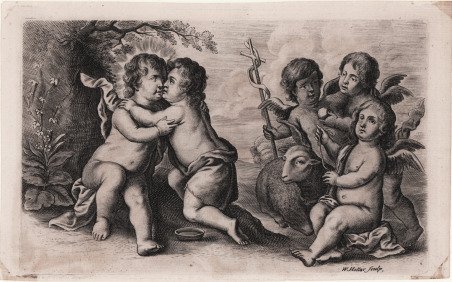
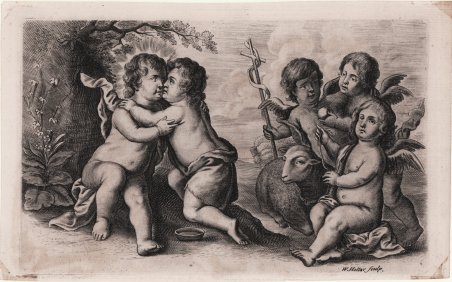
Gesù bambino seduto sotto un cespuglio di rose a sinistra, benedicendo San Giovanni Battista, che gli porge una corona di rose; un agnello disteso tra loro e un cherubino dietro che tocca San Giovanni, un altro che raccoglie rose, e altri due che sistemano fiori in un cesto a destra. Acquaforte, 1646, da Peeter van Avont, firmata all'interno del disegno in basso al centro con i nomi degli artisti: 'P. van Avont inu: W Hollar fecit' e con '11' in basso a destra. Esempio del secondo stato di due. Da una serie di dodici tavole di Hollar, con cherubini e Gesù bambino e San Giovanni Battista; ideate e pubblicata da Peeter van Avont (The New Hollstein nn. 849-860). Pieter van Avont (Mechelen, 1600-1652) è stato un pittore e incisore fiammingo specializzato in ritratti, soggetti religiosi e storici, nonché copie da maestri più celebri, come Rubens e Van Dyck. Dal 1622/1623 fu maestro indipendente iscritto alla corporazione di San Luca di Anversa. Collaborò spesso con altri artisti, quali Jan Brueghel il Vecchio, David Vinckboons, Lucas van Uden, Jan Wildens e Jacques d'Arthois, per i quali provvide le figure, cioè alla pittura dei personaggi facenti da scala di comparazione delle dimensioni nei paesaggi. Wenceslaus Hollar (23 luglio 1607 - 25 marzo 1677) è stato un prolifico artista grafico boemo del XVII secolo, che trascorse gran parte della sua vita in Inghilterra. È particolarmente noto per le sue incisioni e acqueforti. Nacque a Praga, morì a Londra e fu sepolto nella chiesa di Santa Margherita a Westminster. Hollar fu uno dei migliori e più prolifici artisti del suo tempo. Il suo lavoro include circa 3000 incisioni che includono vedute, ritratti, navi, soggetti religiosi, soggetti araldici, paesaggi e nature morte in molte forme diverse. ' ' Bellissima prova, impressa su carta vergata coeva, con margini, in ottimo stato di conservazione. Bibliografia New Hollstein (German) / The New Hollstein: German engravings, etchings and woodcuts 1400-1700 (859.II); Pennington 1982 / A descriptive catalogue of the etched work of Wenceslaus Hollar (496.II). The infant Jesus seated below a rose bush at left, blessing St John the Baptist, who hands him a wreath of roses; a lamb lying between them and a cherub behind touching St John, another picking roses, and two others arranging flowers in a basket at right. Etching, 1646, after Peeter van Avont, lettered within design at lower centre with artists' names: 'P. van Avont inu: W Hollar fecit' and with '11.' in lower right corner. Example of the second state of two. From a set of twelve plates by Hollar, featuring cherubs and the infant Jesus and St John the Baptist, after and published by Peeter van Avont (The New Hollstein nn. 849-860). Pieter van Avont (Mechelen, 1600-1652) was a Flemish painter and engraver who specialized in portraits, religious and historical subjects, as well as copies from more famous masters, such as Rubens and Van Dyck. From 1622/1623 he was an independent master enrolled in the guild of St. Luke in Antwerp. He often collaborated with other artists, such as Jan Brueghel the Elder, David Vinckboons, Lucas van Uden, Jan Wildens and Jacques d'Arthois, for whom he provided the figures, i.e. the painting of the characters as a scale of size comparison in landscapes. Wenceslaus Hollar (July 23, 1607 - March 25, 1677) was a prolific 17th-century Bohemian graphic artist who spent much of his life in England. He is particularly known for his engravings and etchings. He was born in Prague, died in London, and was buried in St. Margaret's Church in Westminster. Hollar was one of the best and most prolific artists of his time. His work includes approximately 3000 etchings that include views, portraits, ships, religious subjects, heraldic subjects, landscapes and still lifes in many different forms. ' ' A fine impression, printed on contemporary laid paper, with margins, ggod condition. Bibliografia New Hollstein (German) / The New Hollstein: German engravings, etchings and woodcuts 1400-1700 (859.II); Pennington 1982 / A descriptive catalogue of the etched work of Wenceslaus Hollar (496.II). Cfr.

 Descubre cómo utilizar
 Descubre cómo utilizar