Giochi di putti
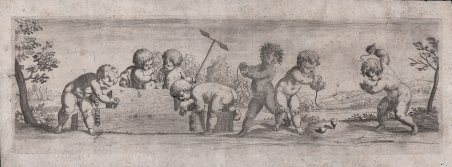
Giochi di putti
Formas de Pago
- PayPal
- Tarjeta de crédito
- Transferencia Bancaria
- Pubblica amministrazione
- Carta del Docente
Detalles
- Año de publicación
- 1630
- Formato
- 380 X 125
- Grabadores
- Anonimo
Descripción
Acquaforte, circa 1630/50, priva di firma e dati editoriali. Bellissima prova, impressa su sottile carta vergata coeva priva di filigrana databile alla prima metà del ‘600, con margini, piccoli strappi restaurati, leggera ossidazione e tracce di colla al verso, nel complesso in buono stato di conservazione. Sebbene anonima la stampa, stilisticamente, rispecchia lo stile francese della prima metà del Seicento. In particolare, appare vicina, ma non appartiene, all’opera di Robert Picou (circa 1593 Tours – 1671 Paris). Non è descritta né da Le Blanc né da Robert-Dumesnil, anche se entrambi registrano alcune tavole raffiguranti soggetti simili. La maggior parte delle opere conosciute di Picou sono, infatti, immagini di bambini o amorini, i cui corpi paffuti sono una caratteristica facilmente riconoscibile. Robert Picou studiò sotto Jacob Bunel e fu attivo nella prima metà del XVII secolo. Poco si sa della vita di questo pittore e incisore, che nel corso della sua carriera fu insignito del titolo di "peintre du roi". Tra il 1623 e il 1626 fu evidentemente a Roma, dove una nota nei registri parrocchiali della chiesa di Sant'Andrea delle Fratte indica che era impiegato come pittore per il re di Spagna. Si pensa anche che fosse amico di Pierre Brebiette. Nel suo catalogo delle opere, Robert-Dumesnil elenca solo sette stampe di Picou, tutte considerate di estrema rarità ("Elles sont si rares, que M. de Marolles n'en avait pu réunir que trois"). Etching, circa 1630/50, lacking signature and printing details. Beautiful proof, printed on thin contemporary laid paper without watermark (datable to the first half of the 17th century), with margins, small restored tears, light oxidation and traces of glue on verso, overall in good condition. Although anonymous, the print stylistically reflects the French style of the first half of the 17th century. It appears close to, but does not belong to, the work of Robert Picou (ca. 1593 Tours - 1671 Paris). Not described by Le Blanc or Robert-Dumesnil, although both of them do record a few plates depicting similar subjects. Most of the works known to be by Picou after his own inventions are images of children or cupids, whose plump bodies are an easily recognisable characteristic. Robert Picou studied under Jacob Bunel and was active in the first half of the 17th century. Little is known of the life of this painter and etcher, who in the course of his career was awarded the title of “peintre du roi”. Between 1623 and 1626 he was evidently in Rome, where a note in the parish records of the church of Sant’Andrea delle Fratte indicates that he was employed as a painter for the king of Spain. He is also thought to have been friends with Pierre Brebiette. In his catalogue of works Robert-Dumesnil lists just seven prints by Picou, all of which he records as being of the utmost rarity (“Elles sont si rares, que M. de Marolles n’en avait pu réunir que trois”). Cfr.
