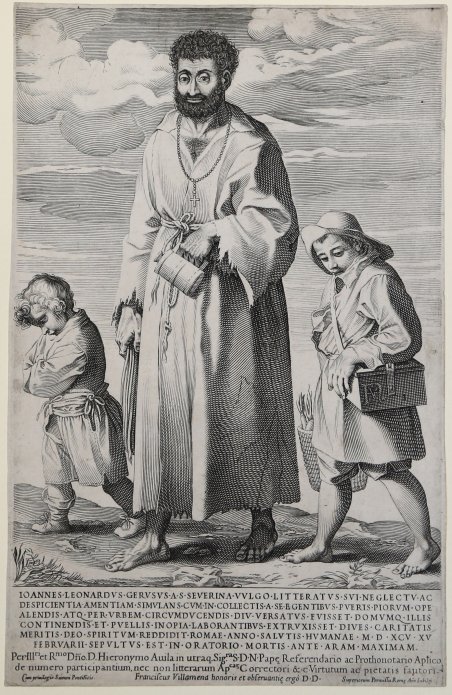
Bulino, 1600, firmato in lastra in basso al centro. Magnifica prova, impressa su carta vergata coeva con filigrana “ancora nel cerchio e stella”, rifilata al rame, in ottimo stato di conservazione. Il ritratto raffigura Giovanni Leonardo Ceruso (1551 – 1595) mentre chiede l’elemosina accompagnato da due bambini. Figura molto popolare nella Roma di fine ’500, fu apprezzato e lodato per la sua opera caritatevole rivolta a “ricettare i putti”, cioè ad occuparsi dei bambini poveri per i quali trovò diversi alloggi, tra via Giulia e piazza del Popolo. La nostra principale fonte biografica è la “Vita di Gio. Leonardo Ceruso detto Letterato” scritta da Marcello Mansi e pubblicata a Roma nel 1625. Apprendiamo che nacque nel 1551 “in Carifi Cafale di San Severino [Carifi è una frazione del comune campano di Mercato San Severino ndr.], Diòcesi di Salerno, luogo lontano da Napoli circa- à trenta miglia.” “E perché spesso, e quasi sempre parlava latino, e con una bacchetta - la quale soleva tenere in mano mentre stava tra scolari- spesso scriveva in terra, i giovani più grandi cominciarono a chiamarlo col soprannome di Letterato che divulgandosi per la Terra, fu da tutti sempre chiamato LETTERATO.” Giunto a Roma, non avendo denaro a sufficienza, fu accettato come palafreniere alla corte dei Medici, prima di dedicarsi “a far la carità di ricettare i putti”, dal 1582 alla sua morte, avvenuta il 15 febbraio del 1595. Nel ritratto Ceruso è accompagnato da due bambini secondo quella che divenne la sua consuetudine: “per non tenere detti Putti otiosi, cominciò ad accoppiarli à due à due, & egli appresso, e con molta mortificatione andavano cantando per la Città le orazioni suddette, il che fu cagione che moltiplicassero ancora l’elemosine che accrescesse ancora, il numero di detti Putti”. La popolarità e la fama di Ceruso furono tali che subito dopo la sua morte “i Governatori dei Putti” in segno di gratitudine fecero realizzare “fra la porta dell’Oratorio e quella di Casa” un ritratto “dal naturale con l’habito, che soleva portare per Roma con la cassetta in mano”. Cosa più interessante, Mansi ricorda che un secondo ritratto fu commissionato dalla Confraternita dell’Oratorio della Morte per essere collocato sul luogo di sepoltura, davanti all’altare maggiore della Chiesa di Santa Maria dell’Orazione e Morte (in via Giulia); rimosso insieme agli ex voto per ordine di Papa Urbano VIII perché non ancora dichiarato Beato, il ritratto “in miglior forma” fu ristampato in rame da Villamena con la lunga iscrizione in basso. Riteniamo quanto mai opportuno riportare il la descrizione fisica di Ceruso che traccia il Mansi, perfettamente aderente all’incisione: “Non disdirà per aventura ' havendo io descritto le fattezze dell' animo del buon LETTERATO , il raccontare ancora le proportioni del corpo* Era dunque questo servo di Dio di mediocre statura, mà ben proportionata, la fronte era larga , e spaziosa, le ciglia inarcate notabilmente, gli occhi neri, il naso alquanto affilato, la bocca larga e le labbra assai sottili, e quasi sempre livide, i denti mediocri, & assai bianchi, il mento alquanto quadro, con barba, e capelli tiranti al nero, & un poco al riccio, le braccia proportionate al rimanente della persona, le mani piuttosto corte ' che lunghe , le spalle assai larghe nel mezzo, e verso i fianchi, per il molto patire, assai svelto , come ancora le gambe assai fottili , e finalmente i piedi secchi, e lunghi”. L'incisione appartiene alla serie che viene definita, erroneamente secondo Michael Bury, "I sei mestieri di Roma". “One of what are incorrectly called the Six Cries of Rome. Although some of these figures appear to be real individuals, familiar to Villamena and to those to whom he dedicated the prints, the tradition out of which they come is that of representations of trades. There are Flemish engravings that could have had an infl. Giovanni Leonardo Ceruso, a mendicant friar, walking holding a mug with two children accompanying him. Engraving, 1600, Lettered in lower margin with six lines of biography and with a dedication to Hieronimo Aquila by the engraver. With privilege 'Cum privilegio summi pontificis' and permission 'Superiorum permissu Romae Anno Iubilei'. Excellent work, printed on contemporary laid paper with "anchor in circle with star" watermark, trimmed to platemark, in very good condition. This can be dated 1600 from the privilege granted in the Jubilee year. Giovanni Lorenzo Ceruso (1551 – 1595), detto il Letterato, born in the diocesi of Salerno, in 1551, his first occupation was a teacher of the parish school. The scholars on account of his good knowl edge of Latin and his habit of writing on the ground with a chopstick called him Letterato. Coming to Rome, because he lacked money he was accepted as a groom in the Medici court, then going to Loreto, he returned to Rome in 1582. On seeing great poverty and abandoned babies, he cared for them first in small rooms in the Cortile di Chigi in Banchi. Moving elsewhere with the orphans, he found housing on via Giulia near the church of Santo Spirito della Nazione del Regno di Napoli. From there he moved to San Lorenzo in Panisperna and then he obtained a place near Madonna de’ Miracoli. Ceruso’s life and his acts of charity were written Marcello Mansi and published in Rome 1625 “Vita di Gio. Leonardo Ceruso detto Letterato”: "in order not to make the children idle, he began to pair them up two by two, and he followed them and with much mortification they went singing prayers and begging alms through the City.” Ceruso Died on February 15, 1595. His popularity and fame were such that soon after his death "the Governors of the Putti" as a sign of gratitude had a portrait made "between the door of the Oratory and that of the House" "from the natural with the habito, which he used to carry around Rome with the cassette in his hand." More interestingly, Mansi recalls that a second portrait was commissioned by the Confraternity of the Oratory of Death to be placed at his burial place, in front of the high altar of the Church of Santa Maria dell'Orazione e Morte (in Via Giulia); removed along with the ex votos by order of Pope Urban VIII because he had not yet been declared Blessed, the portrait "in better form" was “reprinted in copperplate by Villamena” ' with the long inscription at the bottom. The engraving belongs to the series that is called, incorrectly according to Michael Bury, "The Six Trades of Rome": “One of what are incorrectly called the Six Cries of Rome. Although some of these figures appear to be real individuals, familiar to Villamena and to those to whom he dedicated the prints, the tradition out of which they come is that of representations of trades. There are Flemish engravings that could have had an influence, for example the interesting series of Four Elements of 1597, which figured trades, by Claesz Jansz. Clock (Hollstein nos.12-15). But there were already prints of subjects very close to Villamena's circulating in Rome in the 1580s as is suggested by the roast chestnut seller ('il Caldarostaro') and the chimney sweep ('il spazzo Camino') listed among the prints of Pietro de' Nobili in 1584 (Lincoln, 2000, p.187). As McTighe (1993, p. 87) pointed out, this figure of Geminiano demonstrates a very different attitude to the one adopted in Carracci's “Arti di Bologna”. Villamena makes the figure grotesque. In the doggerel verse in the margin it is said that his shout is so loud that it would make Hell shake. It is clear that this is meant to be humorous and Villamena is in a tradition that goes back to Dürer's Peasant at Market (Bartsch VII.99.89)" (cf. Michael Bury, 'The Print in Italy 1550-1620', BM 2001 cat.116) Bibliografia Le Blanc 96; Kühn-Hattenhauer 1979 pp.129-33; cfr. Michael Bury, 'The Print in Italy 1550-1620', BM 2001 cat.116;. Cfr.

 Descubre cómo utilizar
 Descubre cómo utilizar