Globi coelestis in Tabulas Planas Redacti Pars V
Globi coelestis in Tabulas Planas Redacti Pars V
Formas de Pago
- PayPal
- Tarjeta de crédito
- Transferencia Bancaria
- Pubblica amministrazione
- Carta del Docente
Detalles
- Año de publicación
- 1742
- Lugar de impresión
- Norimberga
- Formato
- 580 X 500
- Grabadores
- DOPPELMAIER Gabriel
- Materia
- Carte Celesti
Descripción
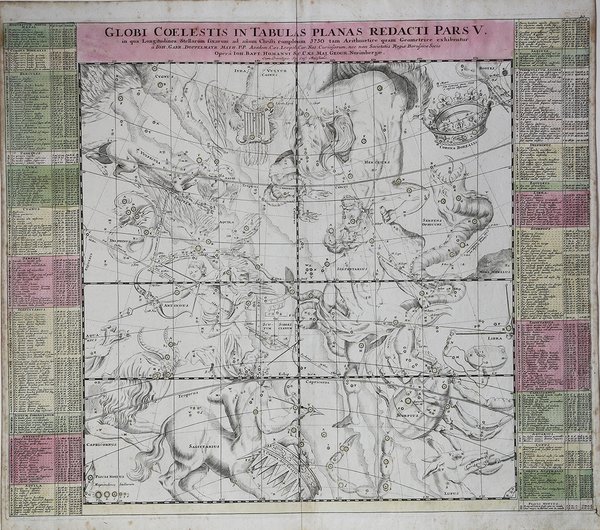
Carta celeste raffigurante le costellazioni zodiacali, rappresentate nella classica forma di animali mitologici. Si tratta della carta numero 24 dell’Atlas Coelestis (1742) di Johann Gabriel Doppelmaier che il professore di matematica all’Aegidien Gymnasium di Norimberga, rifacendosi in parte al lavoro di Pardies, redasse intorno al 1720 per conto dell’officina tipografica fondata nella stessa città nel 1702 dal cartografo Johann Baptist Homann. La mappa, la quinta di sei che unitamente riproducono l’intera volta stellata, è quadrata di 43,4 centimetri di lato, rappresenta le costellazioni contenute nella fascia celeste intorno al solstizio invernale tra i 225° e i 315° di ascensione retta e i +45° e i -45° di declinazione. ' La proiezione gnomonica è concava, cioè geocentrica, e le stelle, suddivise in classi graduate di sei magnitudini, sono posizionate calcolando la precessione degli equinozi per l’anno 1730, ' vengono identificate da lettere dell’alfabeto latino, la successione ricomincia per ogni costellazione e corrisponde all’elenco ' posizionato a destra e sinistra della carta dove, per ogni stella, troviamo le coordinate in latitudine e longitudine, la magnitudine e la descrizione della posizione anatomica nel personaggio mitologico. I reticoli di riferimento permettono di calcolare la posizione delle stelle in riferimento alla loro ascensione retta e declinazione (tacche di un grado) ma anche alla loro latitudine e longitudine (linee ogni 10 gradi). Sono evidenziate le linee dei tropici, l’equatore, l’eclittica e il coluro dei solstizi. Oltre alle costellazioni tolemaiche di pertinenza della fascia vengono descritte o disegnate le seguenti costellazioni non tolemaiche: Antinous, Cerberus, Scutum Sobiescianum, Vulpecula et Anser, Mons Maenalus. Nella carta è tracciato il percorso di una cometa non nominata che, secondo Robert Harry van Gent, che la ricollega a quella che appare nella Pars I in una zona di cielo contigua, è da accreditare a Philippe de la Hire (1692). Questa cometa attualmente non risulta classificata perché non riconducibile ad osservazioni verificate, anche nelle Mémoires de Mathématique et de Physique raccolte in Histoire de l'Académie (Royale) des sciences, per il 1692, non risultano relazioni di osservazioni di comete effettuate dal de la Hire. Nella tavola troviamo però anche i percorsi di C/1577 V1 di Tycho Brahe, 1P/1607 S1 di Joannes Kepler (è la cometa di Halley), C/1661 C1 di Johannes Hevelius, C/ 1680 V1 di John Flamsteed, C/ 1702 H1 di Philippe de la Hire , C/1707 W1 di Giandomenico Cassini e i percorsi parziali delle comete osservate da G. Cassini e Bianchini rispettivamente nel 1706 e nel 1684 ( riportate complete nella tavola ' Pars IV). Incisione in rame, coloritura coeva, in ottimo stato di conservazione. Celestial chart depicting the zodiacal constellations, represented in the classic form of mythological animals. This is map number 24 of the Atlas Coelestis (1742) by Johann Gabriel Doppelmaier that the professor of mathematics at the Aegidien Gymnasium in Nuremberg, referring in part to the work of Pardies, wrote around 1720 on behalf of the printing house founded in the same city in 1702 by cartographer Johann Baptist Homann. The map, the fifth of six that together reproduce the entire starry sky, is square with 43.4 cm side, represents the constellations contained in the celestial belt around the winter solstice between 225 ° and 315 ° of right ascension and +45 ° and -45 ° of declination. The gnomonic projection is concave, i.e. geocentric, and the stars, divided into graduated classes of six magnitudes, are positioned by calculating the precession of the equinoxes for the year 1730, are identified by letters of the Latin alphabet, the succession starts again for each constellation and corresponds to the list positioned to the right and left of the chart where, for each star, we find the coordinates in latitude and longitude, the magnitude and the description of the anatomical position in the mythological character. The reference grids allow you to calculate the position of the stars with reference to their right ascension and declination (notches of one degree) but also to their latitude and longitude (lines every 10 degrees). The lines of the tropics, the equator, the ecliptic and the solstice colure are highlighted. In addition to the Ptolemaic constellations pertaining to the band, the following non-Ptolemaic constellations are described or drawn: Antinous, Cerberus, Scutum Sobiescianum, Vulpecula et Anser, Mons Maenalus. In the chart is traced the path of an unnamed comet that, according to Robert Harry van Gent, who links it to the one that appears in Pars I in an adjacent area of the sky, is to be credited to Philippe de la Hire (1692). This comet is not currently classified because it is not attributable to verified observations, even in the Mémoires de Mathématique et de Physique collected in Histoire de l'Académie (Royale) des sciences, for 1692, there are no reports of observations of comets made by de la Hire. In the table, however, we also find the paths of C/1577 V1 by Tycho Brahe, 1P/1607 S1 by Joannes Kepler (Halley's comet), C/1661 C1 by Johannes Hevelius, C/1680 V1 by John Flamsteed, C/1702 H1 by Philippe de la Hire, C/1707 W1 by Giandomenico Cassini and the partial paths of comets observed by G. Cassini and Bianchini respectively in 1706 and 1684 (shown complete in the table Pars IV). Copper engraving, contemporary coloring, in excellent condition. Cfr.
