Gruppo di Scale ornato di magnifica Architettura.
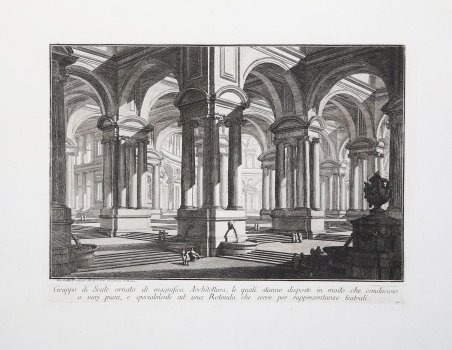
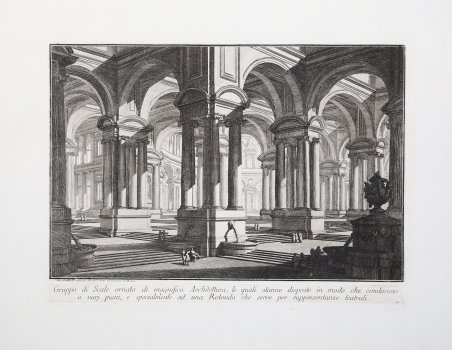
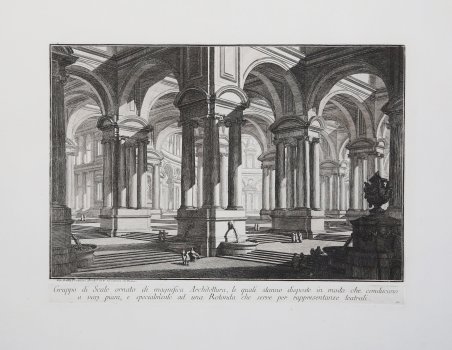
Gruppo di Scale ornato di magnifica Architettura.
Formas de Pago
- PayPal
- Tarjeta de crédito
- Transferencia Bancaria
- Pubblica amministrazione
- Carta del Docente
Detalles
- Año de publicación
- 1750
- Formato
- 250 X 374
- Grabadores
- PIRANESI Giovan Battista
- Descripción
- Robison 9 II/IV, Wilton Ely 11, Focillon 10
Descripción
Acquaforte, bulino e puntasecca, firmata in lastra in basso a sinistra. Esemplare nel secondo stato di quattro. ' La tavola appartiene alla raccolta, iniziata nel 1743, denominata ' Prima Parte di Architetture e Prospettive.Magnifica prova, impressa su carta vergata priva di filigrana, con pieni margini, in ottime condizioni. ' Prima parte di Architetture e Prospettive ' è una pubblicazione del giovane Piranesi, appena stabilitosi a Roma. Il risultato è un’opera non del tutto unitaria, caratterizzata dalla notevole differenza stilistica tra le tavole, ma dal grande fascino e che lascia intuire e prevedere i futuri sviluppi artistici. Il lavoro continua una tradizione di un modello ormai affermato, che prevedeva il capriccio e la veduta, la scenografia ed il trattato di architettura, ma in seguito, analizzando la biografia dell’artista si comprenderà essere soprattutto lo sfogo di una crisi come architetto e di un itinerario interiore vissuto con intensità. Insomma, il frutto dello scontro di una mente legata alla cultura veneziana erede della poesia delle rovine evocata da Marco Ricci e ripresa dal Bellotto e dal Canaletto, e la nuova cultura architettonica che si andava formando nel giovane Piranesi. ' Prima parte di Architetture ' e le successive fantasie architettoniche che la continuano costituiscono un passo decisivo verso lo scopo che egli si prefiggeva nella prefazione all’opera: far sì che il capriccio architettonico portasse a liberare l’architettura dalle catene del mondo materiale e sociale, per farne un’arte veramente liberale. Immediato fu il successo di pubblico che riscosse il lavoro. La prima stesura dell’opera è databile al 1743, e venne dedicata a Nicola Giobbe, grande impresario al servizio della Camera Apostolica e protettore del giovane architetto veneziano. In seguito, la stessa fu inserita in un più ampio discorso che comprendeva anche i quattro ' Capricci ' e pubblicata nelle ' Opere Varie di Architettura Prospettive Grotteschi Antichità Inventate ed incise da Giambattista Piranesi Architetto Veneziano ' stampata da Giovanni Bouchard nel 1750. Esemplare tratto dalla prima edizione della serie ' Opere Varie di Architettura Prospettive Grotteschi Antichità Inventate ed incise da Giambattista Piranesi Architetto Veneziano, edita da Giovanni Bouchard nel 1750. Etching with engraving and drypoint, signed on plate at lower left. Example in the second state of four. Magnificent proof, printed on contemporary laid paper without watermark, whole margins, in very good conditions. From the first edition of the collection Opere Varie di Architettura Prospettive Grotteschi Antichità inventate ed incise da Giambattista Piranesi Architetto Veneziano, edited by Giovanni Bouchard in 1750. This work is part of the project, begun in 1743, called ' Prima parte di Architetture e Prospettive. Prima parte di Architetture e Prospettive ' is a publication by the young Piranesi, who had just settled in Rome. The result is a work that is not entirely unified, characterized by the notable stylistic difference between the plates, but of great charm and that lets you guess and predict future artistic developments. The work continues a tradition of a well-established model, which included the whim and the view, the scenography and the treatise on architecture, but later, analyzing the artist's biography, it will be understood to be above all the outburst of a crisis as an architect and of an inner journey lived with intensity. In short, the result of the clash between a mind tied to Venetian culture, heir to the poetry of ruins evoked by Marco Ricci and taken up by Bellotto and Canaletto, and the new architectural culture that was forming in the young Piranesi. ' Prima parte di Architetture e Prospettive ' and the subsequent architectural fantasies that continue it constitute a decisive step towards the goal he set himself in the preface to the work: to ensure that architectural caprice would lead to free architecture from the chains of the material and social world, to make it a truly liberal art. The work was an immediate success with the public. As mentioned, the first edition of the work dates back to 1743, and was dedicated to Nicola Giobbe, a great impresario at the service of the Camera Apostolica and protector of the young Venetian architect. Later it was included in a wider discourse that included the four ' Capricci ' and published in the ' Opere Varie di Architettura Prospettive Grotteschi Antichità Inventate ed incise da Giambattista Piranesi Architetto Veneziano ' printed by Giovanni Bouchard in 1750. Cfr. Robison 9 II/IV, Wilton Ely 11, Focillon 10
