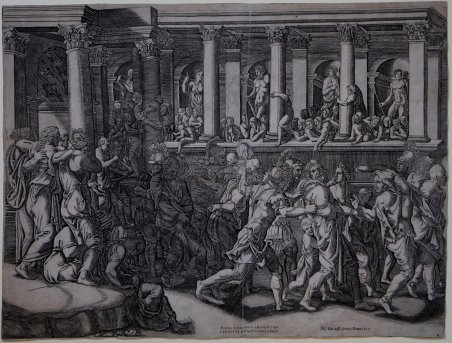
Bulino, circa 1534-1545, firmato in lastra, in basso al centro “IULIUS ROMANUS INVENTOR/GEORGIUS MANTUANUS FECIT”. Esemplare nel secondo stato, di tre, con l’aggiunta, in basso a destra, della firma editoriale “Nico Van aelst formis Romae. 1605”. Da un soggetto di Giulio Romano.Bellissima prova, impressa su due fogli di carta vergata coeva, uniti, rifilati alla linea marginale, in ottimo stato di conservazione.La scena raffigura un corteo formato da prigionieri, di un popolo vinto, che i soldati romani fanno sfilare sulla pubblica via per deriderli. Il corteo, che ha appena oltrepassato un arco, è preceduto da un buffone che, come ricorda Appiano (Guerre Puniche, VIII,9,66) “faceva diverse pantomime, deridendo i nemici prigionieri, per suscitare l’ilarità”.Il soggetto riproduce, in controparte, e con alcune varianti, un disegno di Giulio Romano eseguito per uno degli arazzi ' commissionati da Francesco I, raffiguranti la vita del generale romano Scipione. Il ciclo completo degli arazzi si componeva di due serie: la prima, di 13 arazzi, dedicata alle imprese di Scipione; la seconda, di 10, dedicata ai Trionfi, disegnata da Giulio. Commissionati nel 1532 e completati nel 1535, gli arazzi, tessuti a Bruxelles, sono andati tutti distrutti durante la Rivoluzione Francese. Si sono, invece, conservati i 10 petits patrons, ovvero i disegni preparatori, del Romano, 9 conservati al Louvre e uno a Chantilly. Il disegno preparatorio per Il corteo dei prigionieri è al Louvre, inv. 3540. Oltre all’incisione del Ghisi, soltanto un’altra scena dei Trionfi fu riprodotta in stampa da Primaticcio a Fontainbleau, ed è datata 1543. Quest’opera è la prima lastra di grandi dimensioni incisa da Ghisi. Secondo la Boorsch, è possibile che la lastra sia stata incisa prima del 1534, ovvero prima che i petits patrons fossero spediti a Bruxelles. Inoltre, ipotizza che il modello utilizzato dal Ghisi fosse non il disegno finale di Giulio, ma un altro, molto simile a questo, rimasto a Mantova. La studiosa ha infatti osservato che disegni doppi esistono anche per altri soggetti della serie. Bellini data l’opera alla fine del primo periodo mantovano o ai primi anni del successivo periodo romano, 1546-47, dove l’artista avrebbe portato con sé il disegno. È certo – continua – che il bulino non sia stato stampato a Mantova, come prova l’aggettivo “mantuanus”, che sarebbe stato superfluo aggiungere nella propria città natale. La lastra originale si conserva a Roma, presso la Calcografia Nazionale, inv. 649. Bibliografia Bartsch, XV.68; Boorsch, p.41 n.4.ii; Bellini 1998 p.49 n.7.II. Engraving, circa 1534-1545, signed on the plate, bottom center, "JULIUS ROMANUS INVENTOR / GEORGIUS MANTUANUS FECIT". Second state, of three, added at bottom right the address "Nico Van Aelst formis Romae.1605 ". After Giulio RomanoA good impression, printed on two sheets of contemporary laid paper, joined, trimmed close to the platemark, in excellent condition.The literary source for the image depicted in this print is Appian's Punic Wars (bk. vin, chap, ix, 66): “White oxen came next, and after them elephants and the captive Carthaginian and Numidian chiefs . a chorus of harpists and pipers. . . . One of these, in the middle of the procession, wearing a purple cloak reaching to the feet and golden bracelets and necklace, caused laughter by making various gesticulations, as though he were dancing in triumph over the enemy.”Reproduces in reverse a drawing by Giulio Romano in the Louvre, inv. no. 3540, preparatory to the petit patron (cartone) sent to the weavers of the tapestries for Francis I. Depicing the life of the Roman general Scipio, these were commissioned in 1532 and woven by 1535 in Brussels. They consist of two series, thirteen tapestries representing The Deeds of Scipio and ten The Triumph of Scipio. Giulio Romano made the so-called petits patrons (the drawings used as models for the full- size cartoon from which the weavers would work) for the Triumph series. All ten of these still exist (nine in the Louvre and one at Chantilly).In addition to Ghisi's engraving, only one other print of a scene from the Triumph series was made, by Fantuzzi at Fontainebleau, dated 1543. This was Giorgio Ghisi's first large plate, not yet very satisfactory in draughtsmanship and technique. According to Boorsch, it seems unlikely, although not impossible, that Giorgio made it before 1534, when he was fourteen, the latest date at which the petits patrons would have been sent to Brussels. The print and the petit patron are, however, virtually the same size, and the print does reflect the quality of Giulio's hand. We suggest that the engraving could have been made not from the final petit patron, but from a drawing very similar to it that remained in Mantua when the petits patrons were sent to Brussels. Such drawings are known to have existed for other subjects in the series. It is also possible that the drawing was returned to Mantua after the tapestries were completed. Bellini reports the work at the end of the first period Mantua or early next Roman period, 1546-47, where the artist would bring the design. He claims that that the plate was not printed in Mantua, as evidence the adjective "Mantuanus", which would been superfluous to add in their own hometown.The plate is in the Calcografia Nazionale, in Rome, inv. 649. Bibliografia Bartsch, XV.68; Boorsch, p.41 n.4.ii; Bellini 1998 p.49 n.7.II. Cfr.

 Descubre cómo utilizar
 Descubre cómo utilizar