Il Cristo della Moneta o Il Tributo della Moneta
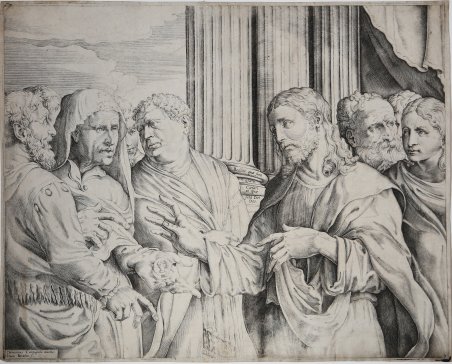
Il Cristo della Moneta o Il Tributo della Moneta
Formas de Pago
- PayPal
- Tarjeta de crédito
- Transferencia Bancaria
- Pubblica amministrazione
- Carta del Docente
Detalles
- Año de publicación
- 1564
- Formato
- 435 X 347
- Grabadores
- BERTELLI Luca
Descripción
Bulino, circa 1564-89, firmato 'Dominicus Campagnola inventor / Lucas Bertelius f.'. Sulla colonna si legge: 'Reddite, quae sunt Caesaris, Caesari: et quae sunt Dei, Deo'.Bellissima impressione di questo raro soggetto inciso da Bertelli da un modello di Domenico Campagnola. Foglio in ottimo stato di conservazione, completo di piccoli margini oltre la battuta del rame.L’impressione risulta molto nitida e fresca, stampata su carta vergellata avente filigrana “Ancora nel cerchio”, databile alla metà del ‘500. La scena rappresenta la parabola della moneta, tratta dal Nuovo Testamento: i farisei, per tendergli una trappola, chiesero a Gesù se fosse lecito o no pagare il tributo a Cesare. Cristo rispose con molta saggezza. Si fece mostrare la moneta con l’immagine dell’imperatore e chiese: “Di chi è questa immagine e l’iscrizione?” I farisei risposero: “Di Cesare”. Allora disse: “Rendete dunque a Cesare quello che è di Cesare e a Dio quello che è di Dio” (Mt 22, 15-21; Lc 20, 20-26; Mc 12, 13-17). “Nell’ultimo tratto della sua vita Domenico Campagnola deve aver fornito a Luca Bertelli i disegni preparatori per per il Tributo della moneta e per la serie dedicata alla parabola di Lazzaro e del ricco Epulone (Lc 16,19-31): Lazzaro al banchetto del ricco Epulone – di cui si conserva un disegno alla Morgan Library di New York - La morte del ricco Epulone, e infine Il ricco Epulone negli Inferi” (cfr. Marsel Grosso, Un Editore Per Tiziano: Luca Bertelli e le Stampe di Devozione tra Italia e Spagna, p. 58, in “Venezia e gli Asburgo”, 2018). Luca Bertelli ebbe una bottega di libraio a Padova tra il 1564 ed il 1594. Già però attorno al 1560, ma solo fino al 1582, fu attivo a Venezia nel mondo della calcografia come editore, incisore e mercante e in una copia dell’incisione di Cornelis Cort, L’Annunciazione, appare nella sottoscrizione l’indicazione della bottega veneziana in aede Salvatoris. Talora nelle sue stampe comparve anche la data di Roma, segno per la Borroni “di un inserimento nel mercato più che di un soggiorno” (cfr. Fabia Borroni - Dizionario Biografico degli Italiani - Volume 9, 1967). Luca Bertelli negli anni ‘80 produsse alcune incisioni firmate L.B. et socius: in questo caso la Borroni ipotizza una partecipazione di Orazio Bertelli, che forse fu suo fratello. ' Foglio di grande interesse collezionistico. Al verso timbro di collezione "CB o GB in un cerchio", stampato in rosso, non identificato in Lugt. Bibliografia Marsel Grosso, Un Editore Per Tiziano: Luca Bertelli e le Stampe di Devozione tra Italia e Spagna, in “Venezia e gli Asburgo. Pittura, collezionismo e circuiti commerciali nel tardo Rinascimento Europeo”, a cura di Benedetta Crivelli, Sarah Ferrari, Marsel Grosso, Padova 2018, pp. 58-59. The tribute to Caesar, with Christ, seen half-length, standing on the right and addressing a man standing on the left and holding two coins in his left hand; several figures surround them; in the background, a curtain and three columns on the right, and the sky on the left; after Domenico Campagnola.Engraving, circa 1564-89, lettered with production detail: 'Dominicus Campagnola inventor / Lucas Bertelius f.'. Lettered within image, on the bottom part of a column: 'Reddite, quae sunt Caesaris, Caesari: et quae sunt Dei, Deo'.A great impression, printed on contemporary laid paper with "anchor in a circle", with small margins, perfect condition.The question of paying tribute to Caesar, at the left two Jews interrogate Christ, one holds a coin, Christ points to the upper right.The subject is taken from the New Testament. The Pharisees ask Christ whether it is right to pay tax to the Romans. Christ, sensing the trap, asks whose likeness and name are on the coinage: 'They say unto him, Caesar's. Then he saith unto them, render therefore unto Caesar the things that are Caesar's; and unto God the things that are God's' (Matthew 22; Mark 12, Luke 20). In the last part of his life Domenico Campagnola provided Luca Bertelli with the preparatory drawings for the Tribute to Caesar and for the series dedicated to the parable of Lazarus and the rich man Epulone (Lk 16,19-31): Lazarus at the banquet of the rich man Epulone - of which a drawing is conserved at the Morgan Library of New York - The Death of the Rich Epulone, and finally The Rich Epulone in the Hell. Luca Bertelli had a bookseller's store in Padua between 1564 and 1594. Already around 1560, but only until 1582, he was active in Venice in the world of chalcography as a publisher, engraver and merchant and in a copy of the engraving of Cornelis Cort, The Annunciation, appears in the signature the indication of the Venetian workshop in aede Salvatoris. Sometimes in his prints also appeared the date of Rome, a sign for Borroni "of an insertion in the market rather than a stay" (see Dizionario Biografico degli Italiani - Volume 9, 1967). Bertelli in the '80s produced some engravings signed L.B. et socius: in this case the Borroni hypothesizes a participation of Orazio Bertelli, which perhaps was his brother. ' A very rare work. On verso colloctor's mark "CB or GB in a circle" printed in red, not in Lugt. Bibliografia Marsel Grosso, Un Editore Per Tiziano: Luca Bertelli e le Stampe di Devozione tra Italia e Spagna, in “Venezia e gli Asburgo. Pittura, collezionismo e circuiti commerciali nel tardo Rinascimento Europeo”, a cura di Benedetta Crivelli, Sarah Ferrari, Marsel Grosso, Padova 2018, pp. 58-59. Cfr. Zani, 1821, pp. 72-73; Zoltán Kárpáti and Eszter Seres, Italian and French Prints before 1620: An On-Line Catalogue, Museum of Fine Arts, Budapest 2012.
