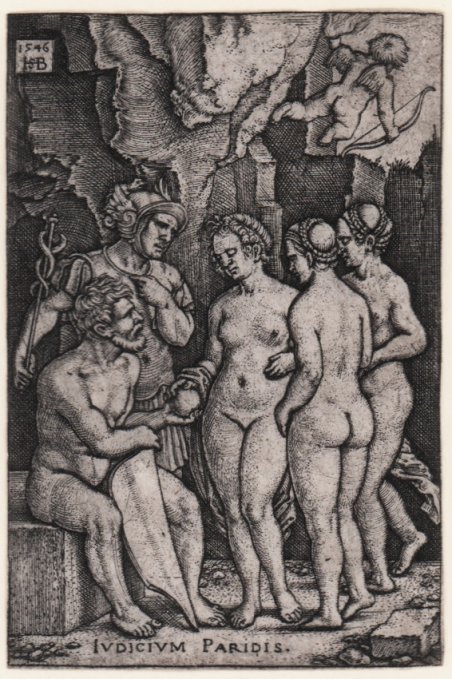
Paride seduto a sinistra e le tre dee a destra, con Venere che accetta la mela. Mercurio con il caduceo in piedi dietro a Paride e davanti alle rocce, mentre Cupido in volo in alto a destra. Bulino, 1546, firmato con il monogramma su una tavoletta in alto a sinistra. In basso "IUDICIUM PARIDIS" lungo il bordo inferiore. Esemplare del secondo stato descritto da Pauli, con i ritocchi a bulino sopra la tavoletta con la firma e la data. Il mito relativo al giudizio di Paride (la ? ? ?, ossia il «confronto» o «giudizio tra le dee») era assai noto nell’Antichità greco-romana e la sua menzione nelle fonti letterarie superstiti è frequente. La ragione è chiara: tra le conseguenze di quell’episodio, attraverso il rapimento di Elena, spiccava la guerra di Troia, durante la quale le dee sconfitte avrebbero continuato a esercitare il proprio odio contro la città. Paride, secondo la mitologia greca, era il figlio di Priamo re di Troia e di Ecuba. Appena nato fu abbandonato sul monte Ida perché, secondo la profezia di Cassandra, egli avrebbe causato enormi sciagure alla sua città. Della vicenda del Pomo d’Oro se ne parla nelle “Troiane” di Euripide. La vicenda ebbe inizio durante il matrimonio tra Peleo e Teti (che sarebbero divenuti i genitori di Achille), originata da un gesto della dea Eris personificazione della discordia e sorella di Ares. La dea lasciò rotolare tra i convitati una mela d'oro, con la scritta “Alla più bella” che suscitò una immediata discussione tra Era, Atena ed Afrodite che ben presto si trasformò in lotta accanita per il possesso del Pomo d’Oro. Non riuscendo a prevalere l’una sulle altre, fu chiesto a Zeus di intervenire, ma questi si rifiutò di esprimere un parere rimettendo il giudizio ad una persona imparziale. Ermes, inviato sulla terra per cercare questa persona, individuò in Paride colui che avrebbe assegnato il Pomo d’Oro alla dea più bella. La scelta di Paride cadde su Afrodite (Venere), che per ricompensarlo gli promise la donna più bella del mondo, ovvero Elena moglie di Menelao re di Sparta. Fu così che Paride, con l'aiuto della dea, rapì Elena portandola con se a Troia e creando il pretesto per la famosa guerra. Con la sua scelta Paride s’inimicò anche Era ed Atena, che perciò si schierarono con i greci. Poco prima del 1520, alcuni giovani artisti della cerchia di Albercht Dürer presero a realizzare incisioni molto piccole che hanno sfidato lo spettatore con un mondo in miniatura, un mondo di nuovo soggetto laico e di interpretazioni non convenzionali di temi tradizionali. A causa delle ridotte dimensioni delle loro incisioni, questi artisti sono stati appellati a lungo, con il nome collettivo, e poco lusinghiero, di Piccoli Maestri di Norimberga. Il nucleo del gruppo consiste in tre artisti di Norimberga, Hans Sebald & Bartel Beham e Georg Pencz, e inoltre Jacob Bink da Colonia e Heinrich Aldegrever da Soest. Ottima prova, impressa su carta vergata coeva, rifilata alla linea marginale, in ottimo stato di conservazione. Bibliografia Pauli 1901-11, Hans Sebald Beham: Ein Kritisches Verzeichniss seiner Kupferstiche Radirungen und Holzschnitte (92.II); Hollstein, German engravings, etchings and woodcuts c.1400-1700 (92.II); Bartsch, Le Peintre graveur (VIII.153.89). Paris seated at left and the three goddesses at right, with Venus accepting the apple. Mercury with caduceus standing behind Paris and in front of rocks, with Cupid in flight at upper right. Engraving, 1546, signed with monogram on tablet at upper left. At bottom "IUDICIUM PARIDIS" along lower edge. Example from the second state described by Pauli, with the retouches above the signature and date tablet. The myth concerning the judgment of Paris (the ? ? ?, i.e., the "confrontation" or "judgment between the goddesses") was well known in Greco-Roman Antiquity, and its mention in surviving literary sources is frequent. The reason is clear: among the consequences of that episode, through the abduction of Helen, was the Trojan War, during which the defeated goddesses would continue to exert their hatred against the city. Paris, according to Greek mythology, was the son of Priam king of Troy and Hecuba. As soon as he was born he was abandoned on Mount Ida because, according to Cassandra's prophecy, he would cause enormous misfortune to his city. The story of the Golden Apple is mentioned in Euripides' "Trojan Women". The affair began during the marriage of Peleus and Thetis (who would become Achilles' parents), originated by a gesture of the goddess Eris personification of discord and sister of Ares. The goddess let a golden apple roll among the guests with the inscription "To the fairest". which sparked an immediate argument between Hera, Athena and Aphrodite that soon turned into a fierce struggle for possession of the Golden Apple. Unable to prevail one over the other, Zeus was asked to intervene, but he refused to give an opinion, deferring judgment to an impartial person. Hermes, sent to earth to search for this person, identified Paris as the one who would award the Golden Apple to the most beautiful goddess. Paris' choice fell on Aphrodite (Venus), who in order to reward him promised him the most beautiful woman in the world, namely Helen the wife of Menelaus king of Sparta. Thus it was that Paris, with the help of the goddess, abducted Helen by taking her with him to Troy and creating the pretext for the famous war. With his choice Paris also antagonized Hera and Athena, who therefore sided with the Greeks. Shortly before 1520, some young artists in Albercht Dürer's circle took to making very small engravings that challenged the viewer with a miniature world of new secular subject matter and unconventional interpretations of traditional themes. Because of the small size of their engravings, these artists have long been affixed with the collective, and unflattering, name of Small Nuremberg Masters. The core of the group consists of three artists from Nuremberg, Hans Sebald & Bartel Beham and Georg Pencz, and in addition Jacob Bink from Cologne and Heinrich Aldegrever from Soest. Very good impression, printed on contemporary laid paper, trimmed at the marginal line, in very good condition. Bibliografia Pauli 1901-11, Hans Sebald Beham: Ein Kritisches Verzeichniss seiner Kupferstiche Radirungen und Holzschnitte (92.II); Hollstein, German engravings, etchings and woodcuts c.1400-1700 (92.II); Bartsch, Le Peintre graveur (VIII.153.89). ' Cfr.

 Descubre cómo utilizar
 Descubre cómo utilizar