Il ritorno del figlio prodigo
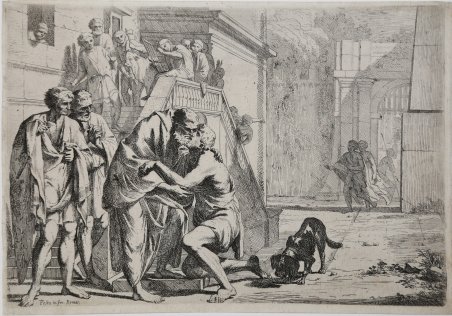
Il ritorno del figlio prodigo
Formas de Pago
- PayPal
- Tarjeta de crédito
- Transferencia Bancaria
- Pubblica amministrazione
- Carta del Docente
Detalles
- Año de publicación
- 1645
- Formato
- 300 X 203
- Grabadores
- TESTA detto "Il Lucchesino" Pietro
Descripción
Acquaforte, 1645 circa, firmata nell'immagine nell'angolo in basso a sinistra: "PTesta. in: fec. Romae”. Primo stato.Bella prova, impressa su carta vergata coeva, con filigrana “grappolo d’uva” (Gravell watermark archive, GRP 055.1), completa oltre la linea del rame, in ottimo stato di conservazione.Questa incisione appartiene alla serie "Il figlio prodigo".Le quattro scene di questa serie si basano sulla parabola del figliol prodigo narrata nel Vangelo di Luca 15:11-32. Come "Le scene della vita di Achille" (n. 118-22), riflette l'interesse di Testa per le serie narrative negli ultimi anni ’40. Il contrasto tra le linee scure e ricche del primo piano e l'incisione più leggera dello sfondo è ancora più evidente in questa stampa rispetto alle altre della serie "Il figlio prodigo". Questa è l'unica stampa della serie per la quale è sopravvissuto un disegno preparatorio. Il disegno, ora nella Galleria dell'Accademia di Venezia, è in controparte e ha quasi le stesse dimensioni della stampa. Le figure principali sono disegnate con contorni molto chiari, senza la modellatura interna che appare nell'incisione. I loro lineamenti e la muscolatura corrispondono alle figure di altri disegni di Testa della fine degli anni '40È stata notata la relazione tra le incisioni di questo soggetto di Testa e Rembrandt, in cui un'analoga enfasi è posta nell'abbraccio intimo di padre e figlio mentre altri membri della famiglia scendono i gradini o guardano fuori da una finestra. La vicenda artistica di Pietro Testa, detto il Lucchesino dalla sua città d’origine, è assai tormentata. Poco o nulla si sa del suo primo apprendistato nella città natale. Arrivato a Roma nel 1629, fu probabilmente dapprima a scuola presso il Domenichino, poi presso la bottega di Pietro da Cortona, suo vero maestro. Il carattere introverso dell’artista gli procurò comunque sempre difficoltà con ' i suoi colleghi: il Cortona infatti fu costretto a cacciarlo dalla sua scuola per l’atteggiamento di sprezzante superiorità assunta dall’allievo . Il Testa frequentò allora la casa del suo primo mecenate, il celebre collezionista Cassiano del Pozzo, per il quale eseguì disegni dall’antico. Fu probabilmente nella sua casa che conobbe il pittore Nicolas Poussin, che influenzerà profondamente la sua arte sia nella sua prima fase di adesione tizianesca ' al movimento neo-veneto, sia nel periodo più maturo, a partire dagli anni 1635 in poi, caratterizzati da un intellettualismo classicheggiante. Resta comunque il fatto che le sue incisioni (che ammontano a 40 tavole circa) furono considerate fin dall’antichità, a partire dal Sandrart e dal Baldinucci, le opere grafiche più importanti del '600 italiano. Etching, 1645 circa, signed in the image in the lower left corner: “PTesta. in: fec. Romae”. First stateGood example, printed on contemporary laid paper, with “grape” (Gravell watermark archive, GRP 055.1) watermak, thin margins, in very good condition.This etching belongs to the series of four “The Prodigal Son”.The four scenes in this series are based on the parable of the prodigal son in Luke 15:11-13. The whole group, like the "Scenes from the Life of Achilles (cat. nos. 118-22), reflects Testa's interest in narrative series in the later 1640s. Cropper: “The contrast between the rich, dark lines of foreground and the lighter etching of the background is even more distinct in this print than the others in The Prodigal Son" series (cat. nos. from 95-97). The dark shadow of the pyramid and the running figures partially in its shadow and partially in brilliant light were also drawn in a more general manner to indicate their distance. The dark lines in the creeper on the crenellated wall and in the inscription over the gate probably indicate a similar attempt by Testa to suggest strong shadow, but the effect here is less optically harmoniousThis is the only print in the series for which a preparatory drawing has survived. The drawing, now in the Galleria dell'Accademia in Venice, is in the reverse sense and has nearly the same dimensions as the print. The main figures are drawn with very clear contours, without the interior modeling that appears in the etching. Their broad, craggy features and generalized musculature conform to those of figures in Testa's other drawings from the late 1640s, such as the preparatory study for “The Triumph of the Virtuous Artist on Parnassus”, although in most of these related studies the drawing of the contours is softened by use of chalk or wash. The relationship between the etchings of this subject by Testa and Rembrandt, in which a similar emphasis is placed on the intimate embrace of father and son as other members of the household come down the steps or look out of a window, has been noted. Where Rembrandt demonstrated his close reading of the biblical text by showing a servant carrying the robe and the shoes called for by the awn prodigal's father, however, Testa singled out instead the detail of the ring brought to the son at his father's request, here held by the man to the left.It it possible that the crenellated city wall was intended by Testa to recall the walls of his native city and that there is, therefore, an autobiographical reference to the story of the prodigal’s return”. Pietro Testa was called Lucchesino for he was born in Lucca. There are but a few news about his apprenticeship in his hometown; for sure, he went to Rome in 1629 to study in the school of Domenichino first and then, towards the end of the year, he moved to the studio of his real master, Pietro da Cortona. His introvert temper caused him a lot of troubles; Cortona, in fact, was obliged to send him away due to his hostile and disdainful behaviour. Testa went then to the house of his first patron, the famous collector Cassiano del Pozzo, and for him he realized his drawings from antiques. Maybe it was in this house that he met Nicolas Poussin who deeply influenced his art both in the neo-Venetian phase and the intellectual classicist one, from 1635. His engravings though, about 40 pieces, have been considered, starting from Sandrart and Bladinucci, the most important graphic works of the Italian XVII century. Cfr. Bartsch, 8; Bellini 24; Cropper, 98
