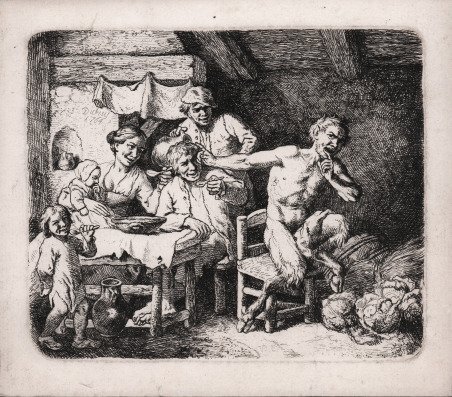
Interno con una famiglia contadina raggruppata intorno a un tavolo; un satiro è seduto all'estremità destra del tavolo. Acquaforte su carta, 1764, firmata e datata in alto a sinistra. Alla maniera di Cornelis Bega; secondo stato con il numero 65 in alto. Una bella impressione stampata su carta vergata contemporanea, con margini, condizioni perfette. Christian Wilhelm Ernst Dietrich detto Dietricy (Weimar, 30 ottobre 1712 – Dresda, 23 aprile 1774) è stato un pittore tedesco. Uscito dalla famiglia di pittori, si rivela assai precoce. Durante la giovinezza pratica molto l'incisione. La protezione dell'elettore di Sassonia, al servizio del quale si trova a partire dal 1733, gli consente di viaggiare in Olanda tra il 1734 e il 1735 e in Italia nel 1743. Perfetto esponente dell'eclettismo dell'epoca, utilizza la sua grande abilità soltanto per copiare o per comporre in pastiches opere dei maestri del XVII e XVIII secolo. Deve essenzialmente la sua fama, che si estese fino a Parigi, ai suoi pastiches di Rembrandt, come la Donna adultera, ora al Louvre di Parigi, ai paesaggi, come il Paesaggio di rocce, da Salvator Rosa, oggi a Varsavia e alla pittura di genere, come i Musici ambulanti, da Isaak van Ostade, oggi alla National Gallery di Londra. Il suo talento si misura in base alla varietà della fattura, che, a seconda dei casi, può essere leggera, impastata o meticolosa. Per rispondere alle numerose richieste di amatori, questo artista senza vera potenza creativa produsse in gran numero quadri e disegni. Il suo lavoro migliore è certamente quello che ha dato alle incisioni. Una collezione di queste al British Museum, prodotta sulle linee generali di uomini precedenti, come Ostade e Rembrandt, rivela sia lo spirito che l'abilità. Bibliografia Thieme-Becker, vol IX, S.259-262; J.F. Linck, ' Dietrichs Oeuvre gravée / Catalogue Raisonné of prints, Berlino 1846, (100.39). Interior with a peasant family grouped around a table; a satyr is seated at the right end of the table, just getting up and knocking over the stool he sat on; cabbages on the floor to right; fireplace in the background to left; in the manner of Bega; second state with the number 65 at the top. Etching on paper, 1764, signed and dated at the upper left. A fine impression printed on contemporary laid paper, with margins, perfect conditions. Christian Wilhelm Ernst Dietrich (30 October 1712 – 23 April 1774) was a German painter and art administrator. In his own works, he was adept at imitating many earlier artists, but never developed a style of his own. He was born at Weimar, where he was brought up early to the profession of art by his father Johann Georg, then painter of miniatures to the court of the duke. Dietrich's sister was painter Maria Dorothea Dietrich. He was more successful in aping the style of Rembrandt, and numerous examples of this habit may he found in the galleries of St. Petersburg, Vienna and Dresden. Dietrich tried every branch of art except portraits, painting Italian and Dutch views alternately with scripture scenes and still life. Dietrich, though popular and probably the busiest artist of his time, never produced anything of his own; and his imitations are necessarily inferior to the originals which he affected to copy. His best work is certainly that which he gave to engravings. A collection of these at the British Museum, produced on the general lines of earlier men, such as Ostade and Rembrandt, reveal both spirit and skill. Dietrich, after his return from the Peninsula, generally signed himself Dieterich, and with this signature most of his extant pictures are inscribed. ' Literature Thieme-Becker, vol IX, S.259-262; J.F. Linck, ' Dietrichs Oeuvre gravée / Catalogue Raisonné of prints, Berlino 1846, (100.39). Cfr.


 Descubre cómo utilizar
 Descubre cómo utilizar